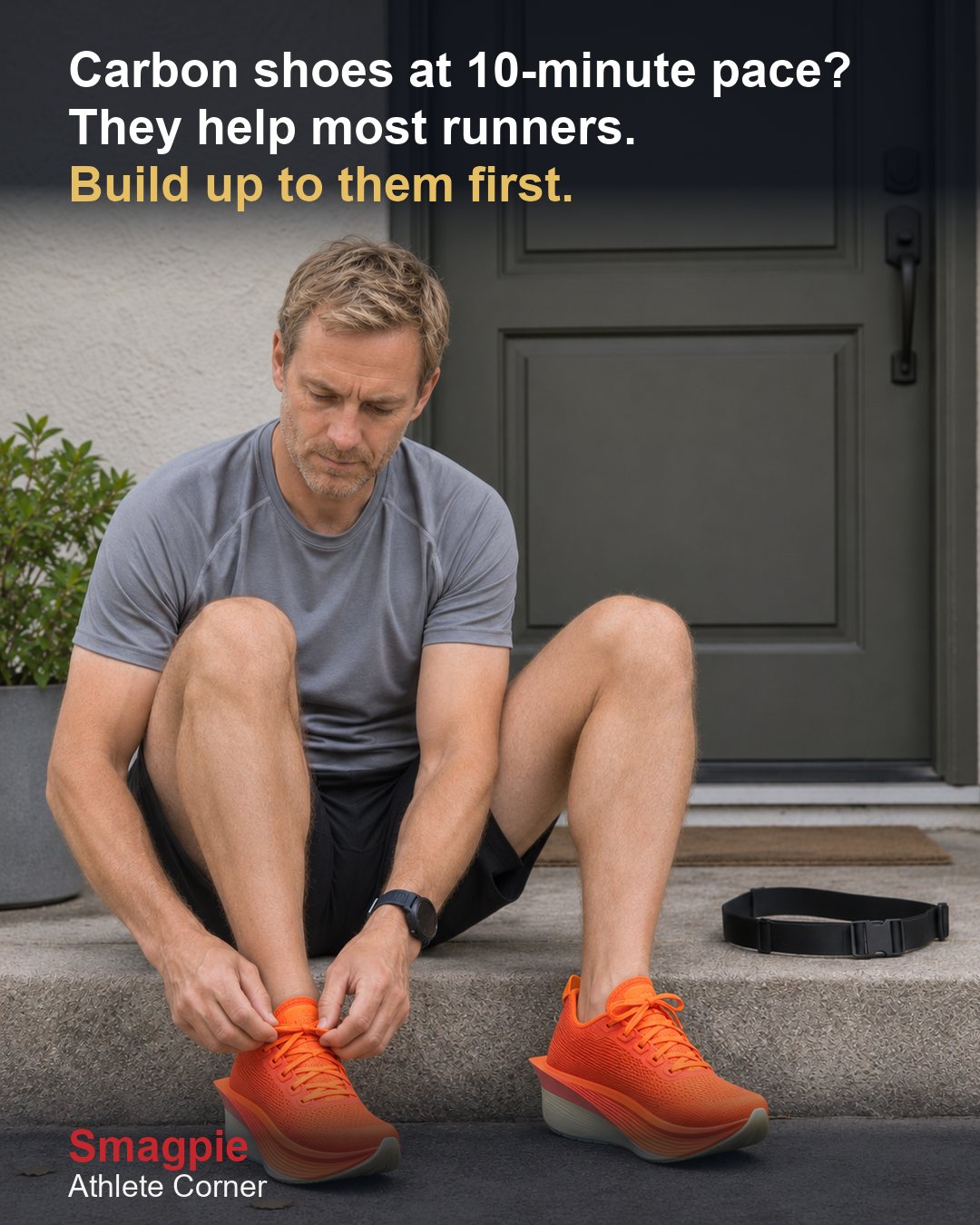
If you run 10-minute miles, or walk the aid stations in an IRONMAN marathon, you’ve heard both sides: carbon-plated shoes only work for fast runners, and carbon-plated shoes save your legs. Here’s what the lab studies found at your pace, and how to find out whether they work for you. If your race is two months out, you still have time, but not much: the last section is the one to read first.
Do they help at slower paces?
For most runners, yes. In the study built for exactly this question, 14 recreational runners tried a carbon-plated racer and an everyday trainer at paces from about 12:50 to 8:00 per mile. The racer cut the energy cost of running by about 2.5% on average, and in this study the saving didn’t shrink at the slow end.1
Other studies found it did shrink a little. Against a shoe of the same weight, a Nike Vaporfly saved under 1% at about 9:40 per mile, too small to be sure it was real.2 So at these paces, expect somewhere around 1 to 3%, not the 4% you’ve seen in the headlines.
You may not feel it, either. In the 14-runner study, the racer only felt easier at the faster paces, and the researchers themselves ask whether a saving that size changes race results for slower runners.1
Part of the gain is simply a lighter shoe: the racer was 62 grams lighter than the trainer, worth about 0.6% on its own. And On, which made all the shoes in the study, also funds the lab.1
Is it the plate or the foam?
It’s the whole shoe: light, springy foam and a stiff plate together. In the same study, a heavier prototype with softer, bouncier foam and a nylon plate saved nothing compared with the trainer, and the racer still beat it after allowing for the weight difference.1 More foam on its own isn’t the answer, and neither is a plate on its own.
The energy saving isn’t placebo, either. These studies measure how much oxygen you use, not how you feel.
Will they work for you?
Maybe. The averages hide a wide spread. In a study of 18 recreational men wearing the same super shoe, the change in energy cost ranged from about 10% worse to 13% better, and 61% ran their fastest 3 km in it.3 In another, 41 recreational runners at about 9:40 per mile tried five shoes. Brands differed, runners disagreed a lot about which shoe was best for them, and nothing the researchers measured, from body size to comfort, predicted who would gain.4
You may have heard that heel strikers can’t use the plate. Nobody has tested that. None of the slow-pace studies split runners by how they land.
So the only way to know is to try them. And if they’re not in the budget, you haven’t lost the race. In our view, months of steady training will move your time far more than any shoe.
What could they be worth on race day?
On paper, quite a bit. One research group modelled how a saving in energy turns into speed. At slower paces, a 1% saving should make you slightly more than 1% faster: about 3 minutes off a 4:30 marathon.5
That’s a prediction, not a race result. These tests lasted minutes, not hours. Nobody has timed slower runners over a marathon in these shoes, or with walk breaks, or after a bike ride.
The real risk: the first long run
Nobody has shown that these shoes raise injury rates. But sports doctors have described five runners who got a stress injury in the navicular, a bone on the top and inside of the midfoot, while using carbon-plated shoes. One, an 18-year-old, wore a new pair for the first time in a 10 km race. Two were elite triathletes aged 36 and 38. One raced a half marathon in shoes he hadn’t really trained in. The other ran 22 miles in shoes he’d worn only two or three times, on much shorter runs.6
The doctors’ advice is to bring the shoes in gradually. Pain on the top or inside of the midfoot is the signal to stop and get it checked.6 If you’re over 35 and building toward the biggest running weeks you’ve ever done, this is the part to take seriously. On a school team? Same rule: never make a race your first run in them, and talk to your coach first.
How to try them
This is our practice, built on the studies above. Start about a month before race day, and finish by about three weeks out, before your taper.
- Short easy runs first. Two or three of them. Check the fit, any rubbing, and how the top of your foot feels the next morning.
- Add some race pace. Run a few race-pace stretches in the middle of a normal run. Keep most of your easy miles in your usual shoes.
- Triathletes: run in them off the bike. A short run after a normal ride, then one longer brick at race effort. Your feet swell over a long day, so check the fit late in the brick, not fresh at the store. Practise starting to run again after a walk break.
- Then go long. Build to one or two long runs in them, without jumping past your usual longest run. A run much longer than your recent longest is a risk on its own, new shoes or not. Use your race-day walk breaks, and check your feet again the next morning.
- Stop for midfoot pain. Pain on the top or inside of the midfoot means stop and get it checked, not run through it.
- Race in them only if they passed. If they felt good and nothing hurt, race in them. If not, the shoes you trained in are a fine choice.
Don’t try to prove the saving with your heart rate. Even in a lab, with runners breathing into a mask, a single test day gave a much blurrier answer; the clear one came from repeating it on three days.1 Test what you can feel.
Sources
- Bolliger A, Spengler CM, Beltrami FG.. Impact of Advanced Footwear Technology on Running Economy at Slower Running Speeds: A Randomised, Cross-Over Investigation. Sports Med Open 2026;12(1):12, 2026. https://pmc.ncbi.nlm.nih.gov/articles/PMC12913831/ ↩
- Joubert DP, Dominy TA, Burns GT.. Effects of Highly Cushioned and Resilient Racing Shoes on Running Economy at Slower Running Speeds. Int J Sports Physiol Perform 2023;18(2):164–170, 2023. https://pubmed.ncbi.nlm.nih.gov/36626911/ ↩
- Hébert-Losier K, Finlayson SJ, Driller MW, et al.. Metabolic and performance responses of male runners wearing 3 types of footwear: Nike Vaporfly 4%, Saucony Endorphin racing flats, and their own shoes. J Sport Health Sci 2022;11(3):275–284, 2022. https://pmc.ncbi.nlm.nih.gov/articles/PMC9189709/ ↩
- Van Hooren B, Copier R, Pedersen S, et al.. The Mediating Effect of Running Biomechanics, Anthropometrics, Muscle Architecture, and Comfort on Running Economy Across Different Shoes. Scand J Med Sci Sports 2025;35(6):e70087, 2025. https://pmc.ncbi.nlm.nih.gov/articles/PMC12141809/ ↩
- Kipp S, Kram R, Hoogkamer W.. Extrapolating Metabolic Savings in Running: Implications for Performance Predictions. Front Physiol 2019;10:79, 2019. https://pmc.ncbi.nlm.nih.gov/articles/PMC6378703/ ↩
- Tenforde A, Hoenig T, Saxena A, Hollander K.. Bone Stress Injuries in Runners Using Carbon Fiber Plate Footwear. Sports Med 2023;53(8):1499–1505, 2023. https://pmc.ncbi.nlm.nih.gov/articles/PMC10356879/ ↩