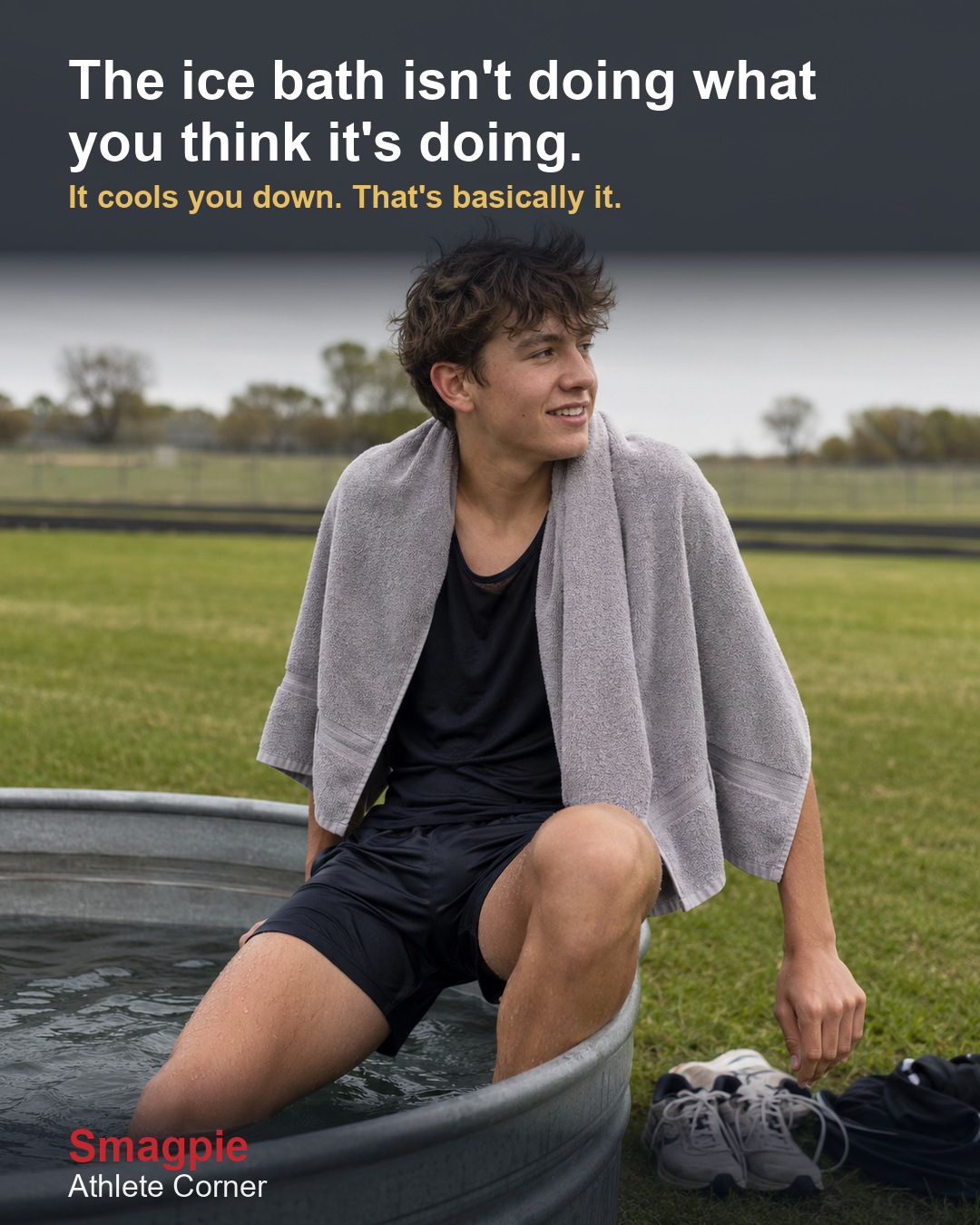
Ice baths are everywhere. Are they actually doing anything?
You’ve probably done it: hard practice, then everyone piles into a freezing tub or trough together, gritting through it, feeling tough afterward. It’s become such a default part of team culture that nobody really asks why anymore. So — what’s actually happening in there?
Short answer: not what most people think.
What it’s actually good for: cooling you down when you got hot
Cold water is genuinely useful after you’ve overheated — a race in the sun, back-to-back practices in a heat wave. Studies that separate “hot day” recovery from “normal day” recovery find a real benefit in the heat and basically nothing on a cool day.1 So the real question isn’t “how sore am I.” It’s “how hot did I actually get?”
What it’s probably not doing: fighting soreness
Here’s a wild study. Researchers compared a real cold tub against plain warm water — except they told athletes the warm water had a “special recovery oil” in it. It was ordinary skin lotion. The fake-oil warm water and the real cold water worked equally well, and both beat plain warm water with no story attached.2 That doesn’t mean ice baths are fake — it means a big chunk of what people feel from them is the same thing you get from believing something is helping. Which, fair enough, is still a real feeling. It’s just not really about the cold.
The “it kills your gains” thing — mostly not about you
If you’ve heard ice baths blunt your training gains, that worry is about lifting weights, not about running, riding, or swimming. Studies that look at strength training find a real, measurable hit if you ice right after lifting. Studies that look at endurance training — actual runs, rides, swims — find basically nothing.1 So if you lift and run, the caution is about the lift, not the run.
Two small things worth doing right
Eat something first. Staying warm in cold water burns through your fuel stores fast. If you’re heading into a cold tub after a hard session, eat or drink something with carbs first — don’t go in on empty.
Don’t chase “it burns calories.” You might’ve heard cold exposure revs up your metabolism. For a lean, trained endurance athlete, there’s basically nothing there to chase — you already don’t have much of the fat-burning tissue this idea depends on. Don’t use cold water as a reason to skip food.
If your team does this and you don’t love it
Here’s the part almost nobody says out loud: among some of the most competitive endurance athletes in the world, only about 1 in 7 actually use cold water immersion regularly.3 It’s not the universal habit it can feel like standing in a trough with your whole team.
You don’t need a medical reason to skip the ice bath. “I’d rather not tonight” is a complete sentence.
If the ritual is fun and your team likes doing it together, that’s a genuinely fine reason to do it. But it should stay exactly that — optional, social, no big deal either way. If skipping it would actually cost you something socially with your team, that’s worth noticing. A good teammate, and a good coach, lets “not tonight” be a normal answer.
The bottom line
Ice baths cool you down. That’s basically it. They don’t meaningfully fight soreness beyond what believing in them does, they don’t hurt your running or riding fitness, and they definitely aren’t a metabolism hack. Use cold water when you’re actually overheated, skip it between same-day efforts, eat first, and don’t let it become something you feel like you have to do.
Sources
- Malta ES, Dutra YM, Broatch JR, Bishop DJ, Zagatto AM.. The Effects of Regular Cold-Water Immersion Use on Training-Induced Changes in Strength and Endurance Performance. Sports Med 2021;51(1):161–174, 2021. https://pubmed.ncbi.nlm.nih.gov/33146851/ ↩
- Broatch JR, Petersen A, Bishop DJ.. Postexercise cold water immersion benefits are not greater than the placebo effect. Med Sci Sports Exerc 2014;46(11):2139–2147, 2014. https://pubmed.ncbi.nlm.nih.gov/24674975/ ↩
- Bezuglov E, Talibov O, Butovskiy M, et al.. The Use of Recovery Modalities by Elite Russian Athletes. Int J Environ Res Public Health 2021;18(21):11698, 2021. https://pubmed.ncbi.nlm.nih.gov/34770213/ ↩