An Instagram post crossed our desk that gets something right and, chasing the correction, gets two new things wrong. It’s a small window into how the whole ice-bath conversation has drifted: everyone arguing about the wrong variable, while the actual evidence sits mostly unread a few clicks away.
The post, from a biohacking account with no named author, is rebutting a worse claim — that women need a warmer 55°F protocol while men thrive in sub-40°F ice baths. That claim is bad science, and the post is right to knock it down. But it leans on two things that don’t hold up: it calls 50–59°F “the standard therapeutic window for recovery and neurochemical signaling,” and it cites the famous “250% dopamine surge” study as supporting evidence.
That’s the pattern worth naming before anything else: a real study, describing a different exposure, measuring a different thing, gets pressed into a temperature recommendation. It’s exactly what the Machado citation does too — a genuine, useful paper about muscle soreness, never measured “neurochemical signaling” at all.2 Read the actual paper, and 50–59°F isn’t even a finding — it’s a median split: researchers ranked nine trials by temperature and drew a line down the middle, calling everything above it “moderate cold” and below it “severe cold.”2 Shift the sample, the line moves with it. The coldest trial in that set is also the longest one, so temperature and duration are tangled together — it’s one comparison, not nine independent replications.
How long, not how cold
The range doesn’t survive contact with better-designed studies: a head-to-head trial comparing 10°C, 15°C, and 20°C directly found no difference between them,3 and a meta-regression across the literature found temperature was “rarely” a significant moderator of outcomes at all.4 What does replicate is duration — somewhere around 10 to 15 minutes. That’s the real, defensible number. Stop optimizing the thermostat and start watching the clock.
The dissociation that should reorganize how you think about this
Here is the finding that matters most for an endurance program, and it gets far less attention than the temperature debate.
A 2021 meta-analysis pooled every controlled trial measuring cold water immersion’s effect on training adaptation, split by training type.5 For resistance training, the harm was real: strength and hypertrophy gains were meaningfully smaller in athletes who iced after lifting (SMD −0.60, p < 0.0001). For endurance training, there was nothing — aerobic power SMD −0.07 (p=0.71), time-trial performance an SMD of exactly 0.00. Every well-designed human endurance study that has directly measured a performance outcome agrees: no effect acutely or after six weeks of repeated use in one trial with muscle biopsies and a thermoneutral control,6 no effect on the exact mitochondrial protein the acute cold-signalling story predicts would move, after a real five-week block, in another.7 (Honest caveat: a more conservative, more recent meta-analysis puts the resistance-training harm at a smaller −0.22, with a confidence interval that technically crosses zero8 — the direction is consistent; the exact size is less settled than −0.60 makes it look.)
Say the practical version of this plainly, because it’s the single most useful correction in the whole topic: the “ice baths kill your gains” worry comes from the weight room. It does not transfer to the workout. If one of your distance runners or cyclists also lifts — and on most modern programs, they do — the caution belongs to that session, not to the tempo run or the interval set that follows it.
What it actually does: reverses heat, not soreness
If cold water immersion isn’t mainly protecting or hurting adaptation, what is it doing? A 2022 systematic review stratified 68 studies by the environment athletes trained in, and the answer sharpened immediately: cold water immersion measurably improved recovery in warm conditions (p < 0.01) but showed no significant benefit in temperate conditions (p=0.06).9 Two other findings point the same direction and both cut against the “it reduces inflammation” story you’ll usually hear: whole-body immersion works meaningfully better than legs-only, and it works better after endurance exercise than after strength exercise10 — backwards for an anti-inflammatory mechanism, since strength work causes more tissue damage, not less.
Ask the right question and it stops being complicated. Not “how sore is my team.” “How hot did they get.” A varsity meet at 3pm in September, full sun, is a genuine case. A November regional at 40°F and drizzling isn’t — and the evidence there is a flat null, not a small, forgivable positive.
One of the sport’s most cautious teams uses it exactly this way, on the record. UAE Team Emirates’s Tour de France ice bath — under a minute, whole-body, 50–59°F — is, per their own medical director, “not intended for recovery or performance… more based on just allowing the rider to feel better.” Their head of performance is blunter: “It is more for the head.”11 Not marketing language — an honest description of a heat-reversal-and-comfort tool from a staff who explicitly say longer submersions are worse, not better.
What it doesn’t do
If it isn’t reliably fighting soreness or inflammation, why does it feel like it works? A 2017 study took the direct measurement almost nobody bothers with — muscle biopsies, not blood draws — comparing ten minutes at 10°C against ten minutes of easy cycling. Inflammatory cells, cytokines, heat-shock proteins: “did not differ significantly between the recovery treatments.”12 The blood-marker changes people usually cite look a lot more like altered clearance from vasoconstriction — washout, not less actual damage.
And then there’s the finding that should make everyone a little more careful about what they attribute to cold specifically. Researchers compared real 10°C cold water immersion against thermoneutral 34.7°C water — dressed up with a fake “specialized recovery oil” a researcher visibly applied. The oil was Cetaphil, an ordinary skin cleanser. Strength recovery, subjective readiness, and soreness were impaired in the plain thermoneutral condition relative to both the cold water and the sham — and the cold water and the sham were statistically indistinguishable from each other.13 Belief matched cold — independently replicated in adolescent athletes using a sham-laser control.14 None of this means cold water “doesn’t work.” A lot of what it does, it does through the same channel a ritual or a placebo does. That’s real. It’s just not the mechanism most people think they’re buying.
The question a coach should be asking isn’t “how sore are they.” It’s “how hot did they get.” Everything else in this topic follows from getting that one question right.
The timing trap
Of everything here, this is the correction most likely to change what happens on a Tuesday. Cold muscle is slow muscle, and icing an athlete between same-day efforts — a swim heat and the final an hour later, the bike-to-run transition of a brick session, repeats at a track meet — measurably slows the next effort while making the athlete feel more recovered. USA Swimming’s own national team consultant states it in one sentence: “Hopping in 55 degree water between repeats or events at the same session will likely lead to slower times.”
The operating principle, since no trial has pinned down an exact number: leave enough time to fully rewarm before the next hard effort. For a triathlete moving between transitions or heats, that’s a decision made mid-meet. For a cyclist, an off-season strength block is arguably more central to periodization than it is for a distance runner, and a heavy squat day followed by a cold tub is exactly the resistance-training scenario the dissociation above warns about. If it follows anything, it should not follow the lifting session — and that’s true whether the athlete in front of you runs, rides, or swims.
Two more pieces of the same puzzle: feed before, not after — carbohydrate at the onset of cold exposure roughly halves the glycogen it burns15 — and keep them still afterward, since core temperature actually bottoms out after exit, and movement there amplifies the drop roughly fourteen-fold.16 Towel, dry clothes, sit down. Not a cool-down jog.
Youth: a smaller problem, treated with a tool that doesn’t fix it
There’s a real, controlled youth literature here — twelve trials, 221 subjects, flatly null on both outcomes that matter: effect on power 0.07, effect on endurance −0.02.17 The cleanest studies in that set back it up: an entire German U18 national field hockey squad, tracked through a real five-day tournament with daily cold immersion, found no improvement in match performance, perceptual recovery, or muscle-damage biomarkers;18 a placebo-controlled crossover in adolescent swimmers found the same.19 There’s a physiological reason for the null: adolescents sustain roughly half the exercise-induced muscle damage adults do20 — less of the very damage cold water immersion is even theoretically trying to blunt.
Put a number on that for your own roster — abstract percentages don’t stick, specific ones do. Among 153 elite endurance track and field athletes, only 15% used cold water immersion at all, against 97% for sauna and 87% for massage.21 On a full 20-person team, that’s three or four kids. Not the whole varsity pack. The honest message isn’t “this is dangerous for your kids.” It’s: you’d be treating a smaller problem than adults have, with a modality that doesn’t reliably fix even the adult version.
The real risk variable is leanness, not sex
The training-adaptation literature behind all of this is close to entirely male — roughly two women across every chronic adaptation trial ever run, combined. Nobody has directly tested whether cold plunging blunts training adaptation in female athletes. That’s a real, honestly-stated gap.
But the physiology says sex itself is mostly the wrong variable to watch. Matched for body fat, the male–female cooling difference mostly disappears22 — and once matched, women actually cool faster, on a higher surface-area-to-mass ratio and lower shivering capacity. What dominates the dose an athlete receives is insulation: an identical 20-minute protocol delivered a −14.4°C intramuscular drop to skinfolds under 8mm, and only −5.0°C over 20mm23 — nearly threefold, from the same tub. Body fat alone predicts that cooling with R² between 0.58 and 0.67.24 A lean adolescent distance runner — of either sex — is close to the worst case in the literature, and is exactly who’s missing from it. One study of collegiate cross-country and football athletes found precisely this: “the smaller and leaner participants cooled at a greater rate.”25
One narrow sex-specific question deserves restraint, not a confident recommendation. Core temperature runs 0.3–0.7°C higher during the luteal phase, and cold-defense thresholds — including shivering — appear to shift upward with it,26 but that cold-side finding rests on one unreplicated 40-year-old study of ten women. Two effects plausibly cancel — a steeper thermal gradient into the water, but a body defending a higher threshold — and which wins has simply never been measured. No CWI trial has ever controlled for cycle phase, including the two that recruited only women. Treat it as an open mechanism, not a reason to change practice.
The under-fueled athlete is the one to watch
If you’ve read our piece on RED-S and low energy availability, you already have the model this needs: energy availability is a budget, and the “cost of being alive” moves with training load and life-load. Cold exposure is a new line item on that ledger — shivering defends core temperature, and roughly 75% of the fuel it burns comes straight out of muscle glycogen27 — the same reserve an energy-deficient athlete has less of. Lean subjects immersed for 90 minutes held the same core temperature as high-fat subjects by burning meaningfully more fuel to do it (VO₂ 11.48 vs 9.19 mL·kg⁻¹·min⁻¹ at 18°C).28 The core gets defended. The athlete pays for it in fuel they may not have.
That matters because the lean-athlete dose problem and the low-energy-availability athlete are frequently the same kid — taking the largest thermal dose at exactly the moment they have the least glycogen banked to cover it. In high school cross-country, 30% of boys and 60% of girls fall below the low-energy-availability threshold29 — that’s the median girl on most rosters, not a rare outlier. Flag this as mechanism, not measured evidence: nobody has directly studied cold exposure in LEA athletes. But the physiology points one direction, and there’s no upside to finding out the hard way. One version of this myth is worth naming directly: cold exposure does not meaningfully “burn extra calories” — a lean, trained athlete already has less recruitable brown fat than a sedentary person, not more. There’s no metabolic upside here. Only the glycogen cost.
The policy void
Search for official guidance on cold water immersion as a recovery tool, and you’ll find almost nothing — and the nothing is itself informative. Every indexed position statement from NATA, the American Academy of Pediatrics, and the American College of Sports Medicine was checked. Not one addresses cold water immersion for recovery. Where national sport institutes do publish numbers, they converge tightly — roughly 10°C for roughly 10 minutes — and then subordinate it hard: one Scandinavian institute’s athlete-facing material states that roughly 95% of training progress comes from the “base” (quality, diet, sleep, recharge) and only about 5% from tools like cold treatment. The UK’s national sport institute, writing for developing athletes specifically, files it under “USE SPARINGLY.” British Cycling: “unless you take a tumble, save the ice cubes for your post-ride recovery smoothie.”
Meanwhile, Florida and Texas both mandate cold-water tubs on the sideline by statute, effective 2026 — for exertional heat stroke, a completely different use case where the evidence is Grade A and survival across 274 documented cases sits at 100%.30 The tub is required by law for a medical emergency; its use as a recovery ritual arrived by cultural drift. The two get conflated constantly — which is exactly the setup for the next section.
Ritual or requirement?
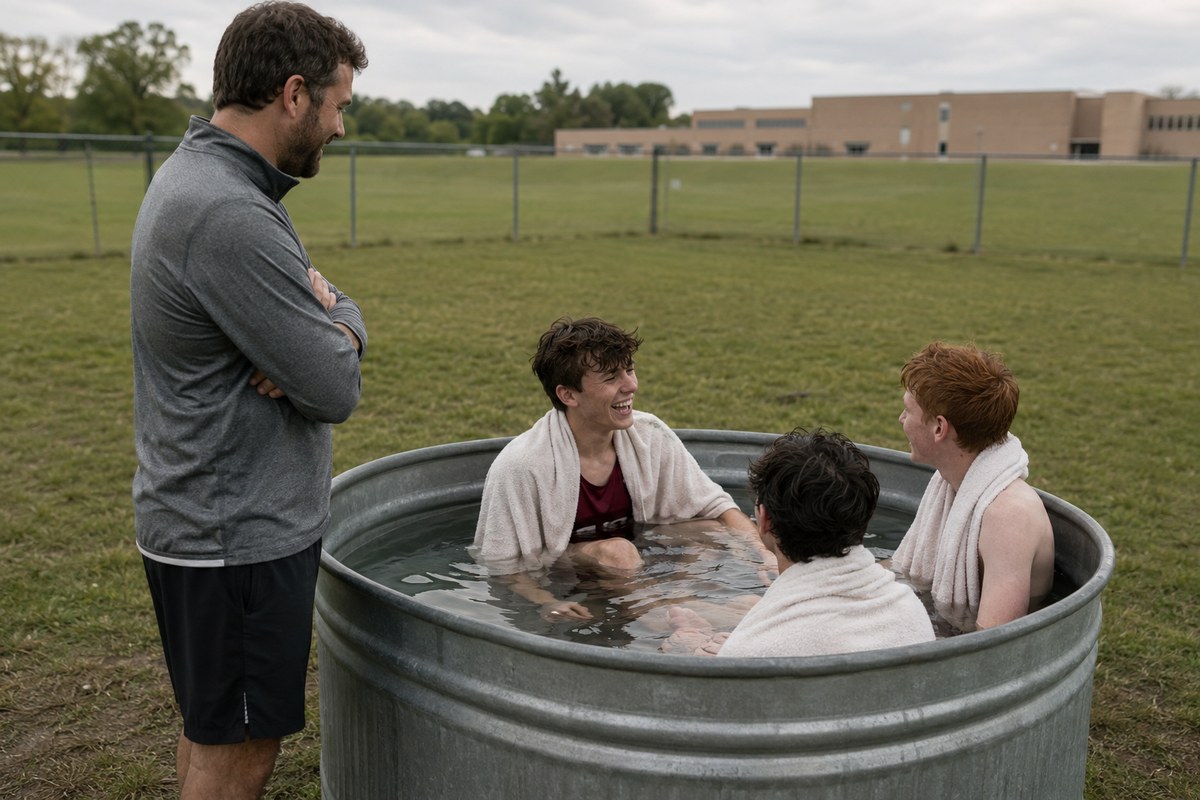
Here’s a question worth sitting with before your team’s next post-practice ice bath, whether you run it or inherited it: could your least popular sophomore skip the tub tonight without it costing him anything socially — not officially, but socially, with the captains and the pack? If the honest answer is no, “optional” was never quite true, regardless of what anyone intended.
This isn’t hypothetical. A 2025 study of 356 adolescent athletes found they consistently rated behaviors like “perform until exhaustion” as acceptable coaching practice — the authors’ conclusion: a young athlete’s sense of what’s acceptable is shaped by the norms of the environment they’re being asked to judge it within.31 That’s the honest mechanism behind a fifteen-year-old’s “yes” to a team ice-bath ritual — not a lie, not dramatic coercion, just a decision made inside an environment that has already told her what the right answer is.
What makes this worth more than a passing note: the claimed justification — “it helps recovery” — is, per everything above, largely a borrowed belief, not a demonstrated one. Nobody invented it to manipulate anyone; it’s standard folklore most coaches picked up the same way theirs did. But once the claimed athletic purpose is mostly placebo, the actual request changes — from “do this, it helps” to “do this, because everyone does,” a different request entirely. That’s precisely the line the vocabulary governing Olympic-pathway coaching is built to catch. SafeSport’s code — which directly governs national-team coaching, and increasingly supplies the language school codes of conduct borrow when writing their own — draws its line at “no athletic purpose,” and states outright that “purported consent… is not a defense, regardless of the person’s perceived willingness to cooperate or participate.”32 Your program doesn’t need to fall under that code directly for the underlying test to be worth applying — and it’s worth remembering that only 15% of the most competitive endurance athletes alive choose to do this at all.21 “The whole team does it” was never really an athletic argument. It was a social one, dressed in athletic language.
None of this means the ritual has to disappear. A few minutes of supervised, head-out, genuinely opt-in cold water after a hot session or a big meet is defensible on its own terms — a shared, comfort-seeking thing a team does together, same as a cool-down in the shade or a team meal. The line isn’t the temperature of the water. The line is whether a kid can say no tonight and still be a full member of the team five minutes later. If yes, it’s a ritual. If no, it was never optional.
What this means for your Tuesday
Not a protocol — you know your roster. What the evidence actually supports:
| Situation | What the evidence supports |
|---|---|
| Hot race or hot two-a-days | Reasonable — this is where the real effect lives |
| Cool-weather practice or race | No case — the evidence here is a null result, not a small positive |
| Base / general-prep phase | Minimize — no upside, and it’s the wrong season to risk it |
| In-season, around a priority race | Individual tool, occasionally — not a weekly habit |
| Same-day, between efforts | Avoid — measurably slower next effort, even if it feels better |
| After a strength/lifting session | Avoid — this is where the adaptation-harm evidence actually lives |
| Exertional heat stroke | Mandatory, separate protocol — treat as medical, not recovery |
Sources
- Šrámek P, Šimečková M, Janský L, Šavlíková J, Vybíral S.. Human physiological responses to immersion into water of different temperatures. Eur J Appl Physiol 2000;81(5):436–442, 2000. https://pubmed.ncbi.nlm.nih.gov/10751106/ ↩
- Machado AF, Ferreira PH, Micheletti JK, et al.. Can Water Temperature and Immersion Time Influence the Effect of Cold Water Immersion on Muscle Soreness? A Systematic Review and Meta-analysis. Sports Med 2016;46(4):503–514, 2016. https://pubmed.ncbi.nlm.nih.gov/26581833/ ↩
- Vaile J, Halson S, Gill N, Dawson B.. Effect of cold water immersion on repeat cycling performance and thermoregulation in the heat. J Sports Sci 2008;26(5):431–440, 2008. https://pubmed.ncbi.nlm.nih.gov/18274940/ ↩
- Moore E, Fuller JT, Bellenger CR, et al.. Effects of Cold-Water Immersion Compared with Other Recovery Modalities on Athletic Performance: Systematic Review and Meta-analysis. Sports Med 2023;53(3):687–705, 2023. https://pubmed.ncbi.nlm.nih.gov/36527593/ ↩
- Malta ES, Dutra YM, Broatch JR, Bishop DJ, Zagatto AM.. The Effects of Regular Cold-Water Immersion Use on Training-Induced Changes in Strength and Endurance Performance. Sports Med 2021;51(1):161–174, 2021. https://pubmed.ncbi.nlm.nih.gov/33146851/ ↩
- Broatch JR, Petersen A, Bishop DJ.. Cold-water immersion following sprint interval training does not alter satellite cell activation or angiogenesis or mitochondrial adaptations. Am J Physiol Regul Integr Comp Physiol 2017;313(4):R372–R384, 2017. https://pubmed.ncbi.nlm.nih.gov/28679683/ ↩
- Malta ES, Neto JCR, Beck WR, et al.. Chronic cold-water immersion after endurance training does not attenuate mitochondrial adaptations. Scand J Med Sci Sports 2026;36(3):e70241, 2026. https://pubmed.ncbi.nlm.nih.gov/41742004/ ↩
- Piñero A, Burke R, Augustin F, et al.. Throwing cold water on muscle growth: A systematic review with meta-analysis of the effects of post-exercise cold water immersion on resistance training-induced hypertrophy. Eur J Sport Sci 2024;24(2):177–189, 2024. https://doi.org/10.1002/ejsc.12074 ↩
- Choo HC, Lee M, Yeo V, Poon W, Ihsan M.. Effect of Cold Water Immersion and Contrast Water Therapy on Recovery in Athletes: A Systematic Review and Meta-analysis Investigating Recovery Environments. J Sports Sci 2022;40(23):2608–2638, 2022. https://pubmed.ncbi.nlm.nih.gov/36862831/ ↩
- Poppendieck W, Faude O, Wegmann M, Meyer T.. Cooling and Performance Recovery of Trained Athletes: A Meta-Analytical Review. Int J Sports Physiol Perform 2013;8(3):227–242, 2013. https://pubmed.ncbi.nlm.nih.gov/23434565/ ↩
- Farrand S, Ryan B.. 'It's just cooling, nothing fancy' — Tadej Pogačar's Tour de France ice bath. Cyclingnews, 2 July 2023, 2023. https://www.cyclingnews.com/news/its-just-cooling-nothing-fancy-tadej-pogacars-tour-de-france-ice-bath/ ↩
- Peake JM, Roberts LA, Figueiredo VC, et al.. The effects of cold water immersion and active recovery on inflammation and cell stress responses in human skeletal muscle after resistance exercise. J Physiol 2017;595(3):695–711, 2017. https://pubmed.ncbi.nlm.nih.gov/27704555/ ↩
- Broatch JR, Petersen A, Bishop DJ.. Postexercise cold water immersion benefits are not greater than the placebo effect. Med Sci Sports Exerc 2014;46(11):2139–2147, 2014. https://pubmed.ncbi.nlm.nih.gov/24674975/ ↩
- Gustafsson J, Montiel-Rojas D, Romare MGA, et al.. Cold water immersion, hot water immersion or sham treatment: effects on body composition and physical performance in adolescent athletes. Eur J Appl Physiol 2025;125(11):3179–3194, 2025. https://pubmed.ncbi.nlm.nih.gov/40498100/ ↩
- Blondin DP, Tingelstad HC, Mantha OL, Gosselin C, Haman F.. Maintaining thermogenesis in cold exposed humans. J Appl Physiol 2010, 2010. https://pubmed.ncbi.nlm.nih.gov/20651221/ ↩
- Christensen PM, et al.. Post-immersion afterdrop and movement. Scand J Med Sci Sports 2017, 2017. https://pubmed.ncbi.nlm.nih.gov/28506514/ ↩
- Murray A, Cardinale M.. Cold applications for recovery in adolescent athletes: a systematic review and meta-analysis. Extrem Physiol Med 2015;4:17, 2015. https://pubmed.ncbi.nlm.nih.gov/26464795/ ↩
- Krueger M, Costello JT, Stenzel M, Mester J, Wahl P.. Cold water immersion in a real-world tournament setting: elite youth field hockey. Eur J Appl Physiol 2020;120(1):295–305, 2020. https://pubmed.ncbi.nlm.nih.gov/31797035/ ↩
- Batista NP, et al.. Placebo-controlled cold water immersion in adolescent swimmers. Eur J Appl Physiol 2024;124(8):2439–2450, 2024. https://pubmed.ncbi.nlm.nih.gov/38548939/ ↩
- Fernandes JFT, Hayes LD, Dingley AF, et al.. Youths Are Less Susceptible to Exercise-Induced Muscle Damage Than Adults. Pediatr Exerc Sci 2024;36(3):123–134, 2024. https://pubmed.ncbi.nlm.nih.gov/38065086/ ↩
- Bezuglov E, Talibov O, Butovskiy M, et al.. The Use of Recovery Modalities by Elite Russian Athletes. Int J Environ Res Public Health 2021;18(21):11698, 2021. https://pubmed.ncbi.nlm.nih.gov/34770213/ ↩
- Tikuisis P, Jacobs I, Moroz D, Vallerand AL, Martineau L.. Comparison of thermoregulatory responses between men and women immersed in cold water. J Appl Physiol 2000;89(4):1403–1411, 2000. https://pubmed.ncbi.nlm.nih.gov/11007575/ ↩
- Myrer JW, Myrer KA, Measom GJ, Fellingham GW, Evers SL.. Muscle temperature is affected by overlying adipose when cryotherapy is administered. J Athl Train 2001, 2001. https://pubmed.ncbi.nlm.nih.gov/12937512/ ↩
- Rech N, Bressel E, Louder T.. Predictive Ability of Body Fat Percentage and Thigh Anthropometrics on Tissue Cooling During Cold-Water Immersion. J Athl Train 2021;56(2), 2021. https://pubmed.ncbi.nlm.nih.gov/33150428/ ↩
- Morrison KE, et al.. Body composition and cooling rate in collegiate cross-country and football athletes. J Athl Train 2018, 2018. https://pubmed.ncbi.nlm.nih.gov/29112514/ ↩
- Hessemer V, Brück K.. Influence of menstrual cycle on shivering, skin blood flow, and sweating responses. J Appl Physiol 1985, 1985. https://pubmed.ncbi.nlm.nih.gov/4077797/ ↩
- Haman F, et al.. Effects of carbohydrate availability on sustained shivering. J Appl Physiol 2002, 2002. https://pubmed.ncbi.nlm.nih.gov/12070189/ ↩
- Glickman-Weiss EL, et al.. Physiological and thermal responses to prolonged cold water immersion by lean and higher-fat subjects. Eur J Appl Physiol Occup Physiol 1991, 1991. https://pubmed.ncbi.nlm.nih.gov/1741720/ ↩
- Matt SA, et al.. Low energy availability in high school cross-country runners. J Am Nutr Assoc 2022, 2022. https://pubmed.ncbi.nlm.nih.gov/34032561/ ↩
- Casa DJ, DeMartini JK, Bergeron MF, et al.. National Athletic Trainers' Association Position Statement: Exertional Heat Illnesses. J Athl Train 2015;50(9):986–1000, 2015. https://pubmed.ncbi.nlm.nih.gov/26381473/ ↩
- Marsollier É, Hauw D, von Roten FC.. Acceptable or Not: An In-depth Analysis of Adolescent Competitive Athletes' Perceptions on Abusive Coaching Behaviors. J Interpers Violence 2025;40(23-24):5634–5656, 2025. https://pubmed.ncbi.nlm.nih.gov/40022614/ ↩
- U.S. Center for SafeSport.. SafeSport Code for the U.S. Olympic and Paralympic Movement, §IX.D.2.b (Physical Misconduct) and §IX.D.4 (Hazing). Revised 31 July 2024, 2024. https://uscenterforsafesport.org/response-and-resolution/safesport-code/ ↩