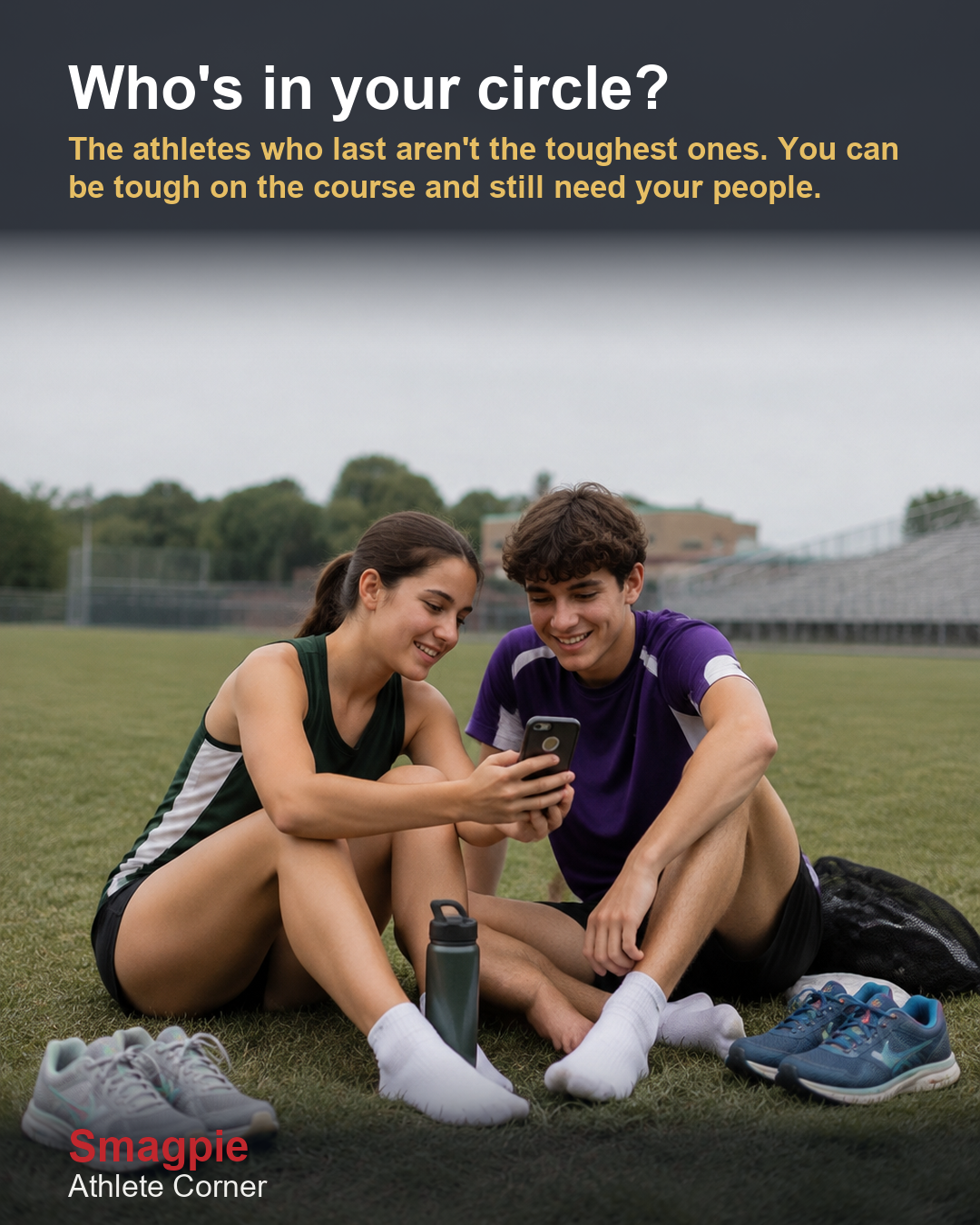
The fastest high-school runner in the country needed one
When Katelyn Tuohy was in high school she was the best girls’ distance runner in America, and it came with more attention than a sixteen-year-old is built for. She says she and her parents “are still a little scarred from the attention I got because it just happened really fast.” What got her through it wasn’t grit. “Lean on your people in your circle. I think that’s what helped me the most.”1
That’s the whole thing. The athletes who last in this sport aren’t the toughest ones. They’re the ones with a few people they can actually talk to.
It’s not a slow-kid thing
Erica Sullivan was seventeen when her dad died. She kept swimming. The hard sets were fine — it was the easy sets, when her brain had room, that got bad. Her coach noticed. He pulled her out of a race, told her she wasn’t going to learn to hate racing on his watch, and got her set up with someone to talk to every week.2 Three years later she won an Olympic silver medal.
Noah Lyles, after his Olympic bronze: “it’s OK not to feel good and you can go out and talk to somebody.” Trayvon Bromell, injured since he was fourteen: “It was literally just my mama and me.” Emma Coburn: “going on a run with a buddy outside is always the best therapy anyone can offer.”
Olympians. Not slow kids. Not weak kids. The best in the world, saying the same thing.
Why a circle actually works
Here’s the part that’s true whether or not you believe it: sport is good for your head, and the reason it’s good is the people.3 Athletes with real support and a real sense of belonging burn out less.4 That’s not a feeling. That’s twenty studies.
And here’s the catch for runners and swimmers. Team sports get that benefit automatically — you can’t play soccer alone. Cross-country and swimming are individual sports that happen to have a team around them. Which means the belonging part only exists if somebody builds it. Your coach builds some of it. You build the rest.
You can be tough on the course and still need your people.
What to actually do
Being tough is for the last 800 meters. It is not for the ride home. Nobody is handing out medals for going through a bad month by yourself.
When it’s bigger than a bad week
Sometimes it’s not a bad week. Sleep goes. Appetite goes. You start dreading practice — not the workout, the whole thing. You’re saying “I’m fine” a lot.
That’s not something your circle fixes, and it’s not something you’re supposed to fix alone. It’s the same as a sore shin that won’t go away: you tell somebody who can do something about it. A parent. The trainer. A teacher you trust. Your coach isn’t a counselor — but a good one will walk you to the person who is, and won’t make it a thing in front of the team.
If you’re ever in a place where you don’t want to be around: call or text 988, or text HOME to 741741. Free, private, any hour.
Build the circle before you need it. Then it’s already there.
Sources
- CITIUS Mag. Katelyn Tuohy turns pro with adidas (podcast). CITIUS Mag, 2023. https://citiusmag.com/podcast/citius-mag-podcast-katelyn-tuohy-turns-pro-with-adidas ↩
- Rieder D. After struggles, deferrals and breakthroughs, Erica Sullivan takes on NCAA swimming. Swimming World, 2022. https://www.swimmingworldmagazine.com/news/after-struggles-deferrals-and-breakthroughs-erica-sullivan-takes-on-ncaa-swimming/ ↩
- Wade L, Eime R, Pankowiak A, et al.. The impact of sports participation on psychological health and social outcomes in children and adolescents: a systematic review. Syst Rev 2026, 2026. https://doi.org/10.1186/s13643-026-03104-1 ↩
- Pacewicz CE, Mellano KT, Smith AL. A meta-analytic review of the relationship between social constructs and athlete burnout. Psychol Sport Exerc 2019;43:155–164, 2019. https://doi.org/10.1016/j.psychsport.2019.02.002 ↩