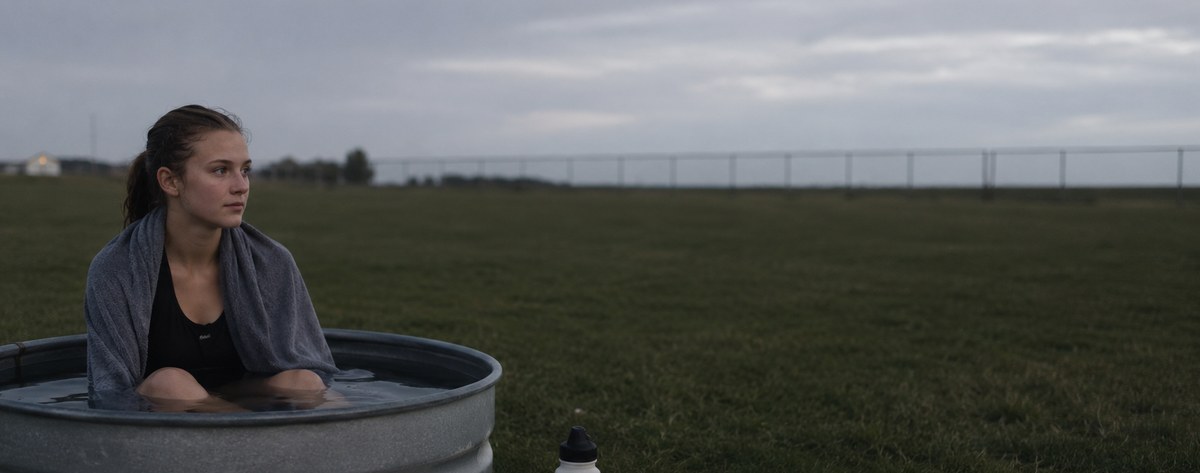
Erica Sullivan was seventeen when her father died. She kept swimming, because that is what you do, and the training was fine — “when I would do these hard workouts, it was fine because I would be focused on the hard workout” — but the recovery sets were where the trouble lived. “The inner dialogue in my head just got really, really bad.”1
Her club coach, Ron Aitken, had known her long enough to tell grief from a slump. He pulled her out of a race. “The minute you start manifesting bad things for yourself and then you dive in the water and those bad things happen, you’re going to create a negative connotation about racing.” Then he made a call, and Sullivan started weekly sessions with a therapist.1 Three years later she won Olympic silver in the 1500 free.
That sequence — a coach who noticed, protected the athlete from the sport for a moment, and got her to the door himself — is the whole argument of this piece. What protects a young athlete over the long run is not toughness. It is a small circle of people they can actually talk to, and one door to a professional when the problem is bigger than the circle. Both are structural. Both are things a coach builds. And on a high-school team, both are mostly decisions you already make: who warms up with whom, who sits where on the bus, who holds the splits clipboard when they are hurt.
What the athletes who made it say
Ask the athletes who lasted what helped, and the answer is consistent.
Katelyn Tuohy was the fastest high-school girl in the country and says she and her parents “are still a little scarred from the attention I got because it just happened really fast.” What got her through: “Lean on your people in your circle. I think that’s what helped me the most.” College worked because “I was shielded with my circle of the team.”2 Noah Lyles, after his Olympic 200 m bronze: “I want you to know that it’s OK not to feel good and you can go out and talk to somebody.”3 Trayvon Bromell, injured since fourteen and paying for surgery out of pocket: “It was literally just my mama and me. Having her as the backbone to carry me through that made it easier to deal with.”4 Emma Coburn: “going on a run with a buddy outside is always the best therapy anyone can offer.”5
And the thing that delayed them was the toughness script. Michael Phelps: “I learned how to communicate at 32.” “We’re supposed to be this big macho strong physically strong human beings, but this is not a weakness, we are seeking and reaching for help.”6 A college distance runner, Keira Mansure, on why athletes stay quiet: “you are supposed to be tough and you are supposed to act a certain way and keep your composure.”7
None of these athletes is your JV sophomore. Tuohy’s problem was too much attention; most of a forty-deep roster has the opposite one. The mechanism is the same. The scale is not.
Why the circle works
Resilience is not a personality trait some kids have. It is a process, and the people around the athlete are half of it. The most-cited model of resilience in sport — built from the careers of Olympic champions — names five things that decide whether a hard week gets read as a challenge or as a threat, and one of them is perceived social support.8 The same mechanism shows up in teenagers: in adolescent athletes, a good coach–athlete relationship predicts less burnout, and part of the reason is that the athlete appraises stress as something to meet rather than something to survive.9
Across twenty studies, athletes with more social support and a stronger sense of belonging report less burnout, and burnout rises with negative social interactions.10 In youth sport specifically, the most common source of that support is the coach — tangible, informational, emotional and esteem support, across 73 studies of athletes aged ten to twenty-two.11 Followed across a full season, support keeps contributing to well-being the whole way through.12
One honest boundary: support is additive. It moves the needle in the right direction all season; it does not cancel out everything else. The pack helps. It does not fix sixty-mile weeks on 1,800 calories, and it does not fix six hours of sleep.
Your sport starts on the wrong side of the ledger
Here is the part that should get a cross-country or swim coach’s attention. Youth sport is good for kids’ mental health, and the ingredient that makes it good is belonging — self-perception, peer connection, social support.13 That is why the benefit shows up most clearly in team sports. In a cohort of more than eleven thousand American kids, team-sport participation went with fewer anxiety and depression symptoms; individual-sport participation went with more.14
Running and swimming are filed under “individual” in those studies. What that means is simple: a cross-country or swim team does not inherit the protective part of team sport from its format. The coach builds it, or it isn’t there.
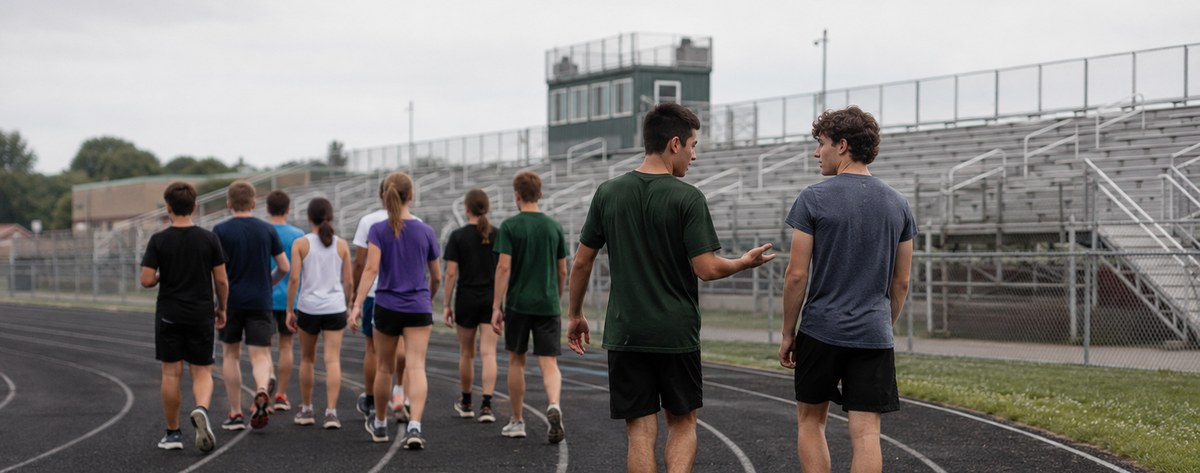
On a roster of forty, the unit of belonging is not the roster. It is the training group. The varsity seven have a circle by default — they run every rep shoulder to shoulder. The kid running 24-minute 5Ks at the back of the JV pack is the “individual-sport athlete,” wearing a team jersey.
In swimming the unit is the lane, and the coach assigns the lane — by speed, which routinely splits friends and puts a fourteen-year-old girl in with seventeen-year-old boys. That is a belonging lever a running coach doesn’t have.
The kids tell you the same thing. “I’m not good enough” is the number-one reason young athletes quit; fun and friends are the top reasons they stay.15 A veteran high-school coach puts it plainly: freshmen leave because “I didn’t like my teammates,” “I wasn’t having fun,” “I felt too much pressure” — and “the goal of the freshman year is not to produce a great freshman runner. The goal is to produce a sophomore who’s still running.”16 Even the stopwatch agrees: across a decade of collegiate results, runners ran about 7–13 seconds faster competing with their team than unattached, depending on the distance.17
So the question to ask in September is uncomfortable and useful: which athlete on this team has no one here they would text at 10 p.m.? With forty kids you cannot answer it alone. Ask it with your captains. They know. You don’t. And ask the corollary: which athlete is still up at 10 p.m. because practice, homework and a shift left no other hour?
The door
Roughly one athlete in five who needs help goes and gets it.18 The things that move that number are not posters. They are relational: someone encouraging them, a provider they already know, and the attitude of the adults around them — coaches especially.19 In the NCAA’s survey of more than 23,000 college athletes, only 54% of men and 40% of women said they were comfortable talking to their coach about mental health — but about 70% had a trusted person they could go to.20 Most athletes have a circle. The coach is often not in it. That is a comfort number, not a trust number, and it is how fifteen-year-olds work.
What makes a high-school coach actually help a struggling athlete turns out to be cheap. In a survey of 190 public high-school coaches, the ones who acted were the ones who knew their school’s mental-health plan and felt confident they could recognise the signs.21 Not the ones with a counselling background. The ones who knew the plan.
And the job is narrow. A panel of coaches, athletes, mental-health clinicians and health educators reached consensus on what a coach’s role in athlete mental health is: say your role out loud, protect confidentiality, attend to changes in behaviour, encourage care-seeking, support athletes who are in care — and never diagnose, never treat, never decide when they come back.22 Awareness campaigns on their own don’t move the needle; teaching teenagers about mental health raises knowledge and intentions and leaves stigma where it was.23 Structure is what converts knowledge into a kid walking through a door.
Know the counselor’s name before the first meet — if you are not on the faculty, you may not. At most high schools there is one door, and sorting what kind of help the athlete needs is the counselor’s job. Yours is to get the kid to the door. Wood and Bryant, an athletic trainer and athletic director at an Oregon high school, said it without apology: “Often, we do not possess the expertise to assist our athletes in these areas of concern; we need to find community resources available to make sure no athlete falls through the cracks.”29 That boundary is not a limitation. It is what makes the job doable.
Before the check-in: your schedule
Whatever you say in August about it being okay to struggle, the schedule says louder. Teenage athletes who sleep under eight hours carry about 1.7 times the injury risk;31 the ones with a history of anxiety or depression sleep worse, and — the finding that should stop you — the most goal-driven athletes keep the worst sleep habits.32 When one program moved swim practice from 7 a.m. to 9 a.m., the swimmers gained a full hour of sleep, their mood and motivation improved, and they lost nothing in the water.33
A 5 a.m. practice sets the sleep budget for the whole roster. A winter season sets it in the dark. How you add volume, how bodies get talked about on deck, whether an injured kid gets a plan with dates on it — these are mental-health decisions a coach makes before anyone has a conversation.
The habit: one real question per kid per week
“Good coaches have weekly one-on-one conversations with their athletes. They might be short conversations, but these quick talks let the athletes know that the coach cares about them and helps coaches catch any potential issues early.”27 Forty kids is eight a day, and the conversation happens on the cooldown walk, at the water jug, on the bus. Give each assistant a dozen and the captains the rest. The version that fits on a whiteboard: “Ask your high schoolers how they are. Then be ready to ask how they REALLY are.”28 Add how are you sleeping — a kid answers that one when they won’t answer the first.
On a running team, the changes worth noticing are concrete:
- Stopped showing to optional Saturdays.
- Splits fell off with no training reason.
- Runs alone now who used to run with the pack.
- Stopped logging.
- Quiet on the bus.
- Eating changed at meets.
- “I’m fine,” with a flat face.
If you are a male coach checking in with girls, do it two-deep or in the open — on deck, in the office with the door open — and put a named woman in the same door: an assistant, the trainer, the counselor. Not because you are untrustworthy, but because many girls won’t pick you, and that is fine if there is another handle on the same door. Open the door to the group first, with parents in the room. One-on-one in August from a male coach to a fifteen-year-old girl is the wrong register.
Race tough, talk easy
Retiring the toughness script does not mean going soft on the last 800. Toughness is for the last mile. It is not for the ride home.
The alternative is already the consensus among the people who treat athletes: normalise. “It has to be OK for an athlete to ask for help, whether they’re struggling with an emotional situation or a sprained ankle.”25 The International Olympic Committee’s guidance for the most stigmatised conditions in our sports — eating disorders and under-fuelling — is to treat them as part of the same continuum as any other sport injury or illness.24 A sports psychiatrist who treats elite athletes describes the moment that matters as “when they feel as if they are not abnormal.”26 And normalising is exactly what the research on help-seeking identifies as the key that opens the door.18 The science and the athletes agree on this one.
Keep the injured athlete inside the loop
The runner with a stress fracture is the athlete most at risk of being forgotten. Injured teenage athletes describe it in one sentence: “Once you’re out, you’re kind of forgotten about… they kind of moved on and I like lost quite a lot of good friendships through it.” And the thing that gave them their footing back was a rehab plan with dates on it: “It gave me a lot of control back… that was probably the most effective thing at improving my mental health.”30
The aqua-jogger alone at 6 a.m. is the loneliest place in this sport. Invited, given a job, never dropped: a role at practice, a seat on the bus, a name in the group chat, and a plan with a date on it.
The whole plan
- Build the circle on purpose. Training groups, lane assignments, the freshman-to-sophomore pairing, the 10 p.m. text question — asked with your captains.
- Say your role out loud, to both rooms, in August. A predictable sequence with a named person and the “I’ll tell you before I tell a parent” line.
- Know the plan. The counselor’s name, before the first meet. Recognise and refer. Never diagnose, never decide return-to-play.
- Fix the schedule first. Sleep is the mental-health intervention your practice time controls.
- One real question per kid per week. Assistants take a dozen; captains take the rest. Add “how are you sleeping.”
- Race tough, talk easy. Normalise asking for help the way you’d normalise taping an ankle.
- Injured athletes stay in. A job, a seat, a group chat, a plan with dates.
If you or an athlete is in crisis: call or text 988 (Suicide & Crisis Lifeline) or text HOME to 741741 (Crisis Text Line). Both are free, confidential, and open 24/7.
Sources
- Rieder D. After struggles, deferrals and breakthroughs, Erica Sullivan takes on NCAA swimming. Swimming World, 2022. https://www.swimmingworldmagazine.com/news/after-struggles-deferrals-and-breakthroughs-erica-sullivan-takes-on-ncaa-swimming/ ↩
- CITIUS Mag. Katelyn Tuohy turns pro with adidas (podcast). CITIUS Mag, 2023. https://citiusmag.com/podcast/citius-mag-podcast-katelyn-tuohy-turns-pro-with-adidas ↩
- ESPN. Noah Lyles, in tears after 200-meter bronze, hopes to be example for mental health. ESPN, 2021. https://www.espn.com/olympics/story/_/id/31957913/noah-lyles-tears-200-meter-bronze-hopes-example-mental-health ↩
- NBC Sports. Trayvon Bromell (profile). NBC Sports, 2022. https://www.nbcsports.com/olympics/news/trayvon-bromell-track-and-field-sprinter ↩
- Wondermind. Emma Coburn. Wondermind, 2023. https://www.wondermind.com/article/emma-coburn/ ↩
- NBC Chicago. Michael Phelps speaks out on mental health at Kennedy Forum summit. NBC Chicago, 2018. https://www.nbcchicago.com/news/local/michael-phelps-speaks-out-on-mental-health-at-kennedy-forum-summit/2036111/ ↩
- The Rider News. Morgan's Message: Broncs take a shot at mental health. The Rider News, 2025. https://theridernews.com/morgans-message-broncs-take-a-shot-at-mental-health/ ↩
- Fletcher D, Sarkar M. A grounded theory of psychological resilience in Olympic champions. Psychol Sport Exerc 2012;13(5):669–678, 2012. https://doi.org/10.1016/j.psychsport.2012.04.007 ↩
- Lee S-H, Choi H. The mediating roles of the challenge appraisal in the relationship between the coach–athlete relationship and adolescent athletes' burnout. Front Psychol 2026;17:1770500, 2026. https://doi.org/10.3389/fpsyg.2026.1770500 ↩
- Pacewicz CE, Mellano KT, Smith AL. A meta-analytic review of the relationship between social constructs and athlete burnout. Psychol Sport Exerc 2019;43:155–164, 2019. https://doi.org/10.1016/j.psychsport.2019.02.002 ↩
- Sheridan D, Coffee P, Lavallee D. A systematic review of social support in youth sport. Int Rev Sport Exerc Psychol 2014;7(1):198–228, 2014. https://doi.org/10.1080/1750984X.2014.931999 ↩
- DeFreese JD, Smith AL. Athlete social support, negative social interactions, and psychological health across a competitive sport season. J Sport Exerc Psychol 2014;36(6):619–630, 2014. https://doi.org/10.1123/jsep.2014-0040 ↩
- Wade L, Eime R, Pankowiak A, et al.. The impact of sports participation on psychological health and social outcomes in children and adolescents: a systematic review and update to the 'Mental Health through Sport' conceptual model. Syst Rev 2026, 2026. https://doi.org/10.1186/s13643-026-03104-1 ↩
- Hoffmann MD, Barnes JD, Tremblay MS, Guerrero MD. Associations between organized sport participation and mental health difficulties: data from over 11,000 US children and adolescents. PLoS One 2022;17(6):e0268583, 2022. https://doi.org/10.1371/journal.pone.0268583 ↩
- Aspen Institute Project Play. National survey of youth and sports: 15 key findings. Project Play, 2026. https://projectplay.org/news/aspen-institute-national-survey-of-youth-and-sports-15-key-findings ↩
- Coach Saltmarsh. Middle school to high school cross country transition guide. coachsaltmarsh.com, 2025. https://coachsaltmarsh.com/high-school-cross-country-transition/ ↩
- Sandholtz N. Is cross country a team sport? The impact of collective identity on individual performance. BYU Kennedy Center lecture (unpublished analysis of TFRRS data), 2026. https://kennedy.byu.edu/is-cross-country-a-team-sport-the-impact-of-collective-identity-on-individual-performance-2026-03-18 ↩
- Cosh SM, McNeil DG, Jeffreys A, Clark L, Tully PJ. Athlete mental health help-seeking: a systematic review and meta-analysis of rates, barriers and facilitators. Psychol Sport Exerc 2024;71:102586, 2024. https://doi.org/10.1016/j.psychsport.2023.102586 ↩
- Gulliver A, Griffiths KM, Christensen H. Barriers and facilitators to mental health help-seeking for young elite athletes: a qualitative study. BMC Psychiatry 2012;12:157, 2012. https://pmc.ncbi.nlm.nih.gov/articles/PMC3514142/ ↩
- NCAA. Student-athletes report fewer mental health concerns (NCAA Student-Athlete Health and Wellness Study). NCAA.org, 2023. http://www.ncaa.org/media-center-student-athletes-report-fewer-mental-health-concerns/ ↩
- Kroshus E, Chrisman SPD, Coppel D, Herring S. Coach support of high school student-athletes struggling with anxiety or depression. J Clin Sport Psychol 2019;13(3):390–404, 2019. https://doi.org/10.1123/jcsp.2018-0004 ↩
- Bissett JE, Kroshus E, Hebard S. Determining the role of sport coaches in promoting athlete mental health: a narrative review and Delphi approach. BMJ Open Sport Exerc Med 2020;6:e000676, 2020. https://pmc.ncbi.nlm.nih.gov/articles/PMC7011013/ ↩
- Vella SA, Swann C, Batterham M, et al.. An intervention for mental health literacy and resilience in organized sports. Med Sci Sports Exerc 2021;53(1):139–149, 2021. https://doi.org/10.1249/MSS.0000000000002433 ↩
- Reardon CL, Hainline B, Aron CM, et al.. Mental health in elite athletes: International Olympic Committee consensus statement (2019). Br J Sports Med 2019;53(11):667–699, 2019. https://doi.org/10.1136/bjsports-2019-100715 ↩
- TrueSport (USADA), Dr. Jennifer Royer. How to best support student-athlete mental wellness. TrueSport, 2023. https://truesport.org/mental-wellness/support-mental-wellness/ ↩
- On Wisconsin (Dr. Claudia Reardon). Balancing athletic excellence and mental health. On Wisconsin, 2021. https://onwisconsin.uwalumni.com/elite-athletes-vulnerable-students/ ↩
- TrueSport (USADA), Jay Coakley PhD. 5 ways caregivers and coaches can support mental wellness. TrueSport, 2023. https://truesport.org/mental-wellness/mental-wellness-for-student-athletes/ ↩
- NFHS. #WeSeeYou campaign. NFHS, 2025. https://weseeyou.community ↩
- Wood C, Bryant K. Challenges of mental-health issues in high school athletics. NFHS, 2019. https://www.nfhs.org/articles/challenges-of-mental-health-issues-in-high-school-athletics ↩
- Wheatley C, Arnold R, Moore L, et al.. A qualitative study exploring factors linked to adolescent athletes' mental health during sports injury. BMJ Open Sport Exerc Med 2026;12(2):e003082, 2026. https://pmc.ncbi.nlm.nih.gov/articles/PMC13141230/ ↩
- Milewski MD, Skaggs DL, Bishop GA, et al.. Chronic lack of sleep is associated with increased sports injuries in adolescent athletes. J Pediatr Orthop 2014;34(2):129–133, 2014. https://doi.org/10.1097/BPO.0000000000000151 ↩
- Stracciolini A, McCracken CM, Meehan WP, Milewski MD. Lack of sleep among adolescent athletes is associated with a higher prevalence of self-reported history of anxiety and depression. J Clin Sport Psychol 2023;17(2):176–188, 2023. https://doi.org/10.1123/jcsp.2021-0004 ↩
- Brandts, Forster, Hecksteden, Meyer. Delaying early morning training time in swimmers: effects on sleep, recovery and performance — a randomized controlled trial. Sports Med Open 2026, 2026. https://pmc.ncbi.nlm.nih.gov/articles/PMC13415721/ ↩
- NCAA Sport Science Institute (coach handout). How to spot mental health struggles in the high school student-athlete. NCAA SSI, 2019. https://cdn3.sportngin.com/attachments/document/3e16-3142023/Recognizing_Issues_in_the_Student-Athlete.pdf ↩