Winter is when FTP gets built: shorter days, the trainer set up in the garage, races months away. Here’s what the research says actually moves the number, and what to do with that.
How much can it move?
It depends on where you start. If you’ve never really trained on the bike, maybe you came to triathlon from running or swimming, there’s a lot of room. In one study, untrained men who rode four to five hours a week raised their maximal power by about a quarter in six weeks; at one hour a week, it barely moved.1 If you’ve been riding the same way for years, expect smaller steps, a few percent per training block.
So set a big target if you like. Just treat it as something to test toward.
1. Test honestly
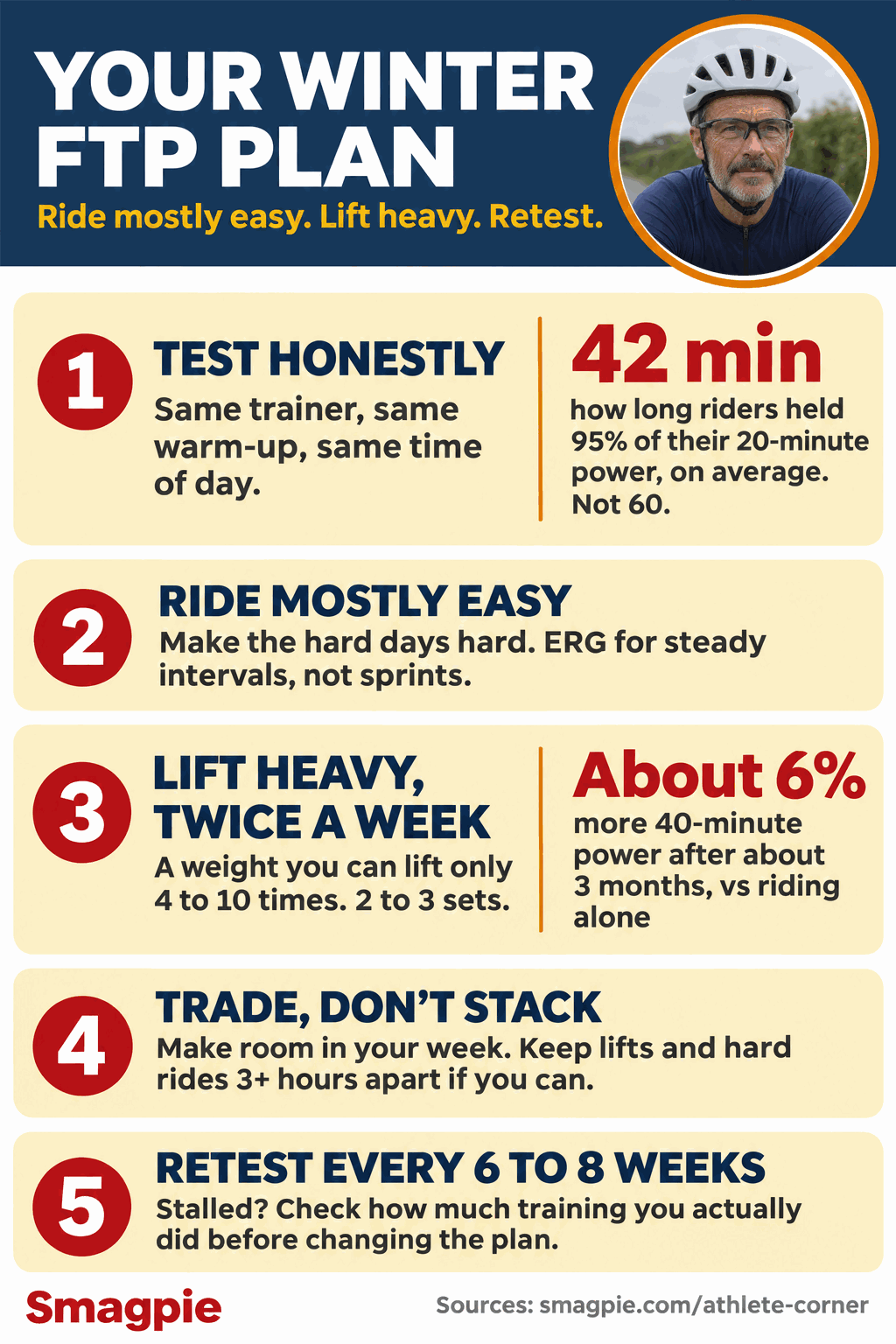
Your FTP is the ruler every workout is measured with. The 20-minute test is very repeatable, but riders in one study could hold 95% of it for about 42 minutes on average, not the full hour it’s meant to represent.2 It’s a little optimistic.
Test the same way every time: same trainer, same warm-up, same time of day, same fan. Don’t bump your FTP after one great virtual race. A number that’s too high makes every workout too hard.
2. Ride mostly easy, and make the hard days hard
In a nine-week trial, endurance athletes who did mostly easy training plus some genuinely hard intervals improved more than those who trained mostly at threshold.3 Winter racing every night feels productive, but “kinda hard every day” is the mix that helped least.
ERG mode is great for steady and threshold intervals because you ride exactly the watts in the plan. It’s bad for short sprints, so switch it off for those. If your cadence starts to sag and the resistance piles on, drop the target a few percent and finish the interval.
3. Lift heavy, twice a week
Adding heavy leg strength work to normal riding improves cycling performance.4 In one research group’s trials, two sessions a week for about three months added roughly 6% to 40-minute power, in men and women alike.5
“Heavy” means a weight you can lift only 4 to 10 times, for 2 to 3 sets, on several leg exercises (squat or leg press, split squat, step-up). Light sets of 10 didn’t do it.45 If you’re new to lifting, spend the first couple of weeks learning the movements with light weights, and keep your riding easy while your legs adapt.
Lifting and riding in the same week don’t cancel each other out. If you can, leave three hours or more between a lift and a hard ride.6
4. Fit it into your week
If you’re a triathlete, you probably can’t just add three hours. Trade instead: during a winter bike block, keep running easy and cut back on hard run sessions for a while. Don’t lift heavy legs the day before a long ride or an important run.
5. Retest, and know what to do if it stalls
Retest every 6 to 8 weeks. If the number didn’t move, look at how much training you actually did before changing anything. In the same study as above, riders who hadn’t improved did once they added two more hours a week.1 Then check whether your test was too generous the first time.
Sources
- Montero D, Lundby C.. Refuting the myth of non-response to exercise training: 'non-responders' do respond to higher dose of training. J Physiol 2017;595(11):3377–3387, 2017. https://pubmed.ncbi.nlm.nih.gov/28133739/ ↩
- Gough LA, Williams JJ, Downes G, et al.. The reliability and construct validity of the functional threshold power test in trained cyclists. J Sci Cycling 2025;14(1), 2025. https://www.open-access.bcu.ac.uk/16282/ ↩
- Stöggl T, Sperlich B.. Polarized training has greater impact on key endurance variables than threshold, high intensity, or high volume training. Front Physiol 2014;5:33, 2014. https://pubmed.ncbi.nlm.nih.gov/24550842/ ↩
- Rønnestad BR, Mujika I.. Optimizing strength training for running and cycling endurance performance: a review. Scand J Med Sci Sports 2014;24(4):603–612, 2014. https://pubmed.ncbi.nlm.nih.gov/23914932/ ↩
- Vikmoen O, Rønnestad BR.. A comparison of the effect of strength training on cycling performance between men and women. J Funct Morphol Kinesiol 2021;6(1):29, 2021. https://pubmed.ncbi.nlm.nih.gov/33803041/ ↩
- Schumann M, Feuerbacher JF, Sünkeler M, et al.. Compatibility of concurrent aerobic and strength training for skeletal muscle size and function: an updated systematic review and meta-analysis. Sports Med 2022;52(3):601–612, 2022. https://pubmed.ncbi.nlm.nih.gov/34757594/ ↩