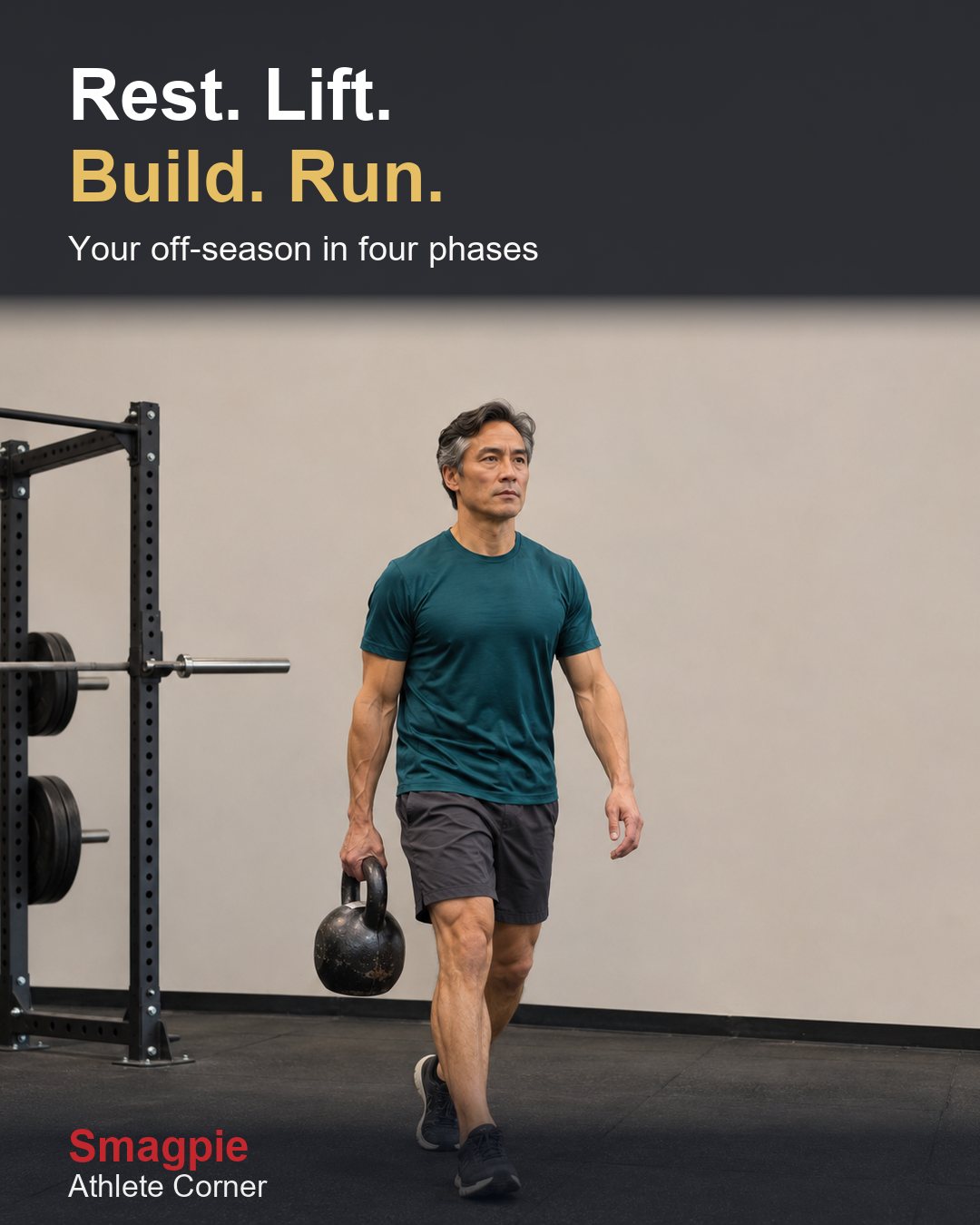
Your last race is done. You have three or four months before the real training starts again. Here’s how I’d use them, in four phases. Most of the plan is coaching practice, because nobody has tested a whole triathlon off-season, but every phase is built on what the research does show.
The one rule: do it twice a week
The strength programs that worked in studies were the ones people actually did. In a marathon study, runners given a short program to do on their own averaged 2 of the 3 weekly sessions, and it made no difference to their injuries.1 Supervised programs looked better.2
So the program is two strength sessions a week, done. If life gets in the way, do a shorter session with three lifts rather than skipping it.
Weeks 1–2: Rest, but don’t stop
Ride, swim and run for fun, with no plan. One short hard session a week is fine if you want it.
Don’t stop completely for much longer than two weeks. A full stop costs fitness quickly, but in cyclists, one hard session a week during a long break held fitness where easy riding alone didn’t.3
Weeks 3–6: Learn to lift
- Two strength sessions a week. Start light, 12 to 15 reps, and learn the movements. Get heavier every couple of weeks.
- Three short swims, focused on technique.
- Three short, easy runs. Keep them going all winter. If running fades to nothing, your bike fitness gets way ahead of what your legs can handle when you start running more.
- One yoga session a week for mobility and posture.
Weeks 7–12: Lift heavy, build the bike
- Lift heavy twice a week: 3 sets of 4 to 6 reps, stopping each set with a rep or two left. You don’t need to test a max.
- Two hard bike sessions a week, the rest easy. Our winter FTP plan has the details.
- Ride hard in the morning, lift in the afternoon, at least three hours later. Don’t lift heavy legs the day before your hardest ride.
- Make the holiday week your easy week.
Weeks 13–16: Hand off to the season
- Lift once a week, and keep it heavy. If you’re over 50, consider keeping two sessions.
- Bring running back with more runs and more minutes first, hard running later.
- The single-run rule: in a study of 5,200 runners, a run more than 10% longer than your longest run of the last 30 days was linked with more overuse injuries.4 If your longest recent run is 50 minutes, the next long run is 55 at most.
What “core” means here
Planks build a strong trunk, but in trained athletes that barely made them faster.5 The core work in this plan is squats and deadlifts, posture work for your hips and glutes, and breathing. Training your breathing muscles improved endurance performance across many studies.6 Keep planks for your warm-up.
Will lifting keep you from getting hurt?
Lifting cut injuries to about a third in sports studies, mostly team sports.7 In runners it has barely been tested, so nobody can promise it.2 It’s still the best bet you have, and it also makes you faster on the bike.
Sources
- Toresdahl BG, McElheny K, Metzl J, Ammerman B, Chang B, Kinderknecht J.. A randomized study of a strength training program to prevent injuries in runners of the New York City Marathon. Sports Health 2020;12(1):74–79, 2020. https://pubmed.ncbi.nlm.nih.gov/31642726/ ↩
- Wu H, Brooke-Wavell K, Fong DTP, Paquette MR, Blagrove RC.. Do exercise-based prevention programs reduce injury in endurance runners? A systematic review and meta-analysis. Sports Med 2024;54(5):1249–1267, 2024. https://pubmed.ncbi.nlm.nih.gov/38261240/ ↩
- Barbieri A, Fuk A, Gallo G, Gotti D, Meloni A, La Torre A, Filipas L, Codella R.. Cardiorespiratory and metabolic consequences of detraining in endurance athletes. Front Physiol 2023;14:1334766, 2023. https://pubmed.ncbi.nlm.nih.gov/38344385/ ↩
- Schuster Brandt Frandsen J, et al.. How much running is too much? Identifying high-risk running sessions in a 5200-person cohort study. Br J Sports Med 2025;59(17):1203–1210, 2025. ↩
- Prieske O, Muehlbauer T, Granacher U.. The role of trunk muscle strength for physical fitness and athletic performance in trained individuals: a systematic review and meta-analysis. Sports Med 2016;46(3):401–419, 2016. https://pubmed.ncbi.nlm.nih.gov/26589515/ ↩
- Illi SK, Held U, Frank I, Spengler CM.. Effect of respiratory muscle training on exercise performance in healthy individuals: a systematic review and meta-analysis. Sports Med 2012;42(8):707–724, 2012. https://pubmed.ncbi.nlm.nih.gov/22765281/ ↩
- Lauersen JB, Andersen TE, Andersen LB.. Strength training as superior, dose-dependent and safe prevention of acute and overuse sports injuries: a systematic review, qualitative analysis and meta-analysis. Br J Sports Med 2018;52(24):1557–1563, 2018. https://pubmed.ncbi.nlm.nih.gov/30131332/ ↩