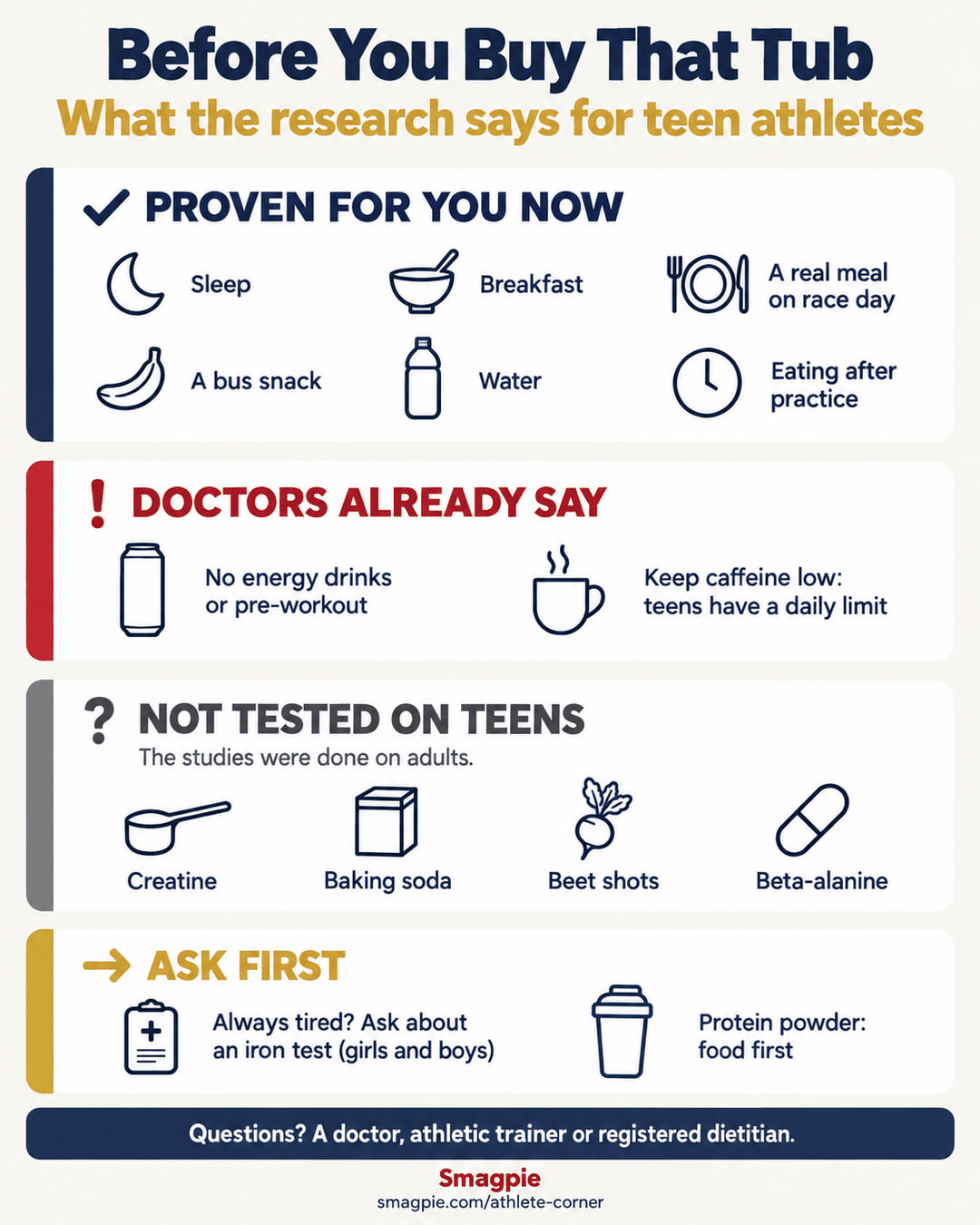
The tub on the counter
You’ve probably seen it. A tub of creatine in somebody’s locker. A can of pre-workout before the long run. A teammate who swears by a beet shot, or a video of a pro cyclist mixing baking soda into a gel. And the question underneath all of it: should I be taking something?
I wanted a straight answer, so I asked our science team to look at what the research says. Here’s the honest version. A few supplements really do help adult athletes in certain races. But almost none of them have been tested on teenagers, so nobody can tell you what they do for us, good or bad. Here’s what the research does and doesn’t cover.
What’s proven for you right now
None of this is exciting, but all of it is proven:
- Sleep. It’s the real performance supplement, and it’s free.
- Breakfast and a real lunch on race day. On invitational Saturdays our bus leaves at 5:45 and varsity doesn’t race until almost noon, so I eat before the bus and pack a snack for it. That bus snack is basically my pre-race meal.
- Water. For practice and a 5K, water is all you need. Drinking way past thirst on a cool day isn’t “safer.”
- A sports drink or gels for long or hot sessions. That’s food, not a supplement.
- Eating soon after practice. More on that below.
If you’re always tired, flat or getting hurt, the first question isn’t which supplement. It’s whether you’re eating enough. Read Underfueling Doesn’t Make You Tougher before you spend a dollar.
What doctors already say
Energy drinks and pre-workout. Pediatricians say the caffeine and other stimulants in energy drinks have “no place in the diet of children and adolescents.”1 Nobody checks supplements before they’re sold, either. The FDA doesn’t approve them first.2 When a lab in Australia bought 200 supplements online, about a third contained substances banned in sport, mostly in pre-workouts and fat burners, and most of those weren’t on the label.3 Dry scooping is a no.
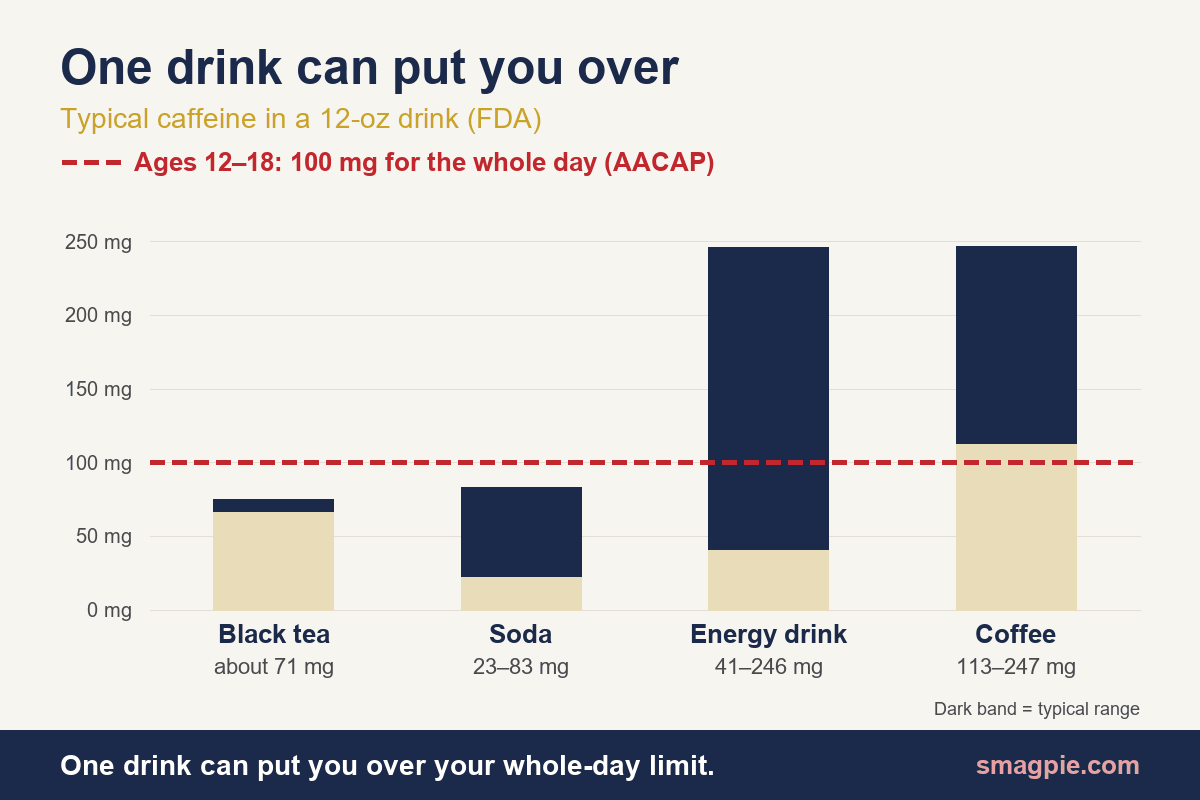
Caffeine. This one has been studied in teens, a little, and the benefit was small and uncertain.4 Adults use it to race faster, but the amount they use is more than a teen’s limit for the whole day. The American Academy of Child and Adolescent Psychiatry says ages 12 to 18 should stay at or under 100 mg a day, with no energy drinks.5 That limit goes fast: a single 12-ounce coffee can be over it.6 Caffeine also costs sleep, and late meets already cost enough.
What hasn’t been tested on teens
Plenty of high schoolers use these. If you’re thinking about one, talk it through with your parents and a doctor first, and know this going in: the studies were done on adults, so nobody can tell you what they do for a teenager, good or bad.
Creatine. It hasn’t been tested for teen distance running, and in adult studies it doesn’t help distance running either.7 It isn’t a steroid, and it doesn’t wreck healthy kidneys.8 The American Academy of Pediatrics’ parent site says, “For young athletes, a food-first regimen works best.”9
Baking soda. Yes, it’s the same stuff some adult runners and cyclists use for short, hard races. It has barely been studied in teenagers. The amount adults use is more than the box says to take in a whole day, and it can wreck your stomach. You’d find that out mid-race. Poison-control cases come from people taking too much.10
Beet shots. Beets as food are great. The concentrated shots haven’t been tested in teens.
Ask first
Iron. If you’re always tired, ask your doctor about a blood test. That goes for boys too. Don’t start iron pills on your own: some athletes need it, and some get too much.11 The doctor reads the result.
Protein powder. Food first. Most of us get enough from normal meals spread through the day, and powder is a convenience, not a performance supplement.12
About that “eat within 20 minutes” rule
You’ve probably heard you have to eat within 20 minutes of practice or the workout is wasted. That deadline isn’t real. The study the idea grew out of compared eating right away with eating two hours later; nothing in it is about 20 minutes.13 But don’t take that as “eating after practice doesn’t matter.” Eating soon after practice is still the right move, because it helps you get enough food across a long school day.14 Grab the snack anyway.
Copy the pros’ habits, not their products
If you race mountain bikes or ride with a junior club, you’ve seen what the pros use. The parts worth copying are free: nothing new on race day, a fueling plan you’ve practiced, eating before you’re hungry, and sleep. The products can wait until you’re an adult with a reason to use them.
Questions?
Take them to your doctor, your school’s athletic trainer or a registered dietitian. Your coach can help you find one. The full, coach-level version of this, with every study, is linked below.
Sources
- Committee on Nutrition and the Council on Sports Medicine and Fitness.. Sports drinks and energy drinks for children and adolescents: are they appropriate?. Pediatrics 2011;127(6):1182-1189, 2011. https://pubmed.ncbi.nlm.nih.gov/21624882/ ↩
- US Food and Drug Administration. Questions and Answers on Dietary Supplements. FDA (content current as of 27 August 2026), 2026. https://www.fda.gov/food/information-consumers-using-dietary-supplements/questions-and-answers-dietary-supplements ↩
- Barker L, Cawley A, Speers N, et al.. Sports Supplement Analysis Survey for the Prevalence of WADA Prohibited Substances in the Australian Online Marketplace. Drug Test Anal 2025;17(10):1857-1864, 2025. https://pubmed.ncbi.nlm.nih.gov/40180440/ ↩
- Liu L, Chen M, Deng H, et al.. Acute Effects and Safety of Caffeine Ingestion in Adolescent Athletes: A Systematic Review and Three-Level Meta-Analysis. Nutrients 2026;18(15):2520, 2026. https://pubmed.ncbi.nlm.nih.gov/42588143/ ↩
- American Academy of Child and Adolescent Psychiatry. Caffeine and Children (Facts for Families No. 131). AACAP, April 2026, 2026. https://www.aacap.org/AACAP/Families_and_Youth/Facts_for_Families/FFF-Guide/Caffeine_and_Children-131.aspx ↩
- US Food and Drug Administration. Spilling the Beans: How Much Caffeine Is Too Much?. FDA Consumer Update (content current as of 28 August 2024), 2024. https://www.fda.gov/consumers/consumer-updates/spilling-beans-how-much-caffeine-too-much ↩
- Fernández-Landa J, Santibañez-Gutierrez A, Todorovic N, et al.. Effects of Creatine Monohydrate on Endurance Performance in a Trained Population: A Systematic Review and Meta-analysis. Sports Med 2023;53(5):1017-1027, 2023. https://pubmed.ncbi.nlm.nih.gov/36877404/ ↩
- Antonio J, Candow DG, Forbes SC, et al.. Common questions and misconceptions about creatine supplementation: what does the scientific evidence really show?. J Int Soc Sports Nutr 2021;18(1):13, 2021. https://pubmed.ncbi.nlm.nih.gov/33557850/ ↩
- Wolf S (American Academy of Pediatrics). My 15-year-old wants to take creatine for sports performance. Is creatine safe for teen athletes?. HealthyChildren.org (AAP parent site), last updated 15 October 2026, 2026. https://www.healthychildren.org/English/tips-tools/ask-the-pediatrician/Pages/my-15-year-old-wants-to-take-creatine-for-sports-performance-Is-creatine-safe-for-teen-athletes.aspx ↩
- Al-Abri SA, Kearney T.. Baking soda misuse as a home remedy: case experience of the California Poison Control System. J Clin Pharm Ther 2014;39(1):73-77, 2014. https://pubmed.ncbi.nlm.nih.gov/24313600/ ↩
- Mettler S, Zimmermann MB.. Iron excess in recreational marathon runners. Eur J Clin Nutr 2010;64(5):490-494, 2010. https://pubmed.ncbi.nlm.nih.gov/20197784/ ↩
- American Academy of Pediatrics. Performance-Enhancing Sports Supplements: Information for Parents. HealthyChildren.org (AAP parent site), last updated 16 October 2026, 2026. https://www.healthychildren.org/English/healthy-living/sports/Pages/Performance-Enhancing-Substances.aspx ↩
- Ivy JL, Katz AL, Cutler CL, et al.. Muscle glycogen synthesis after exercise: effect of time of carbohydrate ingestion. J Appl Physiol (1985) 1988;64(4):1480-1485, 1988. https://pubmed.ncbi.nlm.nih.gov/3132449/ ↩
- Desbrow B, McCormack J, Burke LM, et al.. Sports Dietitians Australia position statement: sports nutrition for the adolescent athlete. Int J Sport Nutr Exerc Metab 2014;24(5):570-584, 2014. https://pubmed.ncbi.nlm.nih.gov/24668620/ ↩