Every season the questions come in. A senior wants to know if she should take creatine because half the boys’ team does. A masters triathlete has read that beetroot juice is worth three percent. A club rider saw a pro on the Tour mix a white powder into a gel and wants to know if he can do the same with baking soda from the pantry. A parent asks whether their son needs to eat within twenty minutes of practice or “the workout is wasted.”
The research on all of this is better than you might expect. The International Olympic Committee convened 25 scientists and anti-doping officials to sort it out, and their answer is short: only a few supplements have good evidence behind them for performance. Caffeine, creatine, buffering agents like sodium bicarbonate, and dietary nitrate, “and possibly also” beta-alanine.1 Each one works for a specific kind of race, at a specific dose, at a specific time before the start. Outside those conditions, each does little or nothing.
The timing advice has a different problem. Most of it is watching the wrong clock.
This is the report card: what works, for which race, and when. Every item carries a teen-evidence flag (has anyone actually tested it on athletes under 18?), and almost every number in it comes from studies of adults, mostly trained men, unless it says otherwise. Much of it was also learned on a bike in a lab, which is worth knowing if you coach cyclists. This is your science too.
Coach minors? The one-box answer
First, the gate: is the athlete eating enough?
Every row on this report card assumes an athlete who is already eating enough to cover their training. If that’s in doubt, nothing below will help. Start with our RED-S article and the high-school fueling pair for runners and swimmers. The athlete most interested in a beet shot is sometimes the one skipping breakfast.
Race day, in the order that matters
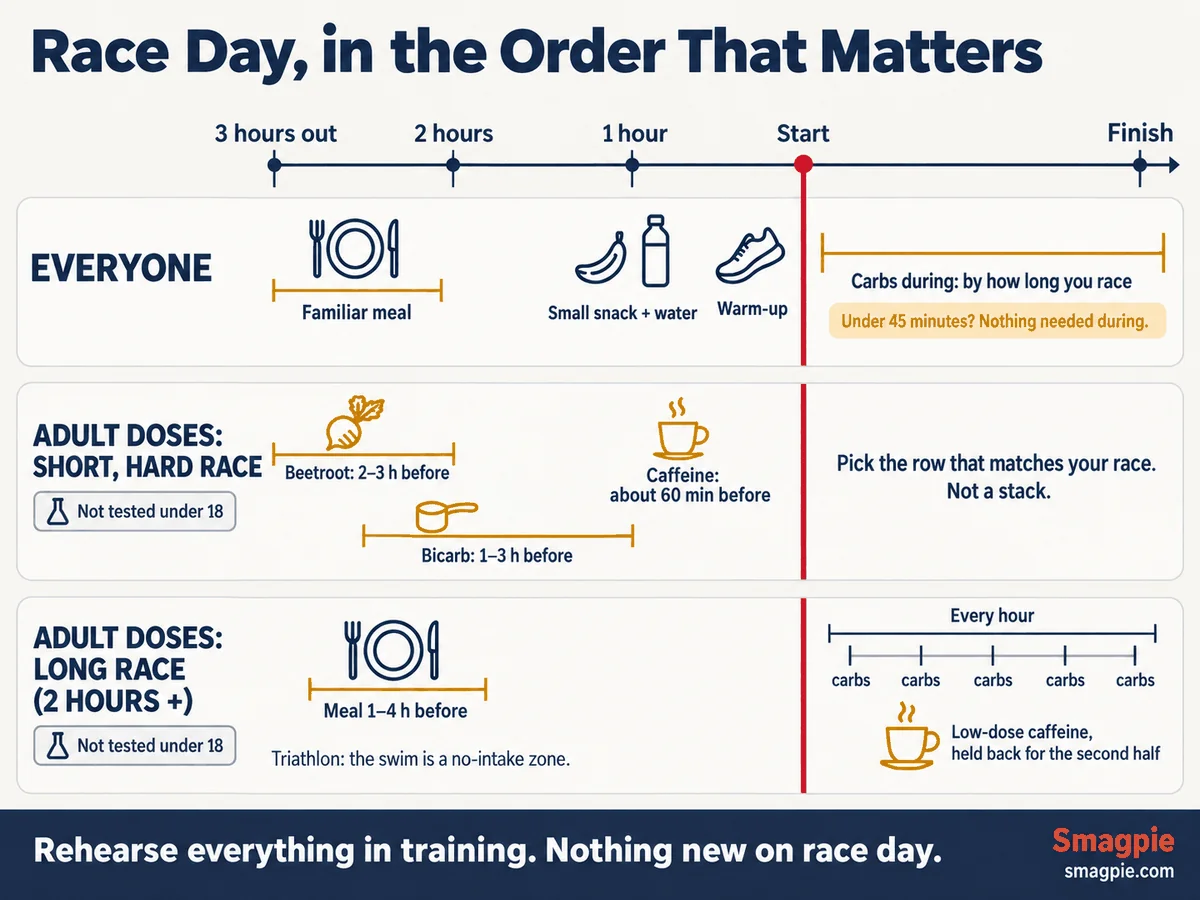
Start with the meal, not the supplement. For races lasting over an hour, the American College of Sports Medicine’s joint position recommends 1–4 g of carbohydrate per kilogram eaten 1–4 hours before.4 For shorter races (a 5K, most track and pool events, a crit or a cyclocross race), the honest advice is simpler: a familiar, carbohydrate-based meal a few hours out, and a small snack if the gap is long. On a cross-country invitational with a 5:45 bus and three different gun times, the varsity runner who ate at 5:15 is six hours from her start. The bus snack is her pre-race meal.
Then carbohydrate during the race, which follows the clock, not the distance. The ACSM bands, checked against the full text:4
| Session or race length | Carbohydrate during | What it looks like |
|---|---|---|
| Under 45 min | Not needed | Every high-school XC race, from the 16-minute front-runner to the 38-minute freshman |
| 45–75 min | Small amounts, including mouth rinse | A Cat 4/5 crit, cyclocross, a 10K for many runners |
| 1–2.5 h | 30–60 g per hour | Half marathon, Olympic-distance triathlon, a club road race |
| Over 2.5–3 h | Up to 90 g per hour, from mixed glucose–fructose products | Marathon for most, 70.3 and Ironman, gran fondo |
Two things about that table. First, the bands describe time spent exercising. On the same 8-mile long run, the runner who finishes in 55 minutes needs nothing during it; the runner who takes 95 minutes has crossed into the 30–60 g band. Second, the numbers are absolute grams per hour, not per kilogram. A 55 kg masters triathlete and an 85 kg one see the same ceiling, and “up to 90” is a ceiling.
In triathlon, the swim is a no-intake zone, the bike is where athletes eat, and the run is where it pays off or doesn’t. In a club crit there’s usually no feed: what’s in the bottle cages at the start is all the rider gets.
The report card
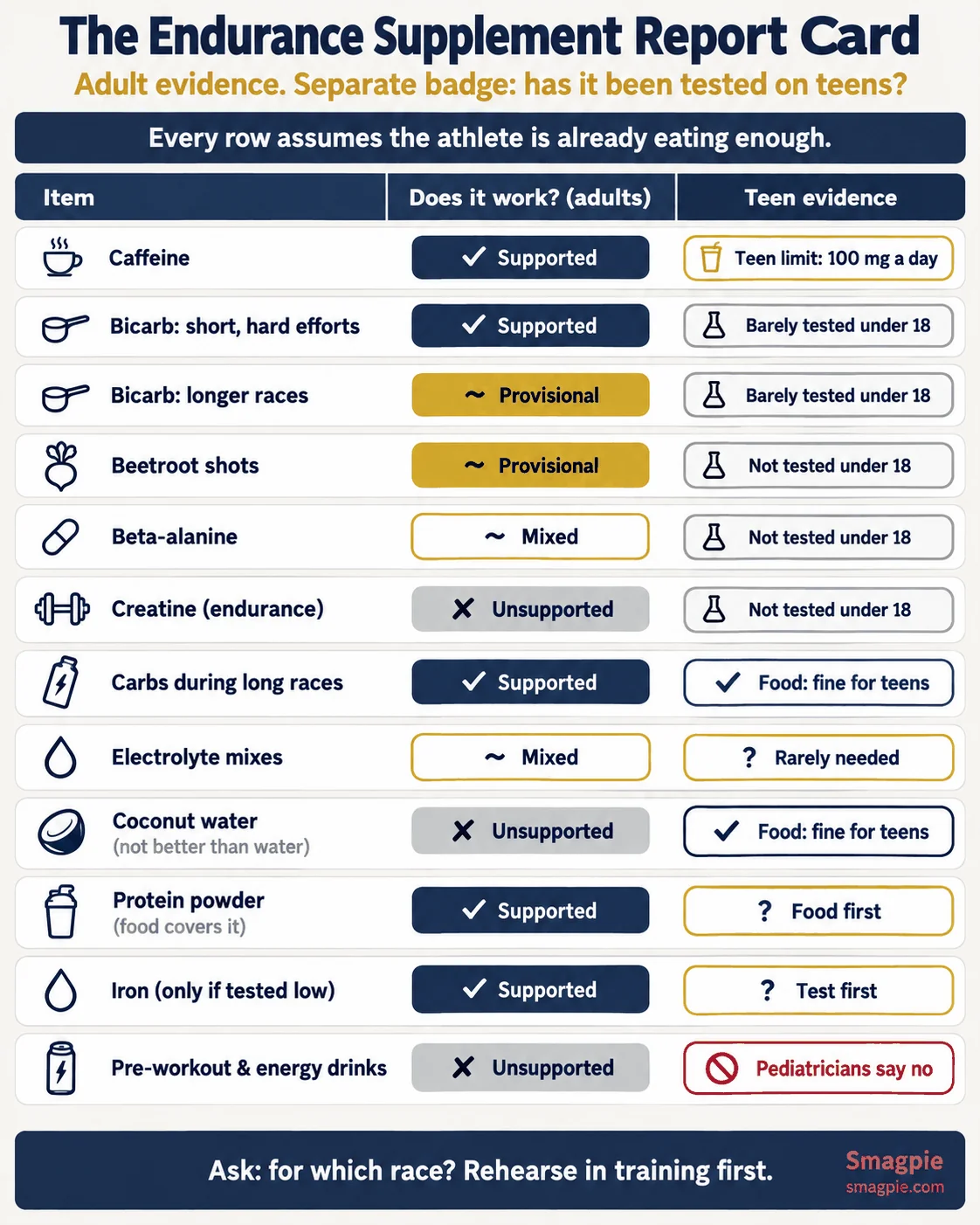
Evidence labels are the ones from our validation: Supported (multiple lines of evidence agree), Provisional (some evidence, not settled), Mixed (genuinely split), Unsupported (doesn’t survive the literature).
| Item | Teen evidence | Evidence for endurance | Which race it fits | Timing |
|---|---|---|---|---|
| Caffeine | Some teen data; teen limit 100 mg a day | ✓ Supported, about 2–4% | Almost all, from 1–2 min efforts to multi-hour time trials | About 60 min before; low doses during long races |
| Bicarb, short efforts | Barely tested under 18 | ✓ Supported | Scheduled hard 30 s–12 min: 800–1500 m, 200–400 m swims, hill-climb TT, prologue, pursuit | 60–180 min before, or split across 3–7 days |
| Bicarb, longer races | Barely tested under 18 | ~ Provisional, industry-linked | 10-mile and 40 km TTs, finishing sprints | As above; split dosing in long races |
| Beetroot / nitrate | Not tested under 18 (beets as food are fine) | ~ Provisional: small | Time trials under about 40 min, non-elite; not yet shown in women | 2–3 hours before; no antibacterial mouthwash |
| Beta-alanine | Not tested under 18 | ~ Mixed | Efforts of about 1–4 min; training block, not race morning | Daily for 4+ weeks |
| Creatine, steady endurance | Not tested under 18 for endurance | ✗ Unsupported | None | n/a |
| Creatine, surges and strength blocks | A few teen strength studies; food first | ~ Provisional, industry-linked | Off-season strength work, interval quality | Daily |
| Carbohydrate during races | ✓ Food: sports drink or gels for long or hot sessions | ✓ Supported | Over 45–60 min | By the clock (table above) |
| 90–120 g per hour | Not tested under 18 | ~ Provisional | Trained-gut adults in races over 2.5 h | Needs weeks of gut training |
| Electrolyte mixes | ~ Rarely needed | ~ Context only | 2 h+, heat, salty sweaters | During long sessions |
| Coconut water | ✓ Fine as a drink | ✗ Not better than water | A recovery drink if you like it | After |
| Protein powder | ~ Food first | ✓ Food covers it | A daily-total question | Any time |
| Iron | ~ Test first | ✓ Only if deficient | None; it’s a medical fix | Morning, doctor-directed |
| Pre-workout / energy drinks | Pediatricians say no to energy drinks | ✗ Not an endurance aid | None | n/a |
| BCAAs, ketone esters, glycerol, colostrum | Not tested under 18 | ✗ Skip | None | n/a |
| Item | Main side effect | Price per dose | Rehearse first? |
|---|---|---|---|
| Caffeine | Lost sleep, jitters, GI upset at high doses | ¢ (a 200 mg tablet is about 5–10¢) | Yes |
| Bicarb as baking soda | GI distress, large sodium load | ¢ (about 15¢) | Yes, more than once |
| Bicarb as coated capsules | Less GI distress | $$ ($2.50–3.50) | Yes |
| Bicarb hydrogel system | Least GI distress | $$$$ (about $17.50) | Yes |
| Beetroot shot | Pink urine, occasional GI upset | $$ (about $2–4 a shot) | Yes |
| Beta-alanine | Tingling skin | $ per day, over 4–12 weeks | n/a |
| Creatine | Water weight, mostly with loading | $ per day (about 22–44¢) | n/a |
| Electrolyte drink mix | None at sensible doses; not fuel | $–$$ | Yes |
Rehearsal changes the arithmetic. The IOC’s one non-negotiable is that a supplement is “thoroughly trialled in training or simulated competition before being used in competition.”1 Two rehearsals plus race day make a hydrogel-bicarb race cost about $52, and the baking-soda version about 45¢.7 The cheapest items on this card carry the best evidence. The most expensive ones carry the weakest, or the most industry-funded.
The three clocks
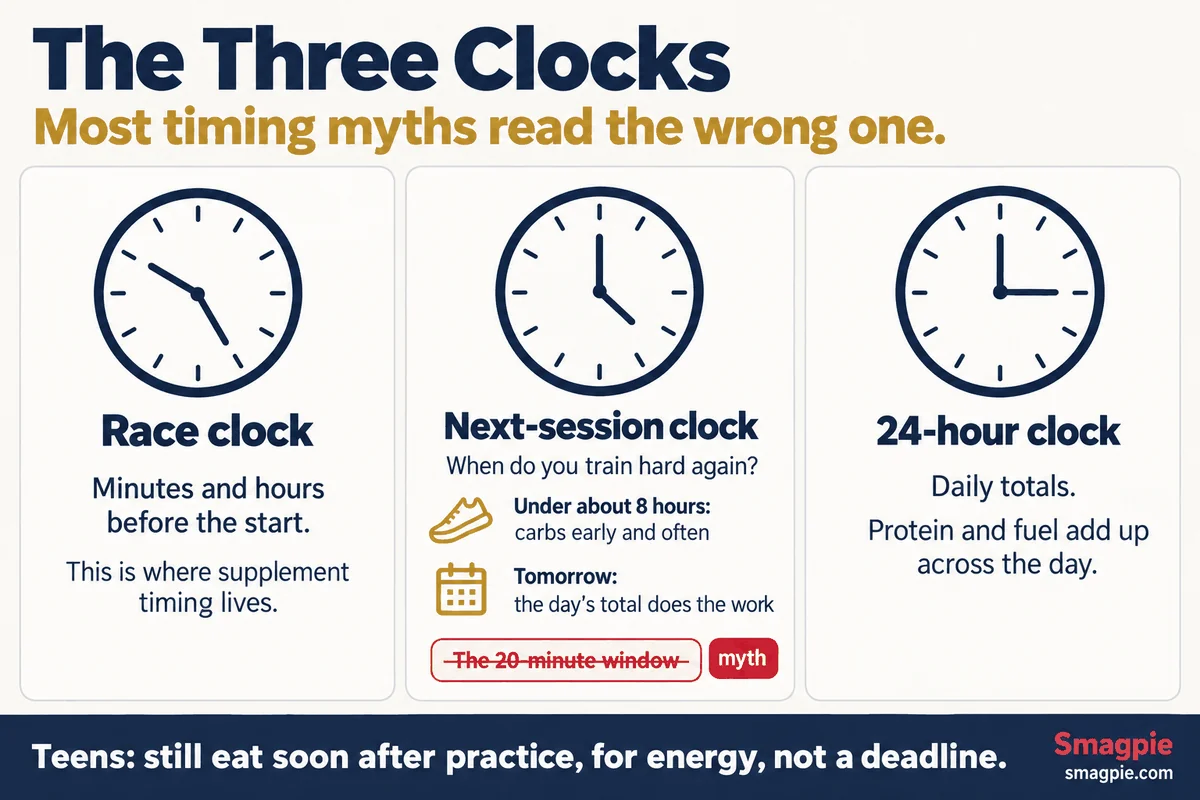
Almost every timing question your athletes ask is about one of three clocks. The race clock is the minutes and hours before a start; that’s where supplement timing lives. The next-session clock is how long until the athlete trains hard again. The 24-hour clock is daily totals. The “eat carbs within 20 minutes” rule confuses the first with the second.
The post-workout carb window: it depends when you train next
We found no study behind the 20-minute rule. Its root is a 1988 experiment that compared drinking carbohydrate immediately after exercise with drinking it two hours later; the delay slowed glycogen storage over the next four hours.8 Nothing in it is about twenty minutes. And when the next hard session is about a day away, the delay stops mattering if total carbohydrate is adequate: a later study found no difference in muscle glycogen at 8 or 24 hours between eating straight away and waiting two hours.9 Or, in cycling terms: you don’t bonk on Saturday because you missed a 20-minute window after Thursday’s ride. You bonk because you didn’t eat in Saturday’s first hour.
The window becomes real when the next fuel-demanding session is less than about 8 hours away. The ACSM calls this “speedy refuelling”: ”< 8 h recovery between 2 fuel-demanding sessions”, eat “1-1.2 g/kg/h for first 4 h, then resume daily fuel needs.”4 In one trial, four hours of high- versus low-carbohydrate recovery meant a second run lasting 80 versus 48 minutes.10 Even high intake leaves muscle glycogen at only about 55% of its starting level six hours later, so a same-day second session starts partly full no matter what.11
| Situation | Clock | What matters |
|---|---|---|
| Practice today, practice tomorrow (most days of a season) | 24-hour | The day’s total carbohydrate |
| Thursday intervals, Saturday group ride | 24-hour | The day’s total, then eating early on Saturday |
| August two-a-days; a 5:30 am swim plus an evening run | Next-session (under 8 h) | Carbohydrate early and often after the first session |
| Saturday TT, then a Saturday crit; prelims and finals on one day | Next-session (under 8 h) | Same |
| A normal stage-race day (finish mid-afternoon, start late next morning) | Closer to 24-hour | A big daily total; start eating early because of volume, not a deadline |
| A 1600 m then a 3200 m at the same meet | Neither rule | Small, familiar carbohydrate and sips between events |
One caution, and it matters more than the myth. “The 20-minute window is a myth” must never travel without “eat after practice anyway.” For teenagers, eating soon after practice is still the right habit, because of the day’s energy total and a routine that survives a school schedule, not because of a glycogen deadline.12
Protein: the 24-hour clock is the right one
The instinct that “the 24-hour window matters more” is correct. When studies control for total protein, the effect of timing disappears,13 and the International Society of Sports Nutrition notes that exercise’s anabolic effect is “long-lasting (at least 24 h).”14 Spreading protein over four or five eating occasions, one of them soon after the key session, is a modest bonus.4 Even the old rule that you can only use about 25 g at once turned out to be wrong, at least after resistance exercise, where 100 g produced a larger and longer response than 25 g.15
What coaches underestimate is the amount. Adult endurance athletes need roughly 1.6–1.8 g per kilogram per day, and more on rest days, when the requirement measured the day after exercise is higher.16 The few studies in women put the average requirement for aerobic endurance work at 1.28–1.63 g/kg/day.17 These are adult numbers; for teens, the high-school fueling pair has the adolescent figures, and most teens get there with food.
The protein number has to sit next to its counterweight. One study of 72 female endurance athletes, average age 42, found protein targets met and carbohydrate short on training days.18 Athletes can over-learn the protein message and under-eat the fuel. Protein before bed is a convenient way to reach the daily total after an evening practice, but in athletes already eating enough protein, including young professional cyclists at a training camp, it hasn’t improved recovery or performance.19
Iron: test, don’t guess
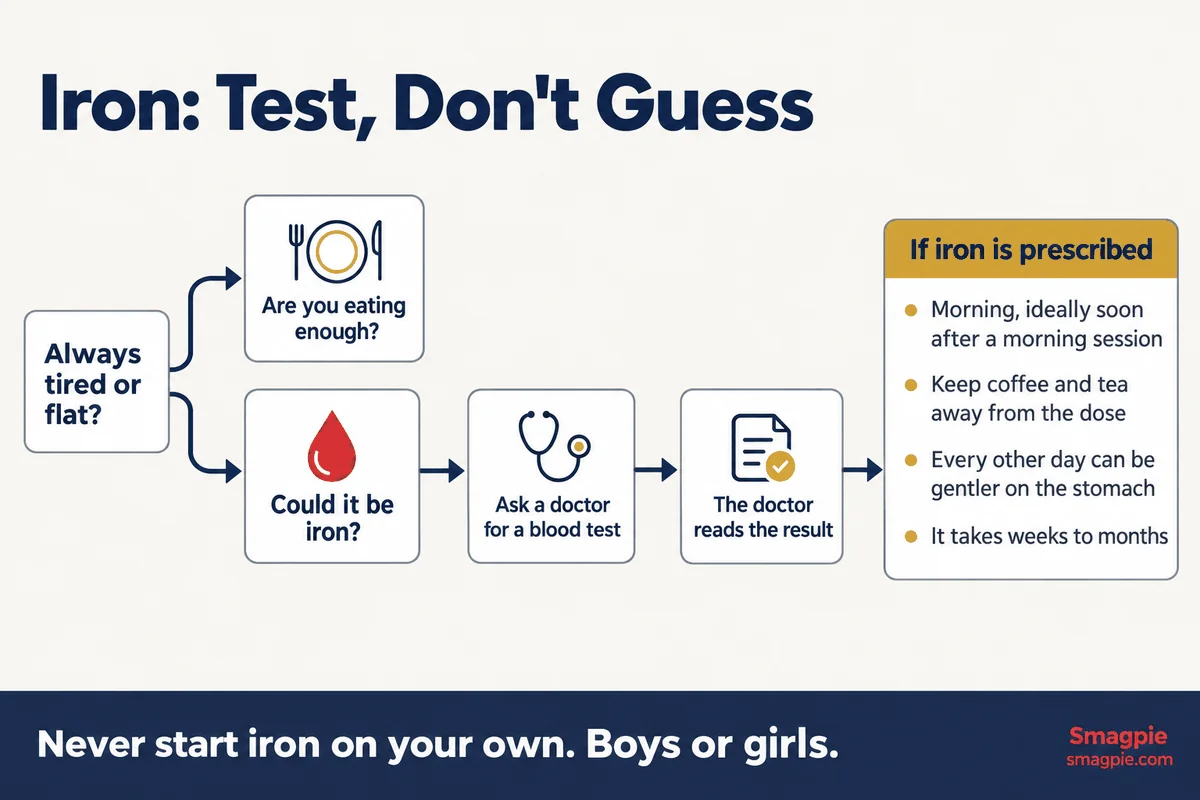
Iron is the most useful item on this card for most rosters, and the most misused. It improves performance when an athlete is genuinely deficient: all six positive trials in athletes who weren’t anaemic treated ferritin, the iron-storage marker, at or below 20 µg/L.20 Deficiency is common, at roughly 15–35% of female and 5–11% of male athlete cohorts.21 On a 22-runner team split evenly, those adult-cohort rates would mean about two to four girls and about one boy. That’s a reason to ask for testing, not a diagnosis.
Supplementing without a test carries its own risk. In one study of recreational marathoners, 15% of the men had iron overload.22 The rule is the same for everyone: never take iron blind. A Swiss sports-medicine guideline puts the deficiency cut-off at ferritin below 30 µg/L for athletes over 15 and below 20 for ages 12–15, and the physician reads the result, not the coach.23
If a doctor prescribes iron, timing helps. Take it in the morning, ideally within about 30 minutes after a morning session, before the post-exercise rise in hepcidin, the hormone that blocks absorption.24 Every-other-day dosing is gentler on the stomach and at least as effective over months.25 Keep coffee and tea away from the dose: coffee an hour before didn’t affect absorption, but coffee with the meal or an hour after it did.26 And restoring iron takes weeks to months. It isn’t a race-week fix.
An always-tired athlete needs two questions asked, not one. Fatigue is also the first sign of under-fueling.
Fluids, electrolytes, coconut water and cramps
How much sodium athletes lose in sweat varies roughly nine-fold between individuals.27 Even so, when researchers modelled the sodium needs of a soccer match and an elite marathon, replacing sodium was unnecessary in every realistic scenario. It became necessary in a 160 km ultramarathon run (many times longer than a century ride) when athletes drank aggressively and had salty sweat.28 A hot Ironman, with 10–17 hours of planned drinking, sits nearer that corner than a marathon does, and in one randomized trial of half-ironman triathletes, salt supplements taken before and during the race lowered total race time.29
The dangerous mistake is overdrinking, not under-salting. At the Western States 100, 94% of runners took sodium supplements, and sodium intake didn’t separate the runners who developed low blood sodium from those who didn’t.30 At the Boston Marathon, 13% of the finishers tested had low blood sodium; the strongest predictors were gaining weight during the race and finishing slower than four hours, about seven times the odds of a sub-3:30 finisher.31 The athlete at risk is the slow, conscientious one drinking at every stop.
| Drink | Serving | Sodium |
|---|---|---|
| What a practice or a 5K needs | — | Water |
| Tap water | 8 oz | about 10 mg |
| Coconut water, packaged unsweetened | 8 oz | about 60 mg |
| Typical sports drink | 750 mL bottle | about 170–600 mg |
| Liquid I.V. | 1 stick | 500 mg |
| Pickle Juice Extra Strength shot | 2.5 oz | 470 mg |
| LMNT | 1 stick | 1,000 mg |
| For comparison: average endurance-athlete sweat loss | per hour | about 1,200 mg, with wide individual variation |
The sweat-loss row is our conversion of a large sports-science sweat dataset, and it varies widely between athletes.32 Coconut water rehydrates about as well as water or a sports drink after mild dehydration, but not better.3334 Its profile is the reverse of sweat: low in sodium, high in potassium. The study most often cited in its favor was funded by a coconut-water company.33
Cramps track pace and fatigue more than salt. In a study of 210 Ironman triathletes, the athletes who cramped didn’t differ in electrolytes or hydration from those who didn’t; racing faster and a history of cramping predicted it.35 Pickle juice shortened electrically induced cramps in a small foot muscle of mildly dehydrated men by about 49 seconds, with no change in blood chemistry. That’s a reflex from the mouth and throat, not a refuel, and it’s lab evidence rather than a proven race fix.36 A Cochrane review found no trials at all of magnesium for exercise cramps.37
”Sold over the counter” isn’t “checked”
The US Food and Drug Administration is plain about it: “Under DSHEA, FDA does not have the authority to approve dietary supplements before they are marketed.”38 When an Australian testing lab bought 200 supplements online, 35% contained substances on the WADA prohibited list, mostly stimulants in pre-workouts and fat burners, and 57% of those didn’t list them on the label.39 Closer to home, in a survey of high-school football players, five reported using a pre-workout that contained an NCAA-banned substance.40
Third-party testing (NSF Certified for Sport, Informed Sport) lowers that risk but doesn’t remove it. USADA’s own guide puts it bluntly: “the only way to have zero risk is to not use supplements.”41 Worth knowing: the heaviest supplement users on most rosters are the masters athletes, not the teenagers, and stacking products multiplies exposure.
The reference shelf
The detail behind each row of the card. Every section opens with what’s known for athletes under 18.
Caffeine
Under 18: a little teen research, showing a small, uncertain benefit. The bigger issue is dose: the adult race dose meets or exceeds every youth daily limit.
Caffeine is the most reliable legal performance aid in endurance sport. At 3–6 mg per kg taken about an hour before, it improves endurance performance by roughly 2–4%;45 a meta-analysis of 46 studies found time trials about 2.2% faster.46 Lower doses, under 3 mg/kg (around 200 mg), also work before or during long events, taken with carbohydrate.1 That’s the café-stop espresso, formalized. Women show a similar aerobic benefit.47
For long races (road races, fondos, 70.3 and Ironman), the practical approach is a lower dose spread out or held back for the second half. Caffeinated gels count toward the total: an athlete who takes 6 mg/kg up front and then a caffeinated gel every hour drifts toward the 9 mg/kg zone where nausea, anxiety and insomnia climb with no added benefit.1 The performance evidence covers time trials of roughly 5 to 150 minutes; no study shows the effect stretching across a 12-hour race.
Habitual coffee drinkers still respond, so skipping the morning cup before a race isn’t necessary.48 Taking caffeine every single day does slowly erode the effect over two to three weeks, though, so a caffeinated gel on every training ride has a cost.49
The real price is sleep. A meta-analysis found caffeine cut total sleep by 45 minutes, and recommended at least 8.8 hours between a 107 mg coffee and bedtime, and 13.2 hours for a 217.5 mg pre-workout serving.50 A race dose for a 60 kg athlete is 180–360 mg. For the evening track meet, the Tuesday-night crit or the swim finals session, that’s a real trade.
For teenagers: in adolescent athletes the benefit is small and uncertain, and the review’s authors don’t support routine use.2 The American Academy of Child and Adolescent Psychiatry advises at most 100 mg a day for ages 12–18 and no energy drinks.3 Europe’s food-safety agency sets 3 mg/kg/day for habitual intake in adolescents,51 and the AIS sets under 2.5 mg/kg/day.42 According to the FDA, a single 12-oz coffee carries 113–247 mg and a 12-oz energy drink 41–246 mg.52 One drink can put a teenager over the line before the race even starts.
Sodium bicarbonate, and the baking-soda question
Under 18: barely tested: one small study of eight young swimmers.53 The effective adult dose is also more than the baking-soda box says to take in a day.
Bicarbonate buffers the acid that builds up during hard efforts. It’s strongest for maximal efforts of about 30 seconds to 12 minutes: the 800 and 1500 m, 200–400 m swims, hill-climb time trials, prologues and pursuits.53 It works in women too, though there are fewer studies in women.54 The minimum effective dose is 0.2 g per kg; 0.3 g/kg is optimal, taken 60–180 minutes before, or split across meals for three to seven days ending the evening before.53
The catch for road racers is that bicarb fits races where the hard minutes are on the schedule. In a crit or a road race, tactics decide when they come, and a 60–180-minute dosing window can’t predict that. One trial gave cyclists a dose split before and during a three-hour simulated race and found about 3% more power in a closing 90-second sprint.55 That’s one study of a cycling finale, not evidence for a 5K kick. Bicarb doesn’t add matches to the book; it may let the last one burn a little brighter. Evidence for steadier efforts such as 40 km time trials is emerging, much of it from hydrogel trials that carry a conflict of interest with the product’s maker.56 For 70.3 and Ironman, bicarb isn’t a tool: the evidence doesn’t reach that far, and long-course races are decided by the gut.
Can you use baking soda? Yes. Baking soda is sodium bicarbonate: the Arm & Hammer label lists the active ingredient as “Sodium Bicarbonate 100%.”57 The AIS calls household baking soda “the most commonly available and economical source.”5 Not baking powder, which is a different product. A level teaspoon weighs about 4.6 g,58 so the optimal dose for a 60 kg athlete, 18 g, is just under four level teaspoons. That’s exactly why you weigh it instead: spoons vary, and this is a dose with a narrow margin for the stomach.
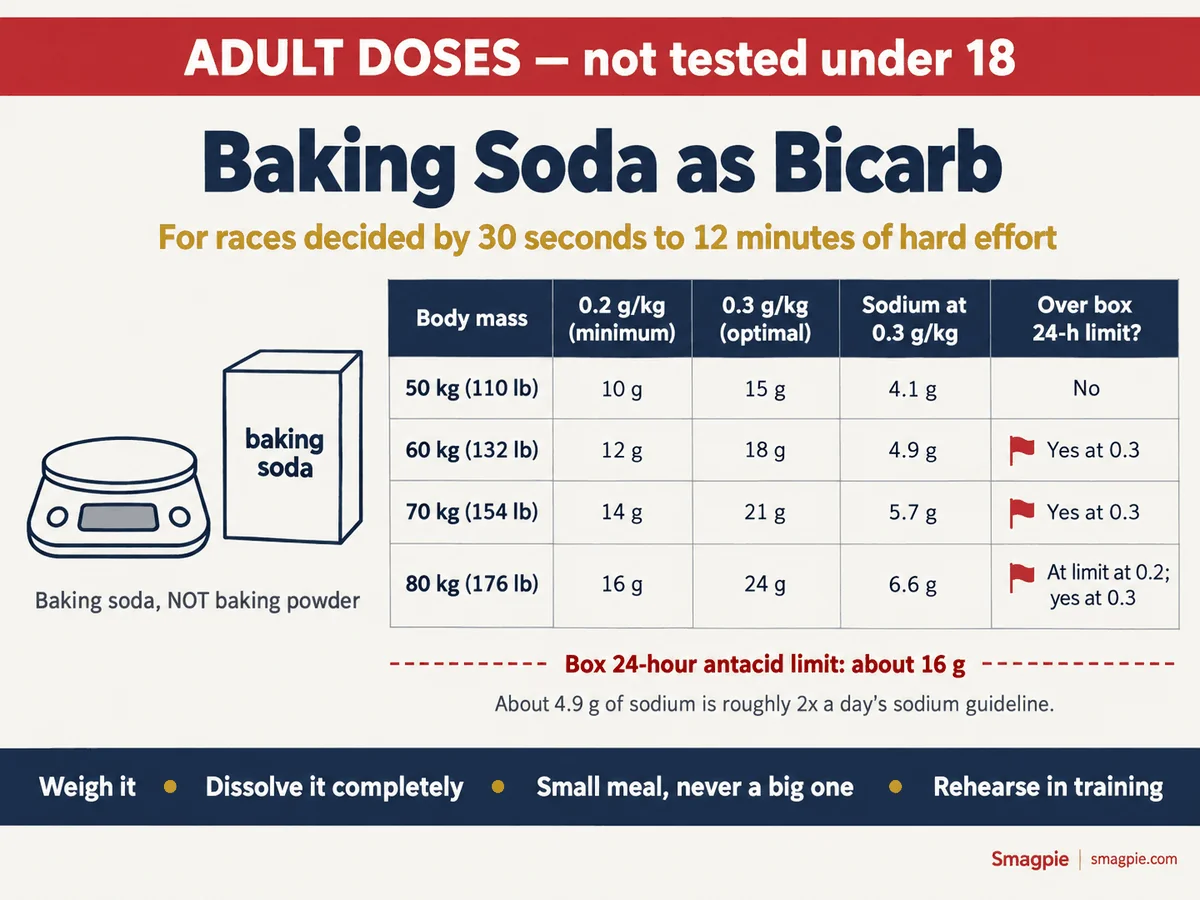
| Body mass | 0.2 g/kg (minimum) | 0.3 g/kg (optimal) | Sodium at 0.3 g/kg | Over the box’s 24-h limit? |
|---|---|---|---|---|
| 50 kg (110 lb) | 10 g | 15 g | about 4.1 g | No |
| 60 kg (132 lb) | 12 g | 18 g | about 4.9 g | Yes, at 0.3 g/kg |
| 70 kg (154 lb) | 14 g | 21 g | about 5.7 g | Yes, at 0.3 g/kg |
| 80 kg (176 lb) | 16 g | 24 g | about 6.6 g | At the limit at 0.2; yes at 0.3 |
At 18 g, that’s about 4.9 g of sodium, roughly twice a day’s sodium guideline in one sitting. The box also warns against taking it “when overly full from food or drink,” so the sport-science advice to take bicarb with a carbohydrate meal means a small one.571 Dissolve it completely and rehearse it in training more than once: bloating, nausea and diarrhea are the usual reasons it fails, and the ways around them (a lower dose, taking it about three hours out, a small meal, split doses, coated capsules or a hydrogel) have never been compared head to head.7 Baking soda is the cheapest form by far, about 15¢ a dose against about $17.50 for the hydrogel system, and the hardest on the stomach.7 Think of it as the aluminum crit bike of bicarb: same job, a fraction of the price, a harsher ride.
Serious harm from baking soda comes from misuse. California’s poison-control system recorded 192 symptomatic cases of misuse over 12 years, 12 of them hospitalized, mostly from using it as an antacid.59 We found no case report from athletic loading.
Beetroot juice and dietary nitrate
Under 18: not tested. Beets as food are fine; for concentrated shots there are no youth data, and a single shot is above the acceptable daily intake Europe’s food-safety agency set in its review of nitrate as a food additive.60
Beetroot’s reputation runs ahead of its evidence. An 80-study meta-analysis found a small overall effect, weaker still in race-like time trials, with no detectable effect in athletes with a VO₂peak of 65 mL/kg/min or higher and none when the dose was taken 90 minutes or less before exercise.61 The “about 3%” you’ll hear quoted is a worked example in that paper (48 seconds over a 16.1 km cycling time trial), not its pooled result. There’s no validated way to map that VO₂peak cut-off onto a category, an FTP or a race time.
Women made up only about 10% of the participants, and the benefit hasn’t been shown in them yet;61 one controlled comparison found gains in men and none in women.62 “Not yet shown in women” is accurate. “Doesn’t work in women” isn’t.
If an adult uses it: 5–9 mmol of nitrate (about one concentrated 70 mL shot), two to three hours before.1 Skip antibacterial mouthwash around the dose; the mouth’s bacteria do the first conversion step.63 Pink urine afterward is harmless.
Beta-alanine
Under 18: not tested.
Beta-alanine is a training-block supplement, not a race-morning one. It needs 4–6 g a day for at least four weeks to raise muscle carnosine.64 Its effect is clearest in exhaustion tests of 30 seconds to 10 minutes and much smaller in race-like performance tests, and there’s little evidence beyond about 10 minutes.65 A crit is a series of one-minute efforts, but the benefit has been shown in single exhaustion tests, not in races. Tingling skin is the side effect.64
Creatine
Under 18: not tested for endurance. The few teen studies are strength and sprint studies,66 and the AAP’s parent site says food first.
It’s probably in your locker room. Creatine use among US teenagers rose sharply between 2019 and 2024.6768 For endurance athletes, the answer is clear: a meta-analysis in trained athletes found no effect on endurance performance.69 The IOC notes the 1–2 kg of water that follows loading may hurt endurance and weight-bearing events, which matters more on the run and the climb than in a flat crit.1 A case for surges and finishing kicks comes from a review whose authors disclose creatine-industry ties.70 At best, creatine is a strength-room and interval-quality tool.
Be honest with teenagers about the other side too: creatine’s reputation for kidney damage is unfounded in healthy people.71 What the AAP’s parent site says is simply that “Creatine does not appear to offer any additional benefit in this age group.”72 Midlife bone, muscle and brain claims are separate questions this article didn’t grade.
High-carb fueling: 90 to 120 grams an hour
Under 18: no adolescent data above about 60 g per hour; treat it as adult, trained-gut territory.
The pro peloton has pushed in-race carbohydrate to 90, 120 and beyond. 120 g/h does raise how much of the ingested carbohydrate the body burns, but it didn’t change how much of the rider’s own stored carbohydrate was used, and performance wasn’t tested.73 A 2026 review suggests the upper limit “could increase from 90 to 120 g/h (at least for trained participants),” and says the 120–200 g/h some athletes now use in the field “is not yet substantiated by current scientific research.”74 Think of 120 g/h as a 54×11: the right gear for a pro engine, the wrong one for most club legs. For most of a club roster, the number that matters is 30–60 g/h, and the real failure is the rider who brings one bottle and no food to a three-hour ride.
Whatever the target, the gut can be trained. In adult runners, two weeks of practicing race-rate intake cut gastrointestinal symptoms substantially.75 Gut training is base miles for the stomach. Carb loading, for events over 90 minutes, reliably raises muscle glycogen,76 but of 14 loading studies only 2 were double-blind, and neither found a performance benefit when athletes also fueled during the race.77 Less proven than its reputation; not a myth.
The skip list
- BCAAs: no endurance benefit in a 2026 systematic review, and redundant if total protein is adequate.78
- Ketone esters: a 2022 meta-analysis found no effect on endurance performance, at a very high price.79 A pro team buying them is spending sponsor money on a long shot; a club rider would be spending entry fees.
- Glycerol hyperhydration: legal again since 2018, but recent hot-weather trials retained more fluid without faster times.80
- Colostrum: the AIS places it in Group D, “Banned or at high risk of contamination.”5
- Pre-workout powders and energy drinks: not endurance aids, frequently stimulant-loaded, and among the categories most often found contaminated.39
What’s genuinely unsettled
The bottom line
A handful of supplements work, each for a particular race at a particular time, and the first question to ask an athlete who wants one is for which race? Rehearse everything in training. Ask when they train next, not how many minutes since they stopped. Treat protein as a daily total, iron as a doctor’s prescription after a test, and electrolytes as a tool for long, hot days. For athletes under 18, almost none of this has been tested, so the honest message is what is proven for them: breakfast, a meet-day lunch, a bus snack, water, sleep and eating after practice. Many will try the rest anyway. Make sure they know the studies weren’t done on people their age, and that a doctor, not a teammate or a video, is the right person to ask about doses.
Sources
- Maughan RJ, Burke LM, Dvorak J, et al.. IOC consensus statement: dietary supplements and the high-performance athlete. Br J Sports Med 2018;52(7):439-455, 2018. https://pubmed.ncbi.nlm.nih.gov/29540367/ ↩
- Liu L, Chen M, Deng H, et al.. Acute Effects and Safety of Caffeine Ingestion in Adolescent Athletes: A Systematic Review and Three-Level Meta-Analysis. Nutrients 2026;18(15):2520, 2026. https://pubmed.ncbi.nlm.nih.gov/42588143/ ↩
- American Academy of Child and Adolescent Psychiatry. Caffeine and Children (Facts for Families No. 131). AACAP, April 2026, 2026. https://www.aacap.org/AACAP/Families_and_Youth/Facts_for_Families/FFF-Guide/Caffeine_and_Children-131.aspx ↩
- Thomas DT, Erdman KA, Burke LM.. American College of Sports Medicine Joint Position Statement. Nutrition and Athletic Performance. Med Sci Sports Exerc 2016;48(3):543-568, 2016. https://pubmed.ncbi.nlm.nih.gov/26891166/ ↩
- Australian Institute of Sport. AIS Sports Supplement Framework. Australian Sports Commission (Group A fact sheets updated November 2025), 2025. https://www.ausport.gov.au/ais/nutrition/supplements ↩
- Wolf S (American Academy of Pediatrics). My 15-year-old wants to take creatine for sports performance. Is creatine safe for teen athletes?. HealthyChildren.org (AAP parent site), last updated 15 October 2026, 2026. https://www.healthychildren.org/English/tips-tools/ask-the-pediatrician/Pages/my-15-year-old-wants-to-take-creatine-for-sports-performance-Is-creatine-safe-for-teen-athletes.aspx ↩
- Winter IP, Sarac P, Wilson PB.. Gastrointestinal Symptoms Associated With Sodium Bicarbonate Supplementation Protocols: A Systematic Review. Eur J Sport Sci 2026;26(8):e70225, 2026. https://pubmed.ncbi.nlm.nih.gov/42499192/ ↩
- Ivy JL, Katz AL, Cutler CL, et al.. Muscle glycogen synthesis after exercise: effect of time of carbohydrate ingestion. J Appl Physiol (1985) 1988;64(4):1480-1485, 1988. https://pubmed.ncbi.nlm.nih.gov/3132449/ ↩
- Parkin JA, Carey MF, Martin IK, et al.. Muscle glycogen storage following prolonged exercise: effect of timing of ingestion of high glycemic index food. Med Sci Sports Exerc 1997;29(2):220-224, 1997. https://pubmed.ncbi.nlm.nih.gov/9044226/ ↩
- Alghannam AF, Jedrzejewski D, Tweddle MG, et al.. Impact of Muscle Glycogen Availability on the Capacity for Repeated Exercise in Man. Med Sci Sports Exerc 2016;48(1):123-131, 2016. https://pubmed.ncbi.nlm.nih.gov/26197030/ ↩
- Fuchs CJ, Veeraiah P, Hermans WJH, et al.. Carbohydrate intake of 10 g/kg body mass rapidly replenishes liver, but not muscle glycogen contents, during 12 h of post-exercise recovery in well-trained cyclists. J Physiol 2025, 2025. https://pubmed.ncbi.nlm.nih.gov/40836481/ ↩
- Desbrow B, McCormack J, Burke LM, et al.. Sports Dietitians Australia position statement: sports nutrition for the adolescent athlete. Int J Sport Nutr Exerc Metab 2014;24(5):570-584, 2014. https://pubmed.ncbi.nlm.nih.gov/24668620/ ↩
- Schoenfeld BJ, Aragon AA, Krieger JW.. The effect of protein timing on muscle strength and hypertrophy: a meta-analysis. J Int Soc Sports Nutr 2013;10(1):53, 2013. https://pubmed.ncbi.nlm.nih.gov/24299050/ ↩
- Jäger R, Kerksick CM, Campbell BI, et al.. International Society of Sports Nutrition Position Stand: protein and exercise. J Int Soc Sports Nutr 2017;14:20, 2017. https://pubmed.ncbi.nlm.nih.gov/28642676/ ↩
- Trommelen J, van Lieshout GAA, Nyakayiru J, et al.. The anabolic response to protein ingestion during recovery from exercise has no upper limit in magnitude and duration in vivo in humans. Cell Rep Med 2023;4(12):101324, 2023. https://pubmed.ncbi.nlm.nih.gov/38118410/ ↩
- Witard OC, Hearris M, Morgan PT.. Protein Nutrition for Endurance Athletes: A Metabolic Focus on Promoting Recovery and Training Adaptation. Sports Med 2025;55(6):1361-1376, 2025. https://pubmed.ncbi.nlm.nih.gov/40117058/ ↩
- Mercer D, Convit L, Condo D, et al.. Protein Requirements of Pre-Menopausal Female Athletes: Systematic Literature Review. Nutrients 2020;12(11):E3527, 2020. https://pubmed.ncbi.nlm.nih.gov/33207749/ ↩
- Fortis HO, Cronin CJ, Johnson KO, et al.. Unintentional Underfuelling and Protein Prioritisation: A Multi-Methods Exploration of Nutrition Practices and Behaviours in Female Endurance Athletes. Nutrients 2025;17(23):3773, 2025. https://pubmed.ncbi.nlm.nih.gov/41374063/ ↩
- Valenzuela PL, Alejo LB, Montalvo-Pérez A, et al.. Pre-sleep protein supplementation in professional cyclists during a training camp: a three-arm randomized controlled trial. J Int Soc Sports Nutr 2023;20(1):2166366, 2023. https://pubmed.ncbi.nlm.nih.gov/36686220/ ↩
- Rubeor A, Goojha C, Manning J, et al.. Does Iron Supplementation Improve Performance in Iron-Deficient Nonanemic Athletes?. Sports Health 2018;10(5):400-405, 2018. https://pubmed.ncbi.nlm.nih.gov/29792778/ ↩
- Sim M, Garvican-Lewis LA, Cox GR, et al.. Iron considerations for the athlete: a narrative review. Eur J Appl Physiol 2019;119(7):1463-1478, 2019. https://pubmed.ncbi.nlm.nih.gov/31055680/ ↩
- Mettler S, Zimmermann MB.. Iron excess in recreational marathon runners. Eur J Clin Nutr 2010;64(5):490-494, 2010. https://pubmed.ncbi.nlm.nih.gov/20197784/ ↩
- Clénin G, Cordes M, Huber A, et al.. Iron deficiency in sports - definition, influence on performance and therapy. Swiss Med Wkly 2015;145:w14196, 2015. https://pubmed.ncbi.nlm.nih.gov/26512429/ ↩
- McCormick R, Sim M, Dawson B, et al.. Refining Treatment Strategies for Iron Deficient Athletes. Sports Med 2020;50(12):2111-2123, 2020. https://pubmed.ncbi.nlm.nih.gov/33057935/ ↩
- von Siebenthal HK, Gessler S, Vallelian F, et al.. Alternate day versus consecutive day oral iron supplementation in iron-depleted women: a randomized double-blind placebo-controlled study. EClinicalMedicine 2023;65:102286, 2023. https://pubmed.ncbi.nlm.nih.gov/38021373/ ↩
- Morck TA, Lynch SR, Cook JD.. Inhibition of food iron absorption by coffee. Am J Clin Nutr 1983;37(3):416-420, 1983. https://pubmed.ncbi.nlm.nih.gov/6402915/ ↩
- Baker LB.. Sweating Rate and Sweat Sodium Concentration in Athletes: A Review of Methodology and Intra/Interindividual Variability. Sports Med 2017;47(suppl 1):111-128, 2017. https://pubmed.ncbi.nlm.nih.gov/28332116/ ↩
- McCubbin AJ.. Modelling sodium requirements of athletes across a variety of exercise scenarios - Identifying when to test and target, or season to taste. Eur J Sport Sci 2023;23(6):992-1000, 2023. https://pubmed.ncbi.nlm.nih.gov/35616504/ ↩
- Del Coso J, González-Millán C, Salinero JJ, et al.. Effects of oral salt supplementation on physical performance during a half-ironman: A randomized controlled trial. Scand J Med Sci Sports 2016;26(2):156-164, 2016. https://pubmed.ncbi.nlm.nih.gov/25683094/ ↩
- Hoffman MD, Stuempfle KJ.. Sodium Supplementation and Exercise-Associated Hyponatremia during Prolonged Exercise. Med Sci Sports Exerc 2015;47(9):1781-1787, 2015. https://pubmed.ncbi.nlm.nih.gov/25551404/ ↩
- Almond CS, Shin AY, Fortescue EB, et al.. Hyponatremia among runners in the Boston Marathon. N Engl J Med 2005;352(15):1550-1556, 2005. https://pubmed.ncbi.nlm.nih.gov/15829535/ ↩
- Barnes KA, Anderson ML, Stofan JR, et al.. Normative data for sweating rate, sweat sodium concentration, and sweat sodium loss in athletes: An update and analysis by sport. J Sports Sci 2019;37(20):2356-2366, 2019. https://pubmed.ncbi.nlm.nih.gov/31230518/ ↩
- Kalman DS, Feldman S, Krieger DR, et al.. Comparison of coconut water and a carbohydrate-electrolyte sport drink on measures of hydration and physical performance in exercise-trained men. J Int Soc Sports Nutr 2012;9(1):1, 2012. https://pubmed.ncbi.nlm.nih.gov/22257640/ ↩
- Pérez-Idárraga A, Aragón-Vargas LF.. Postexercise rehydration: potassium-rich drinks versus water and a sports drink. Appl Physiol Nutr Metab 2014;39(10):1167-1174, 2014. https://pubmed.ncbi.nlm.nih.gov/25017113/ ↩
- Schwellnus MP, Drew N, Collins M.. Increased running speed and previous cramps rather than dehydration or serum sodium changes predict exercise-associated muscle cramping: a prospective cohort study in 210 Ironman triathletes. Br J Sports Med 2011;45(8):650-656, 2011. https://pubmed.ncbi.nlm.nih.gov/21148567/ ↩
- Miller KC, Mack GW, Knight KL, et al.. Reflex inhibition of electrically induced muscle cramps in hypohydrated humans. Med Sci Sports Exerc 2010;42(5):953-961, 2010. https://pubmed.ncbi.nlm.nih.gov/19997012/ ↩
- Garrison SR, Korownyk CS, Kolber MR, et al.. Magnesium for skeletal muscle cramps. Cochrane Database Syst Rev 2020;9:CD009402, 2020. https://pubmed.ncbi.nlm.nih.gov/32956536/ ↩
- US Food and Drug Administration. Questions and Answers on Dietary Supplements. FDA (content current as of 27 August 2026), 2026. https://www.fda.gov/food/information-consumers-using-dietary-supplements/questions-and-answers-dietary-supplements ↩
- Barker L, Cawley A, Speers N, et al.. Sports Supplement Analysis Survey for the Prevalence of WADA Prohibited Substances in the Australian Online Marketplace. Drug Test Anal 2025;17(10):1857-1864, 2025. https://pubmed.ncbi.nlm.nih.gov/40180440/ ↩
- Shoshan T, Post E.. Prevalence of Protein and Pre-Workout Supplement Use among High School Football Players and Potential Product Contamination. Glob Pediatr Health 2021;8:2333794X211031202, 2021. https://pubmed.ncbi.nlm.nih.gov/34291127/ ↩
- US Anti-Doping Agency. Supplement Guide: Reducing Supplement Risk. USADA, 2025. https://www.usada.org/athletes/substances/supplement-guide/ ↩
- Australian Institute of Sport. Caffeine: Group A supplement fact sheet. AIS Sports Supplement Framework (last updated November 2025), 2025. https://www.ausport.gov.au/ais/nutrition/supplements/group_a ↩
- NFHS Sports Medicine Advisory Committee. Position Statement on Supplements (revised April 2012). National Federation of State High School Associations; copy hosted by the MIAA, 2012. https://miaa.net/media/1362 ↩
- NFHS Sports Medicine Advisory Committee. Position Statement on Appearance and Performance Enhancing Drugs and Substances. National Federation of State High School Associations, October 2024, 2024. https://assets.nfhs.org/umbraco/media/7213625/nfhs-smac-position-statement-on-appearance-and-performance-enhancing-drugs-and-substances-final-10-30-24.pdf ↩
- Guest NS, VanDusseldorp TA, Nelson MT, et al.. International society of sports nutrition position stand: caffeine and exercise performance. J Int Soc Sports Nutr 2021;18(1):1, 2021. https://pubmed.ncbi.nlm.nih.gov/33388079/ ↩
- Southward K, Rutherfurd-Markwick KJ, Ali A.. The Effect of Acute Caffeine Ingestion on Endurance Performance: A Systematic Review and Meta-Analysis. Sports Med 2018;48(8):1913-1928, 2018. https://pubmed.ncbi.nlm.nih.gov/29876876/ ↩
- Mielgo-Ayuso J, Marques-Jiménez D, Refoyo I, et al.. Effect of Caffeine Supplementation on Sports Performance Based on Differences Between Sexes: A Systematic Review. Nutrients 2019;11(10):E2313, 2019. https://pubmed.ncbi.nlm.nih.gov/31574901/ ↩
- Gonçalves LS, Painelli VS, Yamaguchi G, et al.. Dispelling the myth that habitual caffeine consumption influences the performance response to acute caffeine supplementation. J Appl Physiol (1985) 2017;123(1):213-220, 2017. https://pubmed.ncbi.nlm.nih.gov/28495846/ ↩
- Lara B, Ruiz-Moreno C, Salinero JJ, et al.. Time course of tolerance to the performance benefits of caffeine. PLoS One 2019;14(1):e0210275, 2019. https://pubmed.ncbi.nlm.nih.gov/30673725/ ↩
- Gardiner C, Weakley J, Burke LM, et al.. The effect of caffeine on subsequent sleep: A systematic review and meta-analysis. Sleep Med Rev 2023;69:101764, 2023. https://pubmed.ncbi.nlm.nih.gov/36870101/ ↩
- EFSA Panel on Dietetic Products, Nutrition and Allergies. Scientific Opinion on the safety of caffeine. EFSA Journal 2015;13(5):4102, 2015. https://doi.org/10.2903/j.efsa.2015.4102 ↩
- US Food and Drug Administration. Spilling the Beans: How Much Caffeine Is Too Much?. FDA Consumer Update (content current as of 28 August 2024), 2024. https://www.fda.gov/consumers/consumer-updates/spilling-beans-how-much-caffeine-too-much ↩
- Grgic J, Pedisic Z, Saunders B, et al.. International Society of Sports Nutrition position stand: sodium bicarbonate and exercise performance. J Int Soc Sports Nutr 2021;18(1):61, 2021. https://pubmed.ncbi.nlm.nih.gov/34503527/ ↩
- Saunders B, Oliveira LF, Dolan E, et al.. Sodium bicarbonate supplementation and the female athlete: A brief commentary with small scale systematic review and meta-analysis. Eur J Sport Sci 2022;22(5):745-754, 2022. https://pubmed.ncbi.nlm.nih.gov/33487131/ ↩
- Dalle S, Koppo K, Hespel P.. Sodium bicarbonate improves sprint performance in endurance cycling. J Sci Med Sport 2021;24(3):301-306, 2021. https://pubmed.ncbi.nlm.nih.gov/34756350/ ↩
- Shannon ES, Regnier A, Dobson B, et al.. The effect of sodium bicarbonate mini-tablets ingested in a carbohydrate hydrogel system on 40 km cycling time trial performance and metabolism in trained male cyclists. Eur J Appl Physiol 2024;124(12):3671-3682, 2024. https://pubmed.ncbi.nlm.nih.gov/39068627/ ↩
- Church & Dwight. Arm & Hammer Baking Soda (sodium bicarbonate) Drug Facts label. DailyMed, US National Library of Medicine, 2026. https://dailymed.nlm.nih.gov/dailymed/lookup.cfm?setid=643fe204-4a7b-00e4-e053-2a91aa0aef06 ↩
- US Department of Agriculture. Leavening agents, baking soda (FDC ID 175040). USDA FoodData Central, 2019. https://fdc.nal.usda.gov/food-details/175040/nutrients ↩
- Al-Abri SA, Kearney T.. Baking soda misuse as a home remedy: case experience of the California Poison Control System. J Clin Pharm Ther 2014;39(1):73-77, 2014. https://pubmed.ncbi.nlm.nih.gov/24313600/ ↩
- European Food Safety Authority. Nitrates and nitrites added to food: re-evaluation (news release). EFSA, 15 June 2017, 2017. https://www.efsa.europa.eu/en/press/news/170615 ↩
- Senefeld JW, Wiggins CC, Regimbal RJ, et al.. Ergogenic Effect of Nitrate Supplementation: A Systematic Review and Meta-analysis. Med Sci Sports Exerc 2020;52(10):2250-2261, 2020. https://pubmed.ncbi.nlm.nih.gov/32936597/ ↩
- Ortiz de Zevallos J, Hogwood AC, Kruse K, et al.. Sex differences in the effects of inorganic nitrate supplementation on exercise economy and endurance capacity in healthy young adults. J Appl Physiol (1985) 2023;135(5):1157-1166, 2023. https://pubmed.ncbi.nlm.nih.gov/37823208/ ↩
- Govoni M, Jansson EA, Weitzberg E, et al.. The increase in plasma nitrite after a dietary nitrate load is markedly attenuated by an antibacterial mouthwash. Nitric Oxide 2008;19(4):333-337, 2008. https://pubmed.ncbi.nlm.nih.gov/18793740/ ↩
- Trexler ET, Smith-Ryan AE, Stout JR, et al.. International society of sports nutrition position stand: Beta-Alanine. J Int Soc Sports Nutr 2015;12:30, 2015. https://pubmed.ncbi.nlm.nih.gov/26175657/ ↩
- Saunders B, Elliott-Sale K, Artioli GG, et al.. β-alanine supplementation to improve exercise capacity and performance: a systematic review and meta-analysis. Br J Sports Med 2017;51(8):658-669, 2017. https://pubmed.ncbi.nlm.nih.gov/27797728/ ↩
- Jagim AR, Kerksick CM.. Creatine Supplementation in Children and Adolescents. Nutrients 2021;13(2):664, 2021. https://pubmed.ncbi.nlm.nih.gov/33670822/ ↩
- Veliz P, Li J, Mattar K, et al.. Recent trends in past-year steroid use, past-year creatine use, and attitudes toward steroid use among US adolescents. Ann Epidemiol 2026;120:110107, 2026. https://pubmed.ncbi.nlm.nih.gov/42092721/ ↩
- HealthDay. Creatine use rose sharply in US teens from 2019 to 2024. HealthDay News, 2 June 2026 (coverage of Veliz et al. 2026), 2026. https://www.healthday.com/healthpro-news/child-health/creatine-use-rose-sharply-in-us-teens-from-2019-to-2024 ↩
- Fernández-Landa J, Santibañez-Gutierrez A, Todorovic N, et al.. Effects of Creatine Monohydrate on Endurance Performance in a Trained Population: A Systematic Review and Meta-analysis. Sports Med 2023;53(5):1017-1027, 2023. https://pubmed.ncbi.nlm.nih.gov/36877404/ ↩
- Forbes SC, Candow DG, Neto JHF, et al.. Creatine supplementation and endurance performance: surges and sprints to win the race. J Int Soc Sports Nutr 2023;20(1):2204071, 2023. https://pubmed.ncbi.nlm.nih.gov/37096381/ ↩
- Antonio J, Candow DG, Forbes SC, et al.. Common questions and misconceptions about creatine supplementation: what does the scientific evidence really show?. J Int Soc Sports Nutr 2021;18(1):13, 2021. https://pubmed.ncbi.nlm.nih.gov/33557850/ ↩
- American Academy of Pediatrics. Performance-Enhancing Sports Supplements: Information for Parents. HealthyChildren.org (AAP parent site), last updated 16 October 2026, 2026. https://www.healthychildren.org/English/healthy-living/sports/Pages/Performance-Enhancing-Substances.aspx ↩
- Podlogar T, Bokal Š, Cirnski S, et al.. Increased exogenous but unaltered endogenous carbohydrate oxidation with combined fructose-maltodextrin ingested at 120 g h<sup>-1</sup> versus 90 g h<sup>-1</sup> at different ratios. Eur J Appl Physiol 2022;122(11):2393-2401, 2022. https://pubmed.ncbi.nlm.nih.gov/35951130/ ↩
- Morton JP, Fell JM, Gonzalez JT, et al.. From Metabolism to Medals: Contemporary Perspectives and Revisiting Carbohydrate Guidelines for Fueling Endurance Athletes during Exercise. J Nutr 2026;156(5):101442, 2026. https://pubmed.ncbi.nlm.nih.gov/41759826/ ↩
- Costa RJS, Miall A, Khoo A, et al.. Gut-training: the impact of two weeks repetitive gut-challenge during exercise on gastrointestinal status, glucose availability, fuel kinetics, and running performance. Appl Physiol Nutr Metab 2017;42(5):547-557, 2017. https://pubmed.ncbi.nlm.nih.gov/28177715/ ↩
- Jones RO, Areta JL, Fortis HO, et al.. Dietary Carbohydrate Intake and Skeletal Muscle Glycogen: A Systematic Review and Meta-Analysis to Determine Optimal Carbohydrate Loading Strategies. Scand J Med Sci Sports 2026;36(10):e70379, 2026. https://pubmed.ncbi.nlm.nih.gov/42828472/ ↩
- Jones RO, Louis J, Saunders B, et al.. Beyond Belief? Absence of Double-Blinding and Limited Ecological Validity in Carbohydrate Loading Research. Int J Sport Nutr Exerc Metab 2026;36(5):553-562, 2026. https://pubmed.ncbi.nlm.nih.gov/42342234/ ↩
- Del Guerra GC, Ohannesian VA, Semerdjian R, et al.. Branched-chain amino acid supplementation and endurance performance: reporting guidelines and systematic review of biochemical vs clinical evidence. Phys Sportsmed 2026;54(3):180-191, 2026. https://pubmed.ncbi.nlm.nih.gov/41655197/ ↩
- Brooks E, Lamothe G, Nagpal TS, et al.. Acute Ingestion of Ketone Monoesters and Precursors Do Not Enhance Endurance Exercise Performance: A Systematic Review and Meta-Analysis. Int J Sport Nutr Exerc Metab 2022;32(3):214-225, 2022. https://pubmed.ncbi.nlm.nih.gov/35042186/ ↩
- Jardine WT, Condo D, Aisbett B, et al.. The Addition of Glycerol and Sodium Chloride to a Hyperhydration Protocol Does Not Improve Half-Marathon Time-Trial Performance in Trained Runners in Warm Conditions. Int J Sports Physiol Perform 2025;20(6):770-778, 2025. https://pubmed.ncbi.nlm.nih.gov/40139199/ ↩