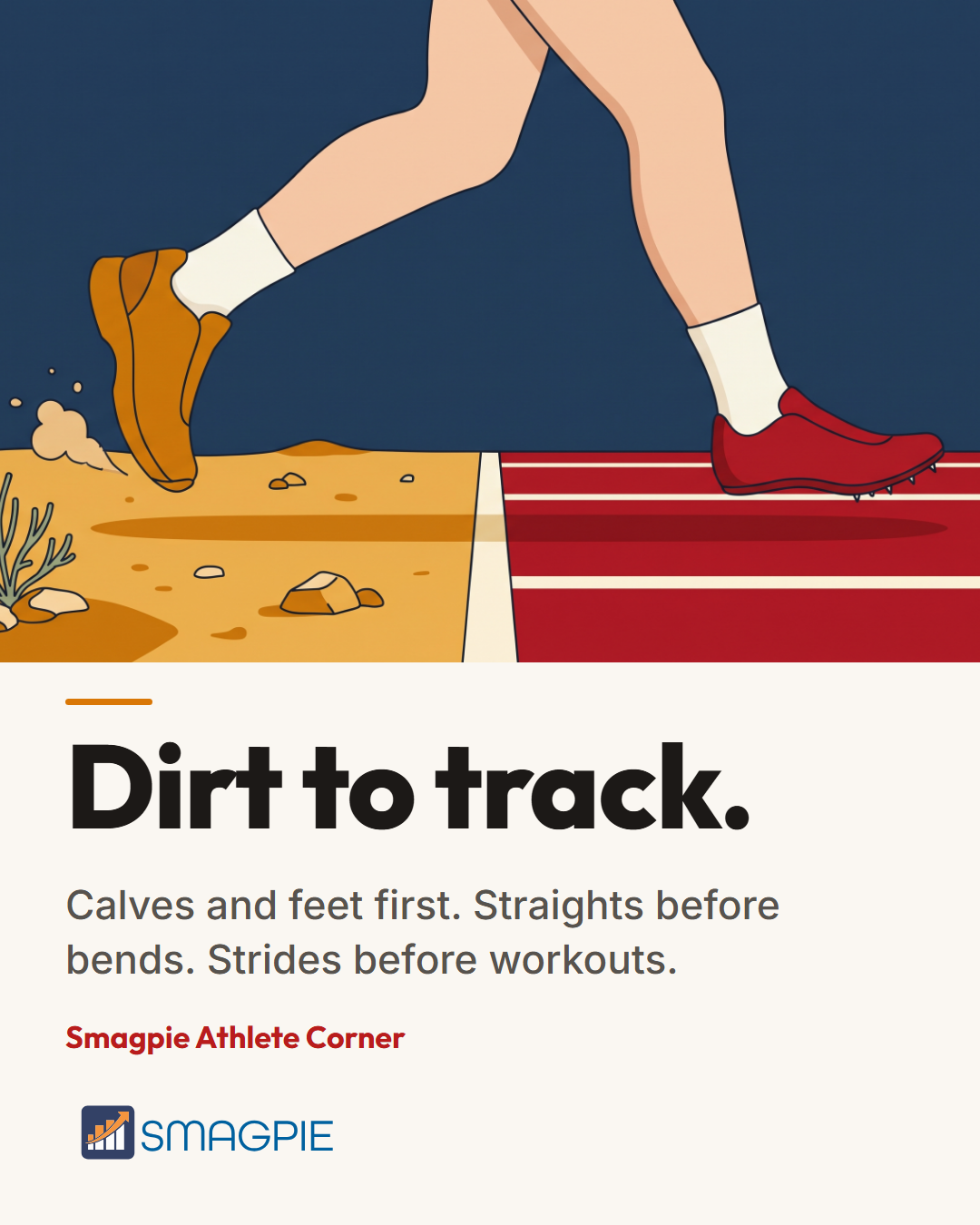
Cross country is dirt and grass, trainers and a lot of steady running. Track is a hard oval, spikes with almost no heel, fast running and bends that always turn the same way. All of that changes in a few weeks, and your calves, Achilles, ankles and knees feel it.
The good news: you have a whole winter to get ready, and the same work that protects your legs makes you faster at the end of a race.
Strength work: why it makes you faster
Runners your age who added jumps, sprints and lifting twice a week for ten weeks got faster at top speed and a little more efficient, without losing any aerobic fitness.1 That’s the last 200 meters of a race.
Why it protects your legs
Strength work is a good bet for staying healthy, but it isn’t a guarantee. The programs that work in studies are the ones people actually do, with a coach watching. So do both sessions, every week.
Your winter, in four parts
1. Reset (2 weeks). Easy running. Learn to squat, lunge and do a single-leg deadlift with light weight. If you have the same ankle or knee pain every year at this switch, tell your coach and see the athletic trainer or a physical therapist now, before the work starts.
2. Build (4 weeks). Lift twice a week. Heavy calf raises, straight-knee and bent-knee, off a step. Tendons get stronger with heavy, slow work, and it takes a couple of months, so start early.2 Do the foot routine in your warm-up (below). Small jumps: pogo hops and skips.
3. Power (4 weeks). Heavier lifts, fewer reps. Bounds, hops and short hill sprints. Running drills like A-skips and B-skips before strides.
4. Onto the track. Fewer jumps. Start wearing spikes about five weeks before your first race, and add one step each week (see the ladder below). Once meets start, keep lifting heavy once a week.
The 8-minute foot routine
Barefoot, as part of your warm-up:
- Short foot: pull the ball of your foot toward your heel without curling your toes, so the arch lifts. 10 times, hold 5 seconds.
- Toe yoga: lift your big toe while the others stay down, then switch.
- Single-leg balance: 30 seconds each side. Close your eyes when it gets easy.
- Ankle rocks: foot flat, heel down, push your knee toward a wall. 10 each side.
- Toe walks and heel walks: 20 meters each.
The research on foot training is mixed. In one study, adult runners who trained their feet got injured much less over a year than runners who didn’t, and it took months to show.3 Another study found a foot and ankle program did no better than stretching.4 It’s 8 minutes and needs nothing, so we keep it short and do it in the warm-up.
Eat for the extra work
You’re adding lifting and jumping on top of your running, so lifting days need more food, not the same plate. A snack with carbs and protein within an hour of lifting is an easy habit. If your period stops or goes missing, or the same bone pain keeps coming back, tell your coach or a parent.
Don’t count stretching as injury prevention
Stretching after a run is fine if you like it, but it doesn’t prevent injuries.5 Before you run, warm up by moving: leg swings, walking lunges, skips. Save long stretches for after.
Bring spikes back slowly
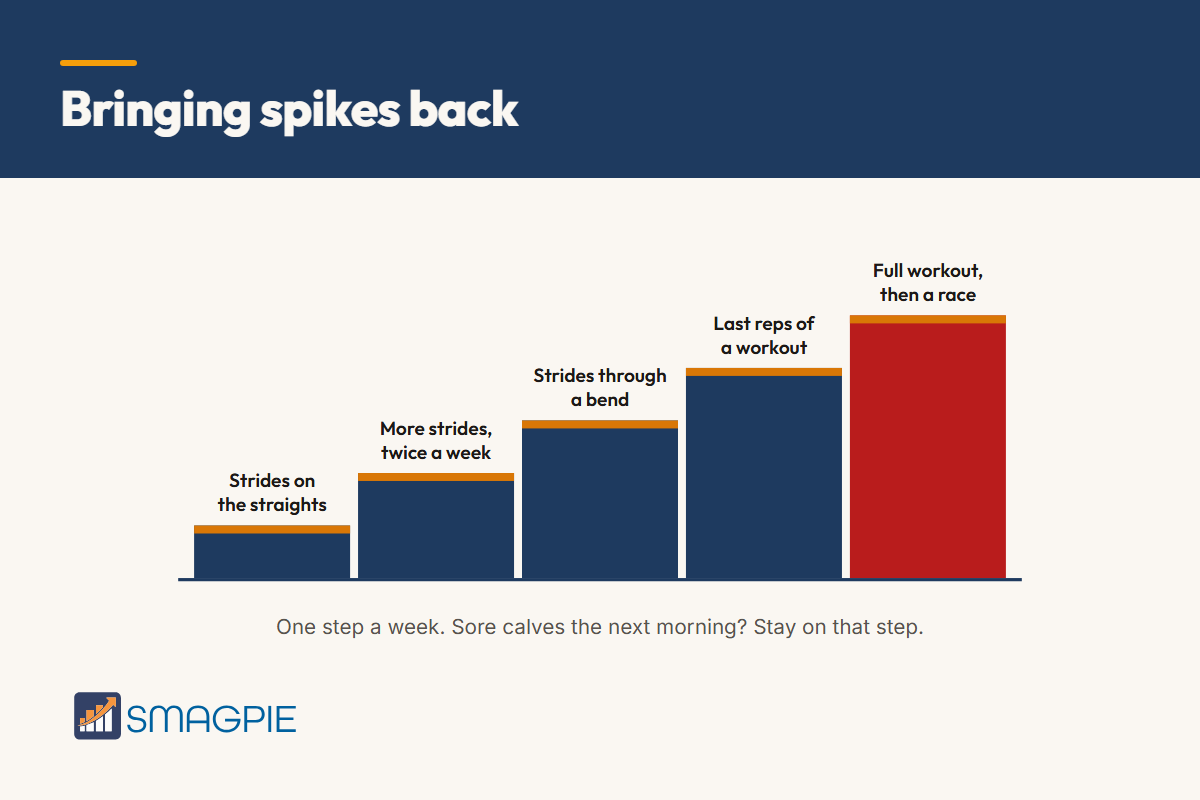
- Straights before bends. First spike strides on the straightaways only. Walk the curves.
- Strides before workouts. Then a few reps of a workout in spikes, then a full workout, then a race.
- One step a week. If your calves are still sore the next morning, stay on that step.
- Easy runs off the track. Dirt, trails or roads.
- Turn the other way. On warm-ups and cooldowns, run the other direction in an outside lane if your track allows it, so the same ankle isn’t on the inside of every bend.
When to tell someone
Tell your coach if pain changes how you run, gets worse during a run, or is still there the next morning. Saying so early is part of the job, not weakness. Pain in one spot on a bone, or pain at night, needs to be checked by a doctor or athletic trainer. More on that in Your Bones Are Still Being Built.
Sources
- Blagrove RC, Howe LP, Cushion EJ, et al.. Effects of strength training on postpubertal adolescent distance runners. Med Sci Sports Exerc 2018;50(6):1224–1232, 2018. https://pubmed.ncbi.nlm.nih.gov/29315164/ ↩
- Bohm S, Mersmann F, Arampatzis A.. Human tendon adaptation in response to mechanical loading: a systematic review and meta-analysis of exercise intervention studies on healthy adults. Sports Med Open 2015;1:7, 2015. https://pubmed.ncbi.nlm.nih.gov/27747846/ ↩
- Taddei UT, Matias AB, Duarte M, Sacco ICN.. Foot core training to prevent running-related injuries: a survival analysis of a single-blind, randomized controlled trial. Am J Sports Med 2020;48(14):3610–3619, 2020. https://pubmed.ncbi.nlm.nih.gov/33156692/ ↩
- Leppänen M, Viiala J, Kaikkonen P, et al.. Hip and core exercise programme prevents running-related overuse injuries in adult novice recreational runners: a three-arm randomised controlled trial (Run RCT). Br J Sports Med 2024;58(13):722–732, 2024. https://pubmed.ncbi.nlm.nih.gov/38724071/ ↩
- Lauersen JB, Bertelsen DM, Andersen LB.. The effectiveness of exercise interventions to prevent sports injuries: a systematic review and meta-analysis of randomised controlled trials. Br J Sports Med 2014;48(11):871–877, 2014. https://pubmed.ncbi.nlm.nih.gov/24100287/ ↩