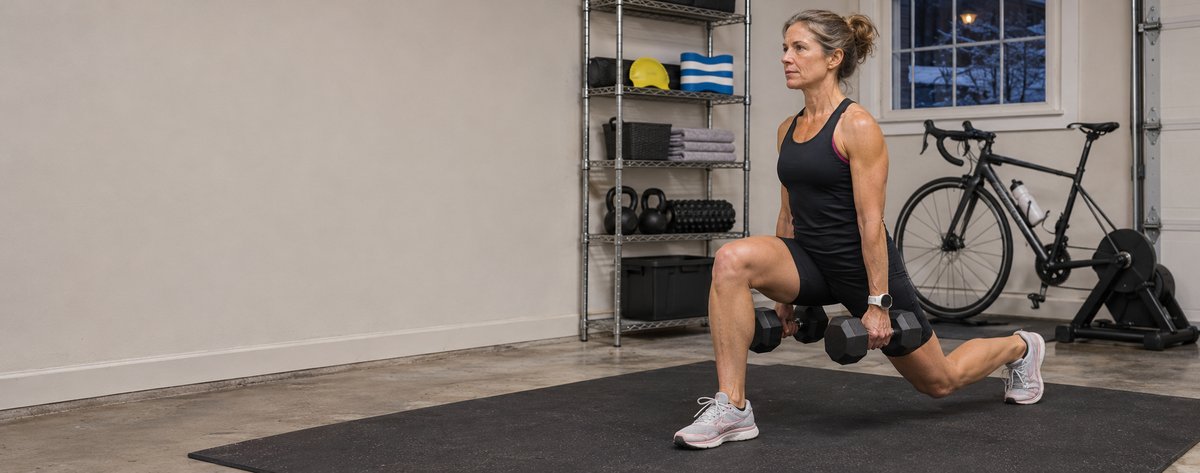
Cross country ends in November. Track starts in the spring. In between, three things change at once: dirt and grass turn into a hard, flat oval; trainers turn into spikes with almost no heel; and much more of the running is fast. That’s when the Achilles, ankle, shin and knee complaints show up.
This is the block I’d use for that gap, written for high school distance runners in their third season and up: they’ve done the running, but most have never had a real strength program. Most of what follows is coaching practice, because nobody has run a trial of a whole cross-country-to-track winter. Where a line rests on evidence, I say so. Where it’s practice, I say that too.
Two notes before you start. Check your state association’s out-of-season rules. In many states a high school coach can’t require winter sessions, or can’t run them at all, so this may need to be an open weight room or a club program. And college runners: your winter is usually the indoor season, with a strength coach. The parts that still apply are the calf and foot work, the jump progression and the spike ladder.
Why the switch hurts
No study has looked at the switch itself. What we do know points at three loads arriving in the same few weeks.
- Track carries its own injury load, more of it for girls. In US high school track, injuries came at about 0.84 per 1,000 practices and meets. Girls were injured at 1.37 times the rate of boys overall and 1.6 times in practice, and overuse injuries made up more than a third of girls’ injuries. Sprints, distance and jumps together accounted for about two-thirds of all track injuries.1
- Spikes change the ankle’s job. In a lab study of 17 collegiate women running at 5K pace, a traditional spike bent the ankle further and put more pressure under the foot than a newer foam-and-plate spike.2 That’s one small study with no injury data, but it fits what coaches see: a low-heeled spike asks more of the calf and Achilles.
- Bends load the inside leg. On a curve, the inside leg can’t push as hard, and the ankle seems to reach its limit.3 That study used flat-out sprints on a far tighter curve than any track, so it tells us the direction, not how much.
- The first big session is often a jump in load. In a 5,200-runner study of adults, the risky session was a single run much longer than the runner’s longest of the last month.4 That was distance, not speed, but the first long workout of spring often fits the pattern. More in our load-spikes article.
So the plan is simple: build the calves, feet and hips before the spikes come out, then add spikes, bends and speed one at a time instead of all at once.
What the block can and can’t promise
Speed: yes, with good evidence. Adding strength and jump work to a distance runner’s training makes them faster at the top end, and slightly more economical, without costing aerobic fitness. Two trials in older teens agree. In one, 16 and 17 year olds (13 of the 25 who started were girls) did jumps, sprints and lifting twice a week for ten weeks: their sprint speed improved and their running economy improved slightly, with no loss of VO₂max.5 In the other, 16 to 18 year olds swapped about a fifth of their running for explosive training for eight weeks and ran about 3% faster on a maximal anaerobic running test, again with no aerobic loss.6 In adult competitive runners, six weeks of jumps took 3.9% off a 2.4 km time trial,7 and nine weeks of explosive training improved 5K time without changing VO₂max.8 Nobody has measured race times in teens. The speed that shows up is the kind a finishing kick uses, which is why I expect it in the last 200 meters. That’s my reading, not a measured result.
Injuries: a good bet, not a promise. Across sport, strength training programs had about two-thirds fewer injuries than the comparison groups, but those trials were mostly team sports.9 When researchers pooled nine injury-prevention trials in runners, most of them at high risk of bias, the programs didn’t show a clear effect either way.10 One reason: programs handed out and done alone don’t get done. In a marathon trial, runners completed about two of their three weekly sessions and the program made no difference.11 Coached programs look better. In adult beginners, mostly women, physiotherapist-supervised hip and core work cut the weekly share of runners with an overuse injury by 39% compared with a stretching group.12 So: coach it, and count the sessions done.
Lifting is safe for teenagers when it’s supervised and technique comes before load.13 A runner who is still growing fast gets the technique-first weeks for longer.
The block at a glance
| Weeks | Phase | The job | Running |
|---|---|---|---|
| 1–2 | Reset | Easy weeks. Learn the lifts and the foot routine, light | Easy, shorter, no workouts |
| 3–6 | Foundation | Lift twice a week, build to moderate loads. Heavy calf work starts. Small jumps. One light week | Base running returns; strides on dirt or grass |
| 7–10 | Power | Lift heavy twice a week. Bigger jumps, hill sprints, drills | Base plus one workout; strides |
| 11–14 | Onto the track | Lift heavy once or twice a week. Fewer jumps. The spike ladder starts five weeks before the first race in spikes | Track workouts begin, partly in trainers |
The running plan is yours; this block sits beside it. If the gap is shorter, cut from Power, not from Foundation. The weeks that build tendon and technique can’t be rushed.
A sample week (weeks 7–10)
Hard days stay hard, easy days stay easy: the jumps, drills and lifting go on the workout days.
| Day | Session |
|---|---|
| Monday | Warm-up and foot routine, drills, jumps, workout, then Lift A |
| Tuesday | Easy run, strides |
| Wednesday | Easy run |
| Thursday | Warm-up and foot routine, drills, jumps, hill sprints, then Lift B |
| Friday | Easy run or off, strides |
| Saturday | Long run |
| Sunday | Off |
Running it with a team
- 45 minutes, three stations. One for the squat or deadlift, one for single-leg work, one for calves, feet and core. Groups rotate. The coach stands at the squat station; partners count reps and watch knees.
- No weight room? A backpack with books, a stair or bleacher, and one pair of dumbbells covers it: step-ups, split squats and single-leg deadlifts with the backpack, single-leg calf raises off a stair, bridges and side planks.
- Kids in a winter sport (basketball, swimming, Nordic) get the minimum: the calf work twice a week, the foot routine and, when they come out, the spike ladder. They’re often the ones hurt in March.
- Kids who skip. If an athlete averages fewer than about 1.5 sessions a week for two weeks, they repeat Foundation and start the spike ladder later. (Practice.)
Weeks 1–2: Reset
What to do: easy running, fewer days, no workouts. Two short strength sessions with light loads or body weight, to learn the movements. Start the foot and ankle routine.
Why: a short break lets the season’s small aches settle, and it’s the time to learn how to squat and hinge before anything is heavy. Don’t take more than about two weeks completely off running unless the athlete is hurt. (Practice.)
This is also the time to deal with pain left over from cross country. If an athlete gets the same ankle or knee pain at every switch, one visit to a physical therapist or athletic trainer before the block starts is worth more than any exercise list. Pain in one spot on a bone, pain at night, or pain that makes the runner limp needs to be checked for a bone stress injury; see our bone stress article.
Weeks 3–6: Foundation
Lifting: two sessions a week
| Session A | Session B |
|---|---|
| Goblet squat (back squat or trap-bar deadlift once technique is solid) | Step-up onto a knee-height box |
| Single-leg Romanian deadlift | Rear-foot-elevated split squat |
| Straight-knee calf raise, heavy, off a step | Bent-knee calf raise (seated, or in a wall sit), heavy |
| Calf hold: 3–5 × 30–45 s at the top of a single-leg raise | Single-leg glute bridge |
| Side plank | Banded side walk, then side plank with top leg raised |
| Weeks | Sets × reps | Reps in reserve |
|---|---|---|
| 1–2 | 2 × 10–12, light | 4 or more |
| 3–4 | 3 × 10, with a weight they could lift about 12 times | 2–3 |
| 5–6 | 3 × 6–8 | 2 |
| Light week (6 or 7) | About 60% of the sets, no jumps | 3 or more |
| 7–10 | 3–4 × 4–6, a weight they could lift 6–8 times | 2 (calf raises and split squats: 1–2) |
| 11–14 | 2–3 × 4–6, still heavy | 2 |
The goblet squat is the default. The back squat and trap-bar deadlift are earned, once a coach has seen the athlete’s technique. Put the light week where exams or the holidays fall; in most schools that’s week 6 or 7.
The calves get the most attention, because the calf and Achilles take the biggest jump in work when the spikes come out. In adults, heavy loading (above about 70% of maximum) made tendons stiffer over programs of eight weeks or more, with bigger changes at twelve weeks or more. Slow and held contractions worked as well as anything else.14 Stiffer is not the same as injury-proof, but it’s why heavy calf work starts in week 3, not in February. The calf hold is the same idea as in our isometric strength article: a hard hold with no impact, which doesn’t leave the legs tired for running.
Do calf raises both ways: straight-knee for the big calf muscle, bent-knee for the deeper one underneath (the soleus). Hold a dumbbell or wear a loaded backpack once body weight gets easy. (Practice.)
The foot and ankle routine (8 minutes, in the warm-up)
| Exercise | Dose |
|---|---|
| Short foot: pull the ball of the foot toward the heel without curling the toes, so the arch lifts | 3 × 10, 5 s hold |
| Toe yoga: big toe up while the others press down, then switch | 2 × 10 each way |
| Toe press: press all toes into the floor, hold | 3 × 20 s |
| Single-leg balance, eyes closed when it’s easy | 3 × 30 s each leg |
| Ankle rocks: knee to wall, heel down | 2 × 10 each leg |
| Toe walks and heel walks | 2 × 20 m each |
The evidence on foot training is mixed, so this routine is short. In one trial, adult recreational runners who didn’t do a foot-strengthening program got injured at about 2.4 times the rate of those who did over a year, and the difference showed up after four to eight months.15 But in the hip-and-core trial above, a third group did an ankle-and-foot program: it did no better than stretching for overuse injuries and had more acute injuries.12 I keep a short routine because it’s cheap and the winter is long, not because the question is settled. It isn’t either trial’s protocol.
The knee
Most knee pain in runners is at the front of the knee, around the kneecap. In a trial with army recruits, four strengthening and four stretching exercises, done in supervised training sessions seven times a week, cut new cases of front-of-knee pain from 4.8% to 1.3% over 14 weeks.16 Those were recruits on a hard course, not runners, the dose was far higher than two sessions a week, and the stretching can’t be separated from the strengthening. Sessions A and B share some of the same movements, nothing more. For a runner who already has kneecap pain, exercise for the hips and knee together is the recommended treatment,17 and a physical therapist should set it.
Mobility: a warm-up, not a stretching session
Stretching on its own doesn’t prevent injuries: in a review of injury-prevention trials, the stretching programs showed no benefit.18 Short static stretches, under a minute per muscle, barely touch performance, and the small effect disappears when dynamic work follows. Holds of a minute or more cost about 4 to 5%.19 So mobility in this block means a dynamic warm-up before every session, and range of motion built through the lifts themselves (a full split squat, a deep step-up).
The 10-minute warm-up (practice): easy jog, then leg swings front-to-back and side-to-side, walking lunges with a reach overhead, ankle rocks to the wall, walking hamstring sweeps, lateral shuffles and carioca. If an athlete likes a short stretch after a run, that’s fine. It just isn’t injury prevention.
Check ankle range with the knee-to-wall test: foot flat, heel down, how far from the wall can the knee still touch it? Compare left with right. A big difference, or an ankle that was recently sprained, is worth showing to the athletic trainer. (Practice.)
Small jumps
Twice a week after the warm-up, before the run: two-footed pogo hops, line hops forward-back and side to side, skipping for height. 40 to 60 foot contacts in total, on grass, turf, a gym floor or a mat, never concrete. The goal is quick, quiet landings with the knee over the toes. Landing training is one of the best-supported ways to protect girls’ knees in court and field sports, and it worked best in mid-teens.20 Distance runners don’t tear ACLs often; I coach landings now because a sloppy landing on a pogo becomes a sloppy landing on a bound. (Practice.)
Fueling a heavier winter
This block adds work: two lifts and two jump sessions a week on top of the running. Lifting days need more food, not the same plate. A snack with carbohydrate and protein within an hour of lifting is an easy habit. A winter of added work on the same intake is how low energy availability starts, and in girls that’s how stress fractures start. Signs to raise with the athlete or a parent: periods that stop or go missing, the same bone pain coming back, legs that stay flat, getting sick often. The full picture is in our bone stress article.
Weeks 7–10: Power
Lifting goes heavy
Same exercises, 3 to 4 sets of 4 to 6, with a weight the athlete could lift 6 to 8 times when fresh, stopping with two reps left. Calf raises and split squats can go to one left; barbell lifts stay at two. Don’t test a one-rep max. (Practice.)
Bigger jumps
| Weeks | Exercises | Foot contacts |
|---|---|---|
| 3–6 | Pogos, line hops, skips for height | 40–60 |
| 7–8 | Bounding (alternate legs), hops over low hurdles, single-leg hops in place | 60–80 |
| 9–10 | Bounding for distance, single-leg hops forward, drop jumps from a low box (20–30 cm) | 80 at most |
| 11–14, once spikes start | Short, sharp sets of the above | 60 at most |
The two teen trials above ran for eight and ten weeks; the ten-week one used two sessions a week, alongside lifting and sprints.56 The contact counts and box heights here are practice. Stop a set when the landings get loud or slow. Jumps come down when the spikes come out, so the Achilles never gets both at full dose.
Hill sprints and strides
Once a week: 6 to 8 hill sprints of 8 to 10 seconds, all-out, on a moderate, dry hill (or a treadmill at an incline), walking back down for full recovery. If the hill is icy, skip it. Strides (6 × 100 m, building to fast) twice a week, in trainers. (Practice.)
Drills: twice a week, before the jumps
A-march, then A-skip; B-skip; high-knee run; butt kicks; straight-leg bounds; carioca. Two passes of 20 to 30 m each. No study shows drills make distance runners more economical. I use them as practice at the posture of running fast, which is what the track asks for, and the bounding drills count as jumps. (Practice.)
Weeks 11–14: Onto the track
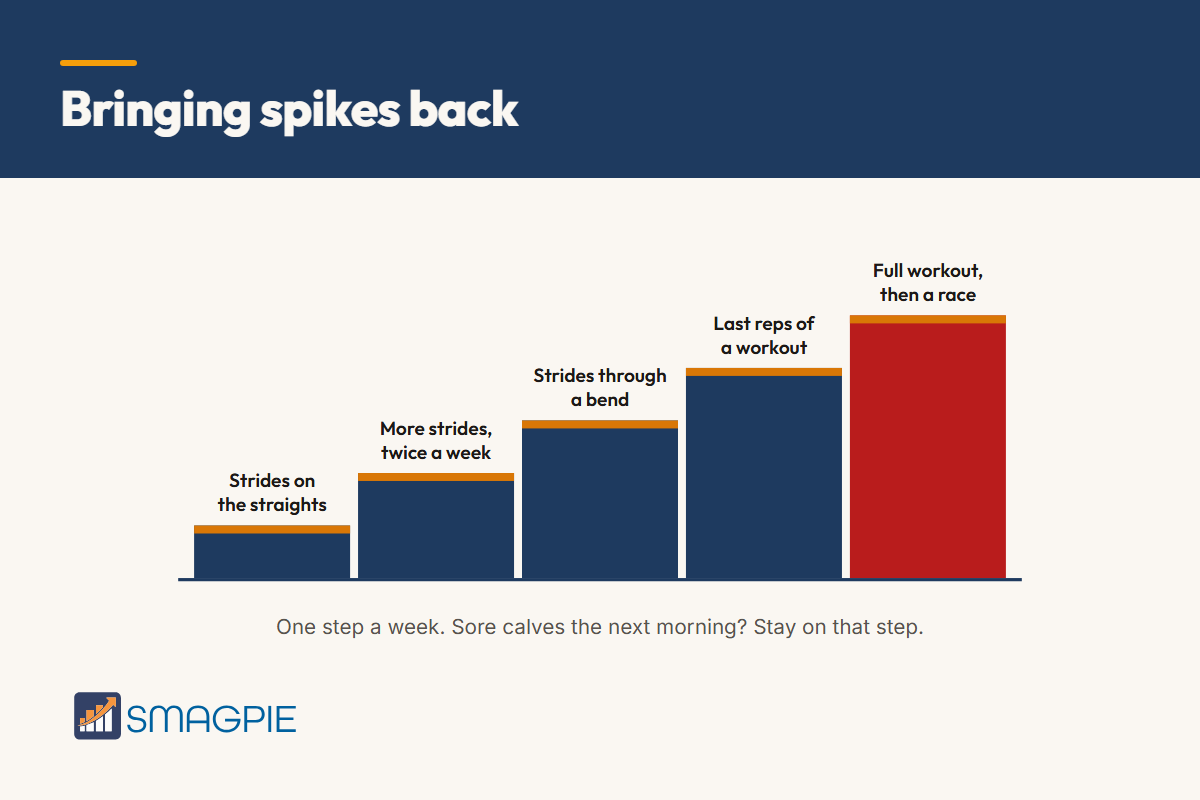
Count the ladder back from the first race in spikes: start it five weeks out. In the north, where the track may be under snow until March, that can mean the first steps happen once spring practice opens. Move up one step a week if the calves feel normal the next morning. If they don’t, repeat the step. (Practice.)
| Weeks before the first race | In spikes | Notes |
|---|---|---|
| 5 | 4 × 80 m strides, straights only, once | Walk the bends |
| 4 | 6 × 100 m strides, straights only, twice | |
| 3 | Strides through one bend; the last 2–3 reps of one workout | The rest of the workout in trainers |
| 2 | One full workout in spikes | Second workout in trainers |
| 1 | Race week | Warm-up and cooldown in trainers |
Three habits for the whole spring (practice):
- Easy runs off the track. Dirt, grass, trails or roads. The track is for workouts.
- Spread the bends. On warm-ups and cooldowns, run the other direction in an outside lane where the facility allows it, so the same ankle isn’t on the inside of every bend.
- Keep the first long session short. The first long track workout of the season is often far more running at speed than anything in the previous month.
And in season: pain that changes how a runner runs, gets worse during a run, or is still there the next morning means stop that step and tell the coach. Tell the team at the start that reporting it early is expected, not weakness.
Fast track: ready for indoor
In some states, indoor meets start in early or mid December, two to four weeks after the last cross-country race. That’s too soon for spikes. Start this the Monday after cross country ends and plan the first spike race for January; the holiday break will take a week anyway. The trade is honest: you skip most of the weeks that build the tendons. An athlete with a history of pain at the switch shouldn’t take the fast track.
| Week | Lifting | Jumps and drills | Spikes |
|---|---|---|---|
| 1 | Learn the lifts, light; foot routine starts | None | None |
| 2 | 2 sessions, 3 × 8–10; heavy calf work starts | Pogos and skips, 40 contacts | None |
| 3 | 2 sessions, 3 × 6–8 | Drills; 40–60 contacts | Strides on the straights |
| 4 | 2 sessions, 3 × 6 | Drills; 40 contacts | Strides through a bend; part of a workout |
| 5 | 1–2 sessions, heavy and short | Short, sharp | First full spike workout or race |
An indoor 200 m track’s bends are about half the radius of an outdoor track’s, and banked, and a runner goes round twice as many of them per mile. Keep spike work on the bends to strides and short reps until the calves are used to it, and do the easy running off the track. Running the other way usually isn’t allowed indoors. When indoor ends, outdoor starts within days, so keep one heavy lift and short jumps going straight through.
Week 14: what you should see
- Both strength sessions done most weeks. If not, that’s the first thing to fix.
- Single-leg calf raises off a step, with control, for 20 or more on each side, with no big difference between legs. (Practice.)
- Quick, quiet landings on bounds and hops.
- Spike sessions with calves that feel normal the next morning.
- In season, one heavy lift a week and a short set of jumps. Don’t drop the lifting when the meets start.
Sources
- Pierpoint LA, Williams CM, Fields SK, Comstock RD.. Epidemiology of injuries in United States high school track and field: 2008-2009 through 2013-2014. Am J Sports Med 2016;44(6):1463–1468, 2016. https://pubmed.ncbi.nlm.nih.gov/26920435/ ↩
- Geisler C, Hannigan JJ.. A biomechanical comparison of track spikes with advanced footwear technology to a traditional track spike in female distance runners. Sports Biomech 2024;23(11):3667–3679, 2024. https://pubmed.ncbi.nlm.nih.gov/39192705/ ↩
- Luo G, Stefanyshyn D.. Limb force and non-sagittal plane joint moments during maximum-effort curve sprint running in humans. J Exp Biol 2012;215(24):4314–4321, 2012. https://pubmed.ncbi.nlm.nih.gov/22972890/ ↩
- Schuster Brandt Frandsen J, et al.. How much running is too much? Identifying high-risk running sessions in a 5200-person cohort study. Br J Sports Med 2025;59(17):1203–1210, 2025. https://bjsm.bmj.com/content/59/17/1203 ↩
- Blagrove RC, Howe LP, Cushion EJ, Spence A, Howatson G, Pedlar CR, Hayes PR.. Effects of strength training on postpubertal adolescent distance runners. Med Sci Sports Exerc 2018;50(6):1224–1232, 2018. https://pubmed.ncbi.nlm.nih.gov/29315164/ ↩
- Mikkola J, Rusko H, Nummela A, Pollari T, Häkkinen K.. Concurrent endurance and explosive type strength training improves neuromuscular and anaerobic characteristics in young distance runners. Int J Sports Med 2007;28(7):602–611, 2007. https://pubmed.ncbi.nlm.nih.gov/17373596/ ↩
- Ramírez-Campillo R, Alvarez C, Henríquez-Olguín C, et al.. Effects of plyometric training on endurance and explosive strength performance in competitive middle- and long-distance runners. J Strength Cond Res 2014;28(1):97–104, 2014. https://pubmed.ncbi.nlm.nih.gov/23838975/ ↩
- Paavolainen L, Häkkinen K, Hämäläinen I, Nummela A, Rusko H.. Explosive-strength training improves 5-km running time by improving running economy and muscle power. J Appl Physiol 1999;86(5):1527–1533, 1999. https://pubmed.ncbi.nlm.nih.gov/10233114/ ↩
- Lauersen JB, Andersen TE, Andersen LB.. Strength training as superior, dose-dependent and safe prevention of acute and overuse sports injuries: a systematic review, qualitative analysis and meta-analysis. Br J Sports Med 2018;52(24):1557–1563, 2018. https://pubmed.ncbi.nlm.nih.gov/30131332/ ↩
- Wu H, Brooke-Wavell K, Fong DTP, Paquette MR, Blagrove RC.. Do exercise-based prevention programs reduce injury in endurance runners? A systematic review and meta-analysis. Sports Med 2024;54(5):1249–1267, 2024. https://pubmed.ncbi.nlm.nih.gov/38261240/ ↩
- Toresdahl BG, McElheny K, Metzl J, Ammerman B, Chang B, Kinderknecht J.. A randomized study of a strength training program to prevent injuries in runners of the New York City Marathon. Sports Health 2020;12(1):74–79, 2020. https://pubmed.ncbi.nlm.nih.gov/31642726/ ↩
- Leppänen M, Viiala J, Kaikkonen P, et al.. Hip and core exercise programme prevents running-related overuse injuries in adult novice recreational runners: a three-arm randomised controlled trial (Run RCT). Br J Sports Med 2024;58(13):722–732, 2024. https://pubmed.ncbi.nlm.nih.gov/38724071/ ↩
- Lloyd RS, Faigenbaum AD, Stone MH, et al.. Position statement on youth resistance training: the 2014 International Consensus. Br J Sports Med 2014;48(7):498–505, 2014. https://pubmed.ncbi.nlm.nih.gov/24055781/ ↩
- Bohm S, Mersmann F, Arampatzis A.. Human tendon adaptation in response to mechanical loading: a systematic review and meta-analysis of exercise intervention studies on healthy adults. Sports Med Open 2015;1:7, 2015. https://pubmed.ncbi.nlm.nih.gov/27747846/ ↩
- Taddei UT, Matias AB, Duarte M, Sacco ICN.. Foot core training to prevent running-related injuries: a survival analysis of a single-blind, randomized controlled trial. Am J Sports Med 2020;48(14):3610–3619, 2020. https://pubmed.ncbi.nlm.nih.gov/33156692/ ↩
- Coppack RJ, Etherington J, Wills AK.. The effects of exercise for the prevention of overuse anterior knee pain: a randomized controlled trial. Am J Sports Med 2011;39(5):940–948, 2011. https://pubmed.ncbi.nlm.nih.gov/21212307/ ↩
- Collins NJ, Barton CJ, van Middelkoop M, et al.. 2018 Consensus statement on exercise therapy and physical interventions (orthoses, taping and manual therapy) to treat patellofemoral pain. Br J Sports Med 2018;52(18):1170–1178, 2018. https://pubmed.ncbi.nlm.nih.gov/29925502/ ↩
- Lauersen JB, Bertelsen DM, Andersen LB.. The effectiveness of exercise interventions to prevent sports injuries: a systematic review and meta-analysis of randomised controlled trials. Br J Sports Med 2014;48(11):871–877, 2014. https://pubmed.ncbi.nlm.nih.gov/24100287/ ↩
- Behm DG, Blazevich AJ, Kay AD, McHugh M.. Acute effects of muscle stretching on physical performance, range of motion, and injury incidence in healthy active individuals: a systematic review. Appl Physiol Nutr Metab 2016;41(1):1–11, 2016. https://pubmed.ncbi.nlm.nih.gov/26642915/ ↩
- Myer GD, Sugimoto D, Thomas S, Hewett TE.. The influence of age on the effectiveness of neuromuscular training to reduce anterior cruciate ligament injury in female athletes: a meta-analysis. Am J Sports Med 2013;41(1):203–215, 2013. https://pubmed.ncbi.nlm.nih.gov/23048042/ ↩