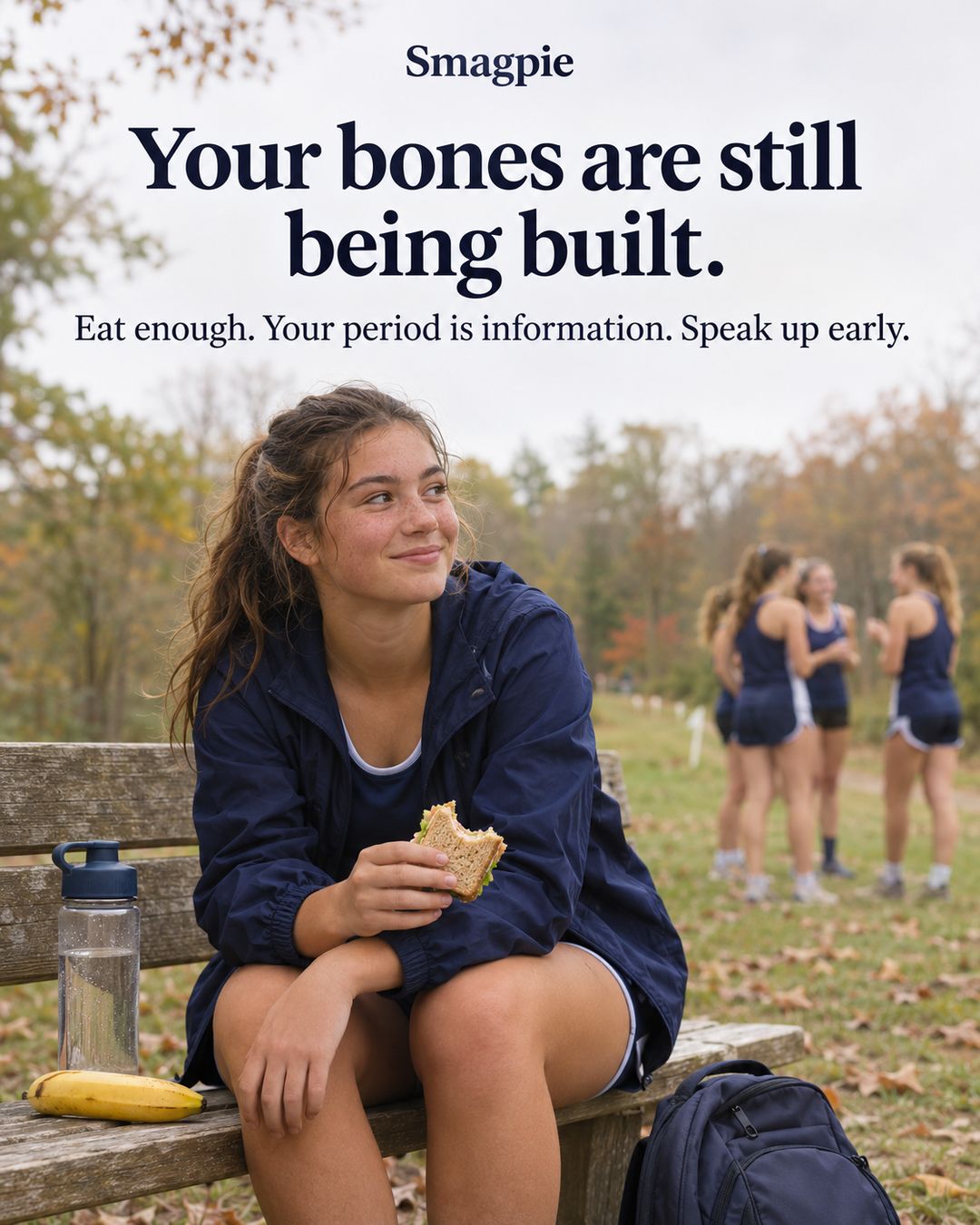
It’s not bad luck
Girls’ cross country has more stress fractures than any of the other high school sports that national injury surveillance tracks, about twice as many as boys’ cross country.1 If you’ve seen a teammate’s season end with a boot on her foot, you’ve seen it.
That doesn’t mean running breaks girls. Most girls never get a stress fracture.2 It means that when they happen, they usually come from a few things stacking up, and most of those things can be noticed and fixed.
The things that stack
Think of it as a pile. One thing on the pile raises the odds a little. Several together raise them a lot. In one study that followed active girls and young women, about 1 in 6 of those with one risk factor got a bone stress injury. With several risk factors, it was between 1 in 3 and 1 in 2.3
The ones you can do something about:
- Not eating enough for what you’re doing. Growing and training both cost energy, and so does just being alive. If the food doesn’t cover all of it, your body cuts back on things it thinks it can skip, and building bone is one of them. Most of the time this isn’t on purpose. You grew, your mileage went up, and your lunch didn’t change.
- Your period going missing or getting irregular. That is one of the ways your body tells you it isn’t getting enough fuel.
- A stress fracture you’ve already had. That is the strongest single predictor of another one.2 If you’ve had one, it’s the best reason to make sure the other things on this list get checked.
- Running and nothing else, all year. In one small study, girls who ran nine or more months a year with no other sport were more likely to have low bone density.4
Your bones are still being built
About 39% of the bone you’ll have as an adult gets built in the four years around your growth spurt.5 For most girls, that’s middle school and high school, right now. Bone you build now is bone you run on for the rest of your life. That’s the real reason to fuel well: not to avoid breaking, but to build.
What to do
Eat enough, and eat often. Breakfast, lunch, something after school before practice, and dinner. Hungry is information too. If practice is at 3:30 and lunch was at 11, pack a snack. Our fueling piece has more.
Treat your period as information. Losing your period does not mean you’re fit or training hard enough. If it stops, gets irregular or hasn’t started by about 15, tell a parent, your athletic trainer or your doctor. It’s training-health information, the same as a sore shin. You don’t have to tell your coach first. On the pill? The bleed you get each month comes from the pill, not your body, so it can’t tell you whether you’re eating enough. Tell your doctor you’re a distance runner, and make any change to the pill with them, not on your own.
Say something early. A sore shin is common. Pain at the hip, groin, pelvis or the top of your foot is not “just tight”. Those are the injuries that take longest to come back from.6 Tell a parent, your athletic trainer or school nurse, and your coach. You can just say: “It hurts at the top of my foot and it isn’t getting better.”
Build your long run gradually. Grow it from the longest run you’ve done recently, not from a big jump because it’s a weekend.
Make strength work part of running. With good coaching it’s safe for teens,7 and across many sports it lowers injuries.8 Nobody has tested yet whether it prevents stress fractures in teen runners.
If you love another sport, keep it. A season of soccer or basketball isn’t a step back from running.
Look out for each other. Don’t comment on teammates’ bodies or what they eat, even as a compliment. “You look so lean” can do more damage than you’d guess.
If thinking about food feels stressful or hard to control, tell a parent, your school counselor or your doctor. That’s a strong thing to do, not a failure.
Sources
- Changstrom BG, Brou L, Khodaee M, Braund C, Comstock RD.. Epidemiology of stress fracture injuries among US high school athletes, 2005-2006 through 2012-2013. Am J Sports Med 2015;43(1):26–33, 2015. https://pubmed.ncbi.nlm.nih.gov/25480834/ ↩
- Tenforde AS, Sayres LC, McCurdy ML, Sainani KL, Fredericson M.. Identifying sex-specific risk factors for stress fractures in adolescent runners. Med Sci Sports Exerc 2013;45(10):1843–1851, 2013. https://pubmed.ncbi.nlm.nih.gov/23584402/ ↩
- Barrack MT, Gibbs JC, De Souza MJ, et al.. Higher incidence of bone stress injuries with increasing female athlete triad-related risk factors: a prospective multisite study of exercising girls and women. Am J Sports Med 2014;42(4):949–958, 2014. https://pubmed.ncbi.nlm.nih.gov/24567250/ ↩
- Rauh MJ, Tenforde AS, Barrack MT, Rosenthal MD, Nichols JF.. Sport specialization and low bone mineral density in female high school distance runners. J Athl Train 2020;55(12):1239–1246, 2020. https://pubmed.ncbi.nlm.nih.gov/33176358/ ↩
- Baxter-Jones AD, Faulkner RA, Forwood MR, Mirwald RL, Bailey DA.. Bone mineral accrual from 8 to 30 years of age: an estimation of peak bone mass. J Bone Miner Res 2011;26(8):1729–1739, 2011. https://pubmed.ncbi.nlm.nih.gov/21520276/ ↩
- Hoenig T, Eissele J, Strahl A, et al.. Return to sport following low-risk and high-risk bone stress injuries: a systematic review and meta-analysis. Br J Sports Med 2023;57(7):427–432, 2023. https://pubmed.ncbi.nlm.nih.gov/36720584/ ↩
- Lloyd RS, Faigenbaum AD, Stone MH, et al.. Position statement on youth resistance training: the 2014 International Consensus. Br J Sports Med 2014;48(7):498–505, 2014. https://pubmed.ncbi.nlm.nih.gov/24055781/ ↩
- Lauersen JB, Bertelsen DM, Andersen LB.. The effectiveness of exercise interventions to prevent sports injuries: a systematic review and meta-analysis of randomised controlled trials. Br J Sports Med 2014;48(11):871–877, 2014. https://pubmed.ncbi.nlm.nih.gov/24100287/ ↩