Most cross-country coaches who have coached girls for a few years can name one. She trained well all summer and was in the top five by September. Then in October she had a sore shin that wasn’t a sore shin, and her season was over. Sometimes it happened again the next year.
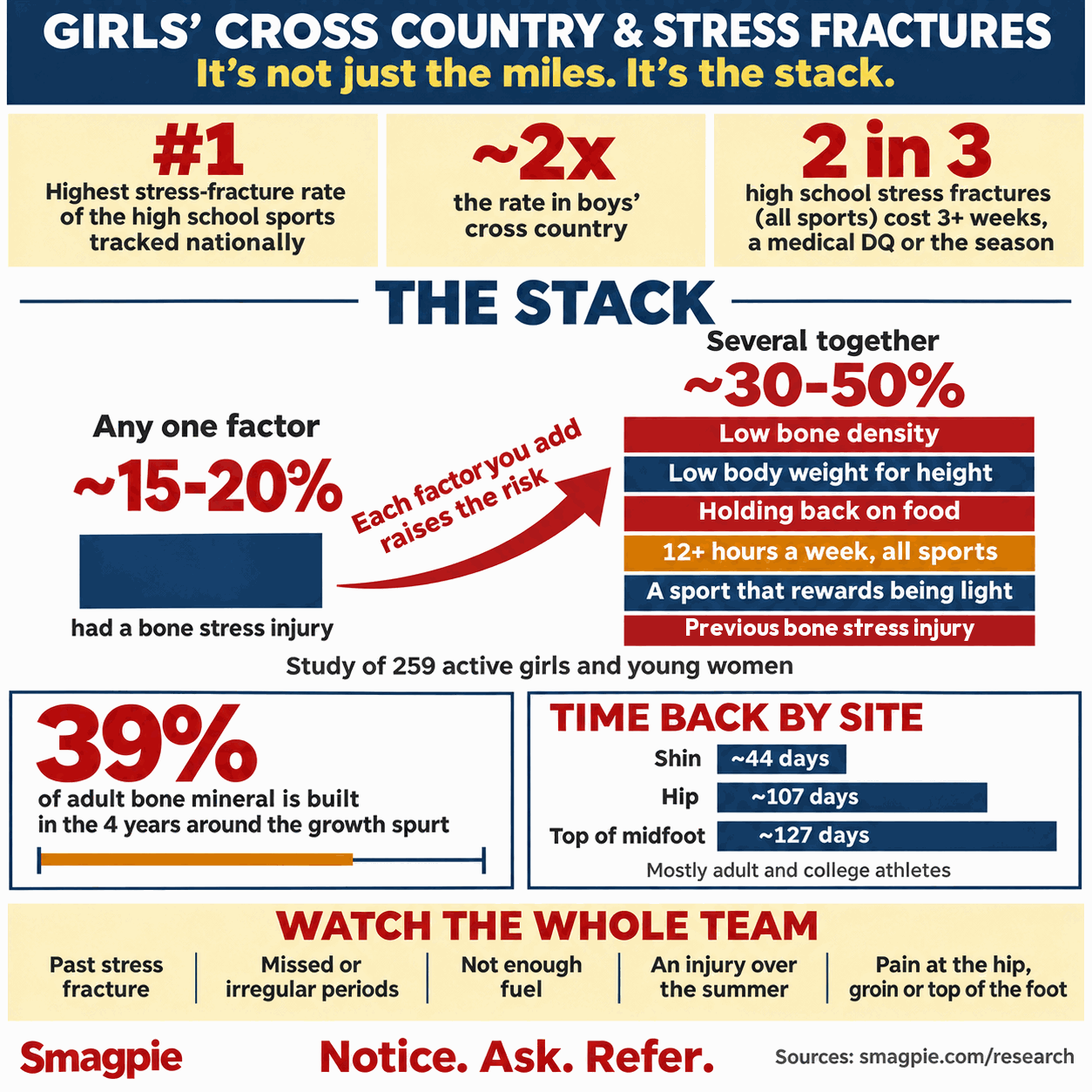
That pattern is real, and it has a shape. Among the high school sports tracked by US national injury surveillance, girls’ cross country has the highest stress-fracture rate, about twice the rate in boys’ cross country.1 Across all sports in the same data, about two out of three stress fractures cost an athlete three weeks or more, a medical disqualification or the rest of the season.1
What makes girls different is not that they are fragile. It is that, in a distance runner, fuel, periods and bone are linked, and they tend to go wrong together while the training itself looks normal. This article covers how often bone stress injuries happen, why they cluster where they do, what plausibly lowers the odds, and the signs a coach can pick up without a lab. It is also honest about how much of this has never been tested in high school girls.
How often, and where
Stress fractures are rare per practice. In the national surveillance data they make up less than 1% of all high school injuries.1 They cluster in girls’ distance running, not in every girl.
A different way of counting gives a picture closer to what coaches live through. One study followed 748 high school runners in California for an average of a little over two seasons. In that time, 5.4% of the girls and 4.0% of the boys had a stress fracture.2 As rough arithmetic, that is about one girl every two seasons on a 20-girl team. In the girls, the shin bone (tibia) was the most common site.
Where the injury is matters as much as whether it happens. A shin injury usually costs weeks. An injury at the hip, the pelvis or the top of the midfoot can cost the season.
| Where | Typical time back | In season terms |
|---|---|---|
| Back-inner edge of the shin (tibial shaft) | about 44 days | about six weeks |
| Hip (femoral neck) | about 107 days | longer than a cross-country season |
| Top of the midfoot (navicular) | about 127 days | the season and then some |
The table comes from a 2023 review that pooled return-to-sport times across studies.3 A five-year study of college track and cross-country athletes found the same pattern from another angle. Injuries in spongier bone (the hip, the pelvis, the base of the spine) took longer to heal, and so did higher-grade injuries on MRI and injuries in athletes with low bone density. Female athletes with missed or irregular periods had higher-grade injuries.4
For a coach, that turns into one rule. Shin soreness is common. Pain at the hip, groin, pelvis or top of the foot is not “tight”. It needs a doctor this week.
It’s not the miles alone. It’s the stack.
If mileage alone explained stress fractures, you would expect the girls running the most miles to get hurt the most. The data don’t show that clearly. In a survey of high school runners, higher weekly mileage went with past injury in boys but not in girls, even though mileage tracked faster times in both.5 In 434 Wisconsin high school cross-country runners, week-to-week changes in training didn’t predict who got hurt.6 In young women distance runners, training factors didn’t predict stress fractures either.7
What did predict them was a cluster of things that build up together. The clearest example is a study that followed 259 active girls and young women, average age 18, and recorded every physician-confirmed bone stress injury.8
- With one risk factor, roughly 15–20% of the athletes had a bone stress injury over the study. The risk factors were 12 or more hours a week of purposeful exercise, low bone density, or low body weight for height.
- With several, it was roughly 30–50%. Low bone density plus 12-plus hours a week gave 29.7%. Twelve-plus hours, plus a sport that rewards being light, plus deliberately holding back on food, gave 46.2%.
This one finding explains why the same workout breaks one runner and not her teammate. The workout is the same. What she brings to it is not.
A study of 163 high school girls across eight sports points the same way. Over one season, disordered eating, missed or absent periods in the past year, and low bone density were each linked with injury.9
Two things keep this from being only about the girls doing the most.
The stack is not a varsity problem. A JV sophomore who skips lunch and runs year-round carries the same stack at lower mileage.
It usually isn’t on purpose. Low energy availability means not enough fuel left over for growing, periods and bone once training has taken its share. The international consensus is clear that it happens with or without disordered eating.10 Think of a girl who grew two inches, added miles and kept eating the same lunch. That is an energy problem first. A lot of it is logistics: an early lunch, practice at 3:30, nothing in between, a long bus ride to a Saturday meet. Our RED-S article covers how the deficit works in the body, and our high school runner fueling piece covers what enough looks like on a school schedule.
The best predictor of the next bone stress injury is the last one. A previous stress fracture was the strongest single risk factor in high school runners of both sexes.2 In young women distance runners, it carried about six times the risk.7
Boys aren’t exempt. The same energy problem shows up in them without the period signal, which is why it is easier to miss. In male college distance runners, 27% had a bone stress injury over about two years, and the same kind of risk score predicted it.11 The signs table below is written for your whole team.
The bone-building window
You have her for four years, and those are the years her skeleton is being built. About 39% of a young adult’s total-body bone mineral is laid down in the four years around the growth spurt, and girls’ total-body bone mineral levels off around age 18.13 Bone she doesn’t build then may not be fully made up later.
Low bone density is not rare in this group. In two small studies of high school girl distance runners, 28% and 36% had bone density below the typical range for their age (a Z-score below −1).1415 That is not osteoporosis, and it is not “a third of girls have weak bones”. It does mean that on a 12-girl varsity, three or four may be carrying it without anyone knowing. Only a scan can tell, and that is a doctor’s call.
The calendar matters too. In one small study of 64 high school girl distance runners, those who ran and played no other sport for nine or more months a year had about five times the odds of low bone density. The range of that estimate is very wide.15 Five or more seasons of endurance running also went with lower bone density.14 Cross country into indoor track into outdoor track into summer base is nine-plus months of running and nothing else, and many programs build that calendar for her without anyone deciding to.
What plausibly lowers the odds
Most of what follows is plausible, low-risk and worth doing. Almost none of it has been tested as an intervention in high school girl runners. Here it is, ordered by how much of it you control.
The calendar. Across young athletes in many sports, specializing early went with about 1.8 times the risk of overuse injury.16 A real break from running, or a season of another sport, is something you can build into the year. A winter of basketball is not disloyalty. The ball-sport evidence is about childhood history: adult elite runners who played more years of ball sports when young had fewer stress fractures later. In women, that link showed up only in those with regular periods.17 Playing other sports doesn’t make up for under-fueling.
The long run. In the largest running-injury study yet, a single run more than 10% longer than the runner’s longest run of the previous 30 days went with a higher rate of overuse injury. Weekly totals didn’t show the same signal.18 Those were adults, mostly men, and the outcome was overuse injury in general, not stress fractures. It has not been tested in teenagers. It is still a sensible way to grow a long run: from her recent longest, not from the calendar. Age-based distance limits for young runners are opinion, not evidence.19
Strength work that actually happens. Across sports and ages, strength-training programs cut sports injuries to under a third in randomized trials.20 The one running-specific trial, a 10-minute self-directed program for adult first-time marathoners, did not reduce injuries.21 The international consensus on youth strength training supports it for teenagers when qualified adults design and supervise it, and finds no evidence that it damages growth plates or stunts growth.22 For your parents’ first question, “is lifting safe for her?”, that is the answer. Whether it prevents bone stress injuries in teen runners hasn’t been studied.
A team that eats. Restoring energy availability is the core of both treatment and prevention in the consensus statements.10 The one multi-year program test, nutrition education at two college distance programs over seven years, did not significantly lower the overall bone stress injury rate. The authors concluded that results depended on each team’s culture and resources.23 What a coach controls is the culture:
- Keep food in the team bag and on the bus, and have a plan for meet days.
- Never weigh athletes. No team weigh-ins, no body-composition testing, no “race weight”.
- No comments on bodies, including praise like “you look fit” or “you’re looking lean”. “Leaner and faster at once” is a warning sign below, so it can’t also be a compliment.
- Listen to what the upperclassmen say about food. The team teaches itself.
Calcium and vitamin D, food first. In 6,712 girls aged 9 to 15, calcium and dairy intake were not linked with stress fractures.24 Calcium still matters for building bone. For teens, the honest approach is food first and testing before supplements, which is the parent’s and doctor’s call. Our supplement report card covers what has and hasn’t been tested under 18.
Signs to watch on your whole team
Eight of these nine you learn by noticing or asking, with no watch, GPS or app. The ninth, a long run far past the athlete’s recent longest, you can check against your own schedule, because you assigned the long run. None of them is a diagnosis. Each is a reason to ask, talk to the parent and the athletic trainer, and refer to a doctor who works with athletes.
| Sign | Who | Why it matters |
|---|---|---|
| A previous stress fracture or bone stress injury | Everyone | The strongest single predictor of the next one.27 |
| Missed or irregular periods, or none by about 15 | Girls | A sign of an energy problem. Linked with more injuries and with higher-grade, slower-healing ones.249 |
| Holding back on food, quick weight change, “leaner and faster at once” | Everyone | An energy deficit that stacks with other risk factors.89 |
| Several of the above together | Everyone | Risk compounds: roughly 15–20% with one factor, 30–50% with several, in one study.8 |
| An injury during summer running | Everyone | Predicted in-season injury in high school girls.26 |
| Runs only, nine or more months a year | Everyone | Linked with low bone density in high school girl runners.15 |
| A long run far past the athlete’s recent longest | Everyone | Linked with overuse injury in adults.18 |
| Very high total hours across every sport and activity | Everyone | A risk factor on its own.812 |
| Pain at the hip, groin, pelvis or top of the foot | Everyone | The sites with the longest recovery.43 |
A regular monthly bleed doesn’t clear an athlete on hormonal contraception. The bleed comes whether or not she’s eating enough, so lean on the other signs in the table and leave the contraception question to her doctor. Our RED-S article explains why.
Sources
- Changstrom BG, Brou L, Khodaee M, Braund C, Comstock RD.. Epidemiology of stress fracture injuries among US high school athletes, 2005-2006 through 2012-2013. Am J Sports Med 2015;43(1):26–33, 2015. https://pubmed.ncbi.nlm.nih.gov/25480834/ ↩
- Tenforde AS, Sayres LC, McCurdy ML, Sainani KL, Fredericson M.. Identifying sex-specific risk factors for stress fractures in adolescent runners. Med Sci Sports Exerc 2013;45(10):1843–1851, 2013. https://pubmed.ncbi.nlm.nih.gov/23584402/ ↩
- Hoenig T, Eissele J, Strahl A, et al.. Return to sport following low-risk and high-risk bone stress injuries: a systematic review and meta-analysis. Br J Sports Med 2023;57(7):427–432, 2023. https://pubmed.ncbi.nlm.nih.gov/36720584/ ↩
- Nattiv A, Kennedy G, Barrack MT, et al.. Correlation of MRI grading of bone stress injuries with clinical risk factors and return to play: a 5-year prospective study in collegiate track and field athletes. Am J Sports Med 2013;41(8):1930–1941, 2013. https://pubmed.ncbi.nlm.nih.gov/23825184/ ↩
- Tenforde AS, Sayres LC, McCurdy ML, Collado H, Sainani KL, Fredericson M.. Overuse injuries in high school runners: lifetime prevalence and prevention strategies. PM R 2011;3(2):125–131, 2011. https://pubmed.ncbi.nlm.nih.gov/21333951/ ↩
- Joachim MR, Heiderscheit BC, Kliethermes SA.. Week-to-week changes in training were not prospectively associated with injuries among Wisconsin high school cross-country runners. Inj Prev 2026;32(2):289–294 (online first 2024), 2026. https://pubmed.ncbi.nlm.nih.gov/39084699/ ↩
- Kelsey JL, Bachrach LK, Procter-Gray E, et al.. Risk factors for stress fracture among young female cross-country runners. Med Sci Sports Exerc 2007;39(9):1457–1463, 2007. https://pubmed.ncbi.nlm.nih.gov/17805074/ ↩
- Barrack MT, Gibbs JC, De Souza MJ, et al.. Higher incidence of bone stress injuries with increasing female athlete triad-related risk factors: a prospective multisite study of exercising girls and women. Am J Sports Med 2014;42(4):949–958, 2014. https://pubmed.ncbi.nlm.nih.gov/24567250/ ↩
- Rauh MJ, Nichols JF, Barrack MT.. Relationships among injury and disordered eating, menstrual dysfunction, and low bone mineral density in high school athletes: a prospective study. J Athl Train 2010;45(3):243–252, 2010. https://pubmed.ncbi.nlm.nih.gov/20446837/ ↩
- Mountjoy M, Ackerman KE, Bailey DM, et al.. 2023 International Olympic Committee's (IOC) consensus statement on Relative Energy Deficiency in Sport (REDs). Br J Sports Med 2023;57(17):1073–1097, 2023. https://pubmed.ncbi.nlm.nih.gov/37752011/ ↩
- Kraus E, Tenforde AS, Nattiv A, et al.. Bone stress injuries in male distance runners: higher modified Female Athlete Triad Cumulative Risk Assessment scores predict increased rates of injury. Br J Sports Med 2019;53(4):237–242, 2019. https://pubmed.ncbi.nlm.nih.gov/30580252/ ↩
- Jayanthi NA, LaBella CR, Fischer D, Pasulka J, Dugas LR.. Sports-specialized intensive training and the risk of injury in young athletes: a clinical case-control study. Am J Sports Med 2015;43(4):794–801, 2015. https://pubmed.ncbi.nlm.nih.gov/25646361/ ↩
- Baxter-Jones AD, Faulkner RA, Forwood MR, Mirwald RL, Bailey DA.. Bone mineral accrual from 8 to 30 years of age: an estimation of peak bone mass. J Bone Miner Res 2011;26(8):1729–1739, 2011. https://pubmed.ncbi.nlm.nih.gov/21520276/ ↩
- Barrack MT, Rauh MJ, Nichols JF.. Prevalence of and traits associated with low BMD among female adolescent runners. Med Sci Sports Exerc 2008;40(12):2015–2021, 2008. https://pubmed.ncbi.nlm.nih.gov/18981950/ ↩
- Rauh MJ, Tenforde AS, Barrack MT, Rosenthal MD, Nichols JF.. Sport specialization and low bone mineral density in female high school distance runners. J Athl Train 2020;55(12):1239–1246, 2020. https://pubmed.ncbi.nlm.nih.gov/33176358/ ↩
- Bell DR, Post EG, Biese K, Bay C, Valovich McLeod T.. Sport specialization and risk of overuse injuries: a systematic review with meta-analysis. Pediatrics 2018;142(3):e20180657, 2018. https://pubmed.ncbi.nlm.nih.gov/30135085/ ↩
- Fredericson M, Ngo J, Cobb K.. Effects of ball sports on future risk of stress fracture in runners. Clin J Sport Med 2005;15(3):136–141, 2005. https://pubmed.ncbi.nlm.nih.gov/15867555/ ↩
- Schuster Brandt Frandsen J, et al.. How much running is too much? Identifying high-risk running sessions in a 5200-person cohort study. Br J Sports Med 2025;59(17):1203–1210, 2025. https://bjsm.bmj.com/content/59/17/1203 ↩
- Krabak BJ, Roberts WO, Tenforde AS, et al.. Youth running consensus statement: minimising risk of injury and illness in youth runners. Br J Sports Med 2021;55(6):305–318, 2021. https://pubmed.ncbi.nlm.nih.gov/33122252/ ↩
- Lauersen JB, Bertelsen DM, Andersen LB.. The effectiveness of exercise interventions to prevent sports injuries: a systematic review and meta-analysis of randomised controlled trials. Br J Sports Med 2014;48(11):871–877, 2014. https://pubmed.ncbi.nlm.nih.gov/24100287/ ↩
- Toresdahl BG, McElheny K, Metzl J, et al.. A randomized study of a strength training program to prevent injuries in runners of the New York City Marathon. Sports Health 2020;12(1):74–79, 2020. https://pubmed.ncbi.nlm.nih.gov/31642726/ ↩
- Lloyd RS, Faigenbaum AD, Stone MH, et al.. Position statement on youth resistance training: the 2014 International Consensus. Br J Sports Med 2014;48(7):498–505, 2014. https://pubmed.ncbi.nlm.nih.gov/24055781/ ↩
- Fredericson M, Roche M, Barrack MT, et al.. Healthy Runner Project: a 7-year, multisite nutrition education intervention to reduce bone stress injury incidence in collegiate distance runners. BMJ Open Sport Exerc Med 2023;9(2):e001545, 2023. https://pubmed.ncbi.nlm.nih.gov/37180969/ ↩
- Sonneville KR, Gordon CM, Kocher MS, et al.. Vitamin D, calcium, and dairy intakes and stress fractures among female adolescents. Arch Pediatr Adolesc Med 2012;166(7):595–600, 2012. https://pubmed.ncbi.nlm.nih.gov/22393172/ ↩
- PM&R.. Retraction notices for Tenforde AS, et al. (PM R 2022;14(9):1056–1067) and Wu AC, et al. (PM R 2022;14(7):793–801). PM R 2023, 2023. https://pubmed.ncbi.nlm.nih.gov/37985200/ ↩
- Rauh MJ, Koepsell TD, Rivara FP, Margherita AJ, Rice SG.. Epidemiology of musculoskeletal injuries among high school cross-country runners. Am J Epidemiol 2006;163(2):151–159, 2006. https://pubmed.ncbi.nlm.nih.gov/16306308/ ↩