The season is over. Your athlete has 12 to 16 weeks before the race build starts, and every magazine has an opinion about what to do with them.
Here is the program I’d hand an age-group triathlete in the northern hemisphere, built on what the research supports. Most of it is coaching practice, because nobody has run a trial of a whole triathlon off-season. Where a line rests on evidence, I say so. Where it’s practice, I say that too. Where it’s my own experience, it’s in first person.
The program at a glance
| Weeks | Phase | The job | Evidence |
|---|---|---|---|
| 1–2 | Transition | Rest without stopping. Easy, unstructured, one short hard session a week if wanted | Supported: a full stop costs fitness fast |
| 3–6 | Foundation | Learn to lift, twice a week. Three short swims, three short easy runs, one yoga session | Practice, on provisional evidence |
| 7–12 | Build the engine | Lift heavy twice a week. The bike FTP block goes here | Practice: when to build FTP is a coaching choice |
| 13–16 | Hand-off | Lift once a week, still heavy. Running volume comes back before intensity | Provisional, plus the single-run rule |
With only 12 weeks, cut from Build the engine first. Don’t shorten the learning weeks.
Twice a week is the program
Before any of the details: the strongest pattern in the injury research is that the programs that worked were the ones athletes actually did.
A 2024 review of nine trials in 1,904 runners found exercise programs did not lower injury overall, but a closer look at three small supervised trials was positive.1 In a marathon study where runners did a ten-minute program on their own, they completed an average of 2.0 of the 3 weekly sessions, and the program made no difference to injuries.2 Supervision, compliance and who was studied are tangled together in those trials, so this is a pattern rather than a proof. It is still the most consistent thing in the data.
So, for the coach:
- Count sessions done, not sessions planned. Two strength sessions a week is the program.
- If an athlete logs fewer than two for two weeks in a row, shorten the session rather than let it drop. Thirty minutes and three lifts that get done beat an hour that doesn’t. (Practice.)
- For the self-coached athlete, book one session with a coach or physio to check the main lifts, and film a set now and then. It’s the nearest thing to the supervision the successful trials had. (Practice.)
Weeks 1–2: Transition
What to do: two easy, unstructured weeks. Ride for fun, swim without a clock, run with friends. If the athlete wants one short hard session a week, let them. Don’t stop completely for longer than about two weeks unless they’re injured.
Why: a full stop costs fitness quickly. In small studies of endurance athletes, VO₂max fell about 4 to 7% in two weeks off and about 10% by five weeks.34 Much of that early loss is blood volume, which comes back quickly.3 But cutting volume while keeping a little intensity holds most of it.45 In cyclists, one hard session a week during an eight-week break held VO₂max where easy riding alone didn’t. That comes from very few studies, and one uncontrolled study suggests older riders lose more on a break.3
The hard session, if they want one, is play, not a test. On the bike: about an hour, 15 to 20 minutes easy, then 4 to 6 efforts of 2 to 3 minutes at about 8 out of 10, easy spinning between. Or a few hill repeats outside, or a lively group ride. Go by feel or heart rate; no FTP needed. (Practice.)
Light learning sessions in the weight room can start in week 2, so the first soreness is over before running and riding pick up.
Weeks 3–6: Foundation
Lifting: learn the movements, then load them
Two sessions a week. The goal by week 7 is heavy lifting with good form, and the way there is patience.
Heavy strength work makes cyclists faster, with two sessions a week for about 12 weeks and then one a week in season, as a review by Rønnestad and Mujika recommends.6 The full case for lifting on the bike, including the trial numbers, is in our FTP article. This piece shows how to fit it into the triathlete’s winter.
| Weeks | Sessions | Sets × reps | Reps in reserve |
|---|---|---|---|
| 2–4 | 2 | 2 × 12–15, light | 3 or more |
| 5–6 | 2 | 2–3 × 8–10 | 2–3 |
| 7–12 | 2 | 3 × 4–6, heavy | 1–2 |
| 13–16 | 1 (masters: consider 2) | 2–3 × 4–6, still heavy | 1–2 |
Don’t test a 4-rep max. “4 to 10 rep max” means a load you could lift only 4 to 10 times; finishing each set with one or two reps left gets you there without a max test nobody is supervising. (Practice.)
Plan a lighter week every third or fourth week.
| Lift A: two legs, heavy | Lift B: one leg, hips, upper back |
|---|---|
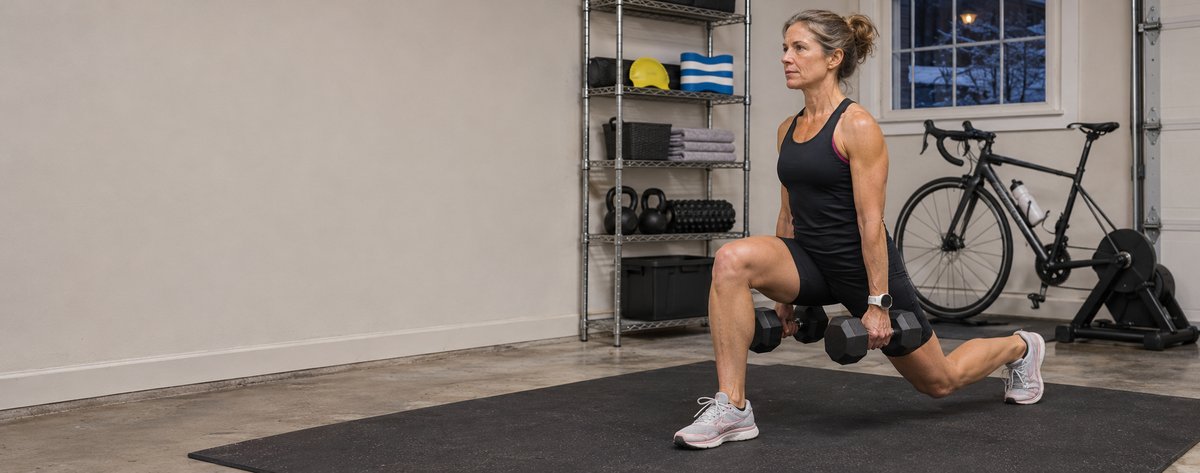
| Squat, or leg press | Split squat or step-up |
| Romanian deadlift or trap-bar deadlift | Single-leg Romanian deadlift or hip thrust |
| Straight-knee calf raise, heavy | Bent-knee (seated) calf raise, heavy |
| Isometric holds: mid-thigh pull or heavy calf hold, a few seconds each | Row or pull-up |
| Loaded carry | Jumps (from week 5 or later, below) |
Why these. In 174 iron-distance finishers, overuse injuries clustered at the knee, the lower leg and the lower back.7 The program aims heavy work at all three: quads, calves and Achilles, and the back through big lifts. The bent-knee calf raise trains the soleus, the calf muscle that takes the most load in running and the one triathletes most often skip.
Heavy holds, not long holds. Tendons got stiffer with loads above about 70% of maximum, over 8 to 12 weeks or more, and holding still worked about as well as lowering a weight slowly. Light loads did almost nothing.8 In the trial behind our isometrics article, runners did 3-second all-out holds, twice a week.9 That trial measured running performance, not tendons; pairing the two findings is reasoning, not a result. Either way, the holds that count are short and hard: hard enough that you couldn’t hold much longer. They are not the 45-second holds used in rehab for pain, which are a different tool.
Jumps, for bone, kept short
Swimming and cycling put almost no impact through the skeleton, so triathletes have more reason than runners to add a little. The case is mechanism, mostly from animal studies: a few minutes of impact, separated by hours, loads bone better than more running.10 Jumps are not the best tendon builder; heavy load is. Treat this whole section as practice.
- Start with pogos (small, quick bounces on both feet), then skips and bounds. Two legs before one.
- About 40 to 60 low contacts a session, building toward 80 to 100.
- Hours away from runs, not straight after a hard one. The end of Lift B works.
- Single-leg hops wait until the athlete can do slow single-leg calf raises without pain. Masters athletes get a few more weeks of heavy lifting before jumping.
Swim, bike and run in Foundation
- Swim: three short swims a week, with technique as the focus. It’s the cheapest training of the winter and the limiter for many age-groupers. (Practice.)
- Yoga: one session a week, all winter and into the build. It’s mobility, posture and practice at slow breathing on an easy day. No study we found shows it prevents injury, and stretching alone did nothing in the injury reviews,11 so it’s here as practice, not protection.
- Run: three short, easy runs a week, with strides once the lifting soreness settles. Don’t let running fade. If it does, the athlete’s longest recent run in week 13 is tiny, and the bike fitness runs well ahead of what the legs can take. (Practice, on the detraining evidence: keep frequency, cut volume.4)
- Bike: easy, plus the optional short hard session.
Weeks 7–12: Build the engine
When to build FTP
No study says FTP must be built in winter. A systematic review of 11 studies (about 200 athletes) comparing intensity-first with traditional training orders found no order better than another, and the studies were low quality.12 What the evidence does support is in the FTP article: FTP rises with enough riding and with a mostly-easy mix that includes truly hard work, while a diet of only threshold work did little.1314
So the timing is a coaching choice. Here’s why I put the bike block in weeks 7 to 12 (practice):
- The lifting is routine by then. Weeks 3 to 6 are when new lifters are sore, and sore legs spoil quality bike sessions.
- Running is still easy. Run volume comes back before run intensity, so the bike can carry the week’s hard work without fighting a hard run day.
- There’s time. For most age-groupers, the back of the winter is when they can actually ride enough.
The holiday problem. For a late-season finisher, weeks 7 to 12 land between Thanksgiving and New Year. Put the lighter week on the holiday on purpose. If an athlete’s holidays will wreck the block anyway, swap the order: do the FTP block in weeks 3 to 8 and peak the lifting in weeks 7 to 12.
For long-course athletes, FTP is often not the limiter; durability and aerobic volume are. The block still helps, but it doesn’t replace the long, easy rides.
The bike block
All practice, built on the evidence linked above.
- Two quality rides a week at most, plus one or two easy rides, one of them a longer weekend ride. Most of the riding stays easy.
- Ride 1, threshold: start with sweet-spot intervals and build toward 2 × 20 minutes around threshold.
- Ride 2, harder and shorter: 5 × 3 to 4 minutes hard, or sets of 30 seconds on, 15 seconds off.
- Ride hard in the morning and lift that afternoon, at least three hours later. That keeps the other days easy. Spreading lifts and hard rides onto separate days gives an age-grouper four hard days plus swims, which is too many. A 2022 review found lifting and endurance work only blunted strength gains when they were within about 20 minutes of each other.15 Whether a lift spoils the next day’s ride wasn’t measured, so the spacing is practice.
- No heavy legs the day before the hard short-interval ride. Masters athletes who can’t recover from double days can split them, with an easy day after the lift.
- A lighter week around week 10.
- Test FTP in week 7 and week 12, same protocol, same trainer, same power source, same fan, never the day after legs. Test week 12 at the end of the lighter week. The week-7 number may read low while the legs adapt to lifting.
On the trainer. ERG mode is good for threshold and sweet-spot work, poor for 30/15s and short efforts, where the resistance lags. Ride those in resistance or slope mode. Before the race build, add some threshold work paced by the athlete, not the trainer, because nobody holds the watts on race day. Give riders without a power meter a heart-rate or effort version of every session. (I’ve used MyWhoosh as a free trainer app; we’re not affiliated.)
| Day | Session |
|---|---|
| Monday | Yoga. Breathing work |
| Tuesday | Morning: threshold ride. Afternoon: Lift A |
| Wednesday | Swim. Easy run |
| Thursday | Morning: short hard intervals on the bike. Afternoon: Lift B, jumps at the end |
| Friday | Swim. Easy run with strides |
| Saturday | Long easy ride. Optional short easy run off the bike |
| Sunday | Easy run. Optional swim |
Travel weeks. Keep twice a week alive with what travels: single-leg work, calf holds and the breathing block. A short session that happens beats the perfect one that doesn’t.
”Core”: what it means here
Planks and crunches build trunk strength. They barely make athletes faster. A review of trials in trained athletes found core-only training produced large gains in trunk strength but small or no gains in performance, and trunk strength was only weakly linked to performance at all.16 The trials were low quality, but the pattern held.
In this program, “core” means:
- Big free-weight lifts. Squats and deadlifts work the deep back muscles harder than ball or machine core exercises, by muscle-activity measures in healthy adults.17 Lift A is core work.
- Posture work for the hips and glutes, coached if possible. In a trial of novice runners, a physio-supervised hip and core program cut the share of runners with overuse injuries by 39% compared with stretching.18 That’s one trial, in novices, but it’s the best one there is. An ankle-and-foot program in the same trial didn’t help and had more acute injuries, so don’t sell foot drills as protection.
- A short breathing block. Training the breathing muscles improved endurance performance in a review of 46 studies, more in less-fit athletes and longer events.19 A common setup is an inspiratory trainer, about 30 breaths twice a day, for six weeks or so. (Practice on the dose; the device needs no brand.)
- Weekly yoga for mobility and posture (practice, above).
- Planks as a warm-up. Fine there. Not the program.
That’s one person. The evidence beside it: posture work on its own hasn’t been tested for preventing injury in endurance athletes; the hip-and-core trial above is the closest. In one trial in people with chronic low back pain, adding diaphragm training to exercise improved trunk stability more than exercise alone, but the exercise-only group had the bigger drop in pain.20 Those were young adults, averaging about 22. So diaphragm work for a cranky back is reasonable to try. It is not a back-pain cure. And for a triathlete whose back hurts on the bike, check the bike fit before blaming the core. (Practice.)
Weeks 13–16: Hand-off
Strength drops to once a week, and stays heavy
In one small trial, well-trained cyclists who lifted twice a week for 12 weeks and then once a week for 13 kept their strength and muscle gains into the race season.21 That was 6 lifters against 6 controls, cyclists only, so it’s provisional. A review of maintenance studies adds that strength held for months on one session a week if the load stayed heavy, and that older adults needed about two sessions.5 So: one heavy session a week; masters athletes, consider keeping two. The session that drops is the light one, not the load.
On the bike, keep one threshold-type ride and let it turn race-specific: longer tempo, race-pace blocks.
Running comes back: volume first, and watch the single long run
By week 13 the bike has kept aerobic fitness high, but bone and tendon adapt to running more slowly. That mismatch is the classic triathlete injury around week 14.
Two rules, both resting on evidence:
- Volume before intensity. Add runs and minutes first, hard running later.10
- The single-run rule. In a study of more than 5,200 recreational runners, a run more than 10% longer than the runner’s longest run in the previous 30 days went with a higher rate of overuse injury.22 Weekly totals didn’t show the same signal (our article on it). This is a per-run rule. It is not the old “10% a week” rule, which hasn’t held up in the research.23
The study measured distance. Triathletes usually run by time, so the minutes version below is our conversion. Runs off the bike count toward the 30 days.
| Week | Runs a week | Longest in last 30 days | Cap for the next long run | Quality |
|---|---|---|---|---|
| 12 | 3 | 50 min | 55 min | none |
| 13 | 3–4 | 55 min | 60 min | strides |
| 14 | 4 | 60 min | 66 min | strides |
| 15 | 4 | 66 min | 72 min | short hills |
| 16 | 4 | 72 min | 79 min | tempo |
Injury: what to promise and what not to
Strength training cut sports injuries to about a third in two reviews by Lauersen and colleagues, and stretching did nothing.1124 Those trials were mostly team and mixed sports, ages 12 to 40. In runners, it hasn’t been shown yet: the 2024 review of runners found only four trials that used strength training at all, all light.1 So it is untested in runners, not disproven.
That’s how I’d put it to an athlete: heavy lifting is the best-supported bet for staying healthy, and it also makes you faster on the bike. For the run, the speed case is thinner: it rests on the isometrics trial and the broader review, not the cycling numbers.96 Don’t promise a percentage of injuries avoided.
Sources
- Wu H, Brooke-Wavell K, Fong DTP, Paquette MR, Blagrove RC.. Do exercise-based prevention programs reduce injury in endurance runners? A systematic review and meta-analysis. Sports Med 2024;54(5):1249–1267, 2024. https://pubmed.ncbi.nlm.nih.gov/38261240/ ↩
- Toresdahl BG, McElheny K, Metzl J, Ammerman B, Chang B, Kinderknecht J.. A randomized study of a strength training program to prevent injuries in runners of the New York City Marathon. Sports Health 2020;12(1):74–79, 2020. https://pubmed.ncbi.nlm.nih.gov/31642726/ ↩
- Barbieri A, Fuk A, Gallo G, Gotti D, Meloni A, La Torre A, Filipas L, Codella R.. Cardiorespiratory and metabolic consequences of detraining in endurance athletes. Front Physiol 2023;14:1334766, 2023. https://pubmed.ncbi.nlm.nih.gov/38344385/ ↩
- Mujika I, Padilla S.. Detraining: loss of training-induced physiological and performance adaptations. Part II: Long term insufficient training stimulus. Sports Med 2000;30(3):145–154, 2000. https://pubmed.ncbi.nlm.nih.gov/10999420/ ↩
- Spiering BA, Mujika I, Sharp MA, Foulis SA.. Maintaining physical performance: the minimal dose of exercise needed to preserve endurance and strength over time. J Strength Cond Res 2021;35(5):1449–1458, 2021. https://pubmed.ncbi.nlm.nih.gov/33629972/ ↩
- Rønnestad BR, Mujika I.. Optimizing strength training for running and cycling endurance performance: a review. Scand J Med Sci Sports 2014;24(4):603–612, 2014. https://pubmed.ncbi.nlm.nih.gov/23914932/ ↩
- Andersen CA, Clarsen B, Johansen TV, Engebretsen L.. High prevalence of overuse injury among iron-distance triathletes. Br J Sports Med 2013;47(13):857–861, 2013. https://pubmed.ncbi.nlm.nih.gov/23902775/ ↩
- Bohm S, Mersmann F, Arampatzis A.. Human tendon adaptation in response to mechanical loading: a systematic review and meta-analysis of exercise intervention studies on healthy adults. Sports Med Open 2015;1:7, 2015. https://pubmed.ncbi.nlm.nih.gov/27747846/ ↩
- Lum D, Barbosa TM, Aziz AR, Balasekaran G.. Effects of isometric strength and plyometric training on running performance: a randomized controlled study. Res Q Exerc Sport 2023;94(1):263–271, 2023. https://pubmed.ncbi.nlm.nih.gov/35323106/ ↩
- Warden SJ, Edwards WB, Willy RW.. Preventing bone stress injuries in runners with optimal workload. Curr Osteoporos Rep 2021;19(3):298–307, 2021. https://pubmed.ncbi.nlm.nih.gov/33635519/ ↩
- Lauersen JB, Bertelsen DM, Andersen LB.. The effectiveness of exercise interventions to prevent sports injuries: a systematic review and meta-analysis of randomised controlled trials. Br J Sports Med 2014;48(11):871–877, 2014. https://pubmed.ncbi.nlm.nih.gov/24100287/ ↩
- González-Ravé JM, González-Mohino F, Rodrigo-Carranza V, Pyne DB.. Reverse periodization for improving sports performance: a systematic review. Sports Med Open 2022;8:56, 2022. https://pubmed.ncbi.nlm.nih.gov/35445953/ ↩
- Stöggl T, Sperlich B.. Polarized training has greater impact on key endurance variables than threshold, high intensity, or high volume training. Front Physiol 2014;5:33, 2014. https://pubmed.ncbi.nlm.nih.gov/24550842/ ↩
- Montero D, Lundby C.. Refuting the myth of non-response to exercise training: 'non-responders' do respond to higher dose of training. J Physiol 2017;595(11):3377–3387, 2017. https://pubmed.ncbi.nlm.nih.gov/28133739/ ↩
- Schumann M, Feuerbacher JF, Sünkeler M, et al.. Compatibility of concurrent aerobic and strength training for skeletal muscle size and function: an updated systematic review and meta-analysis. Sports Med 2022;52(3):601–612, 2022. https://pubmed.ncbi.nlm.nih.gov/34757594/ ↩
- Prieske O, Muehlbauer T, Granacher U.. The role of trunk muscle strength for physical fitness and athletic performance in trained individuals: a systematic review and meta-analysis. Sports Med 2016;46(3):401–419, 2016. https://pubmed.ncbi.nlm.nih.gov/26589515/ ↩
- Martuscello JM, Nuzzo JL, Ashley CD, Campbell BI, Orriola JJ, Mayer JM.. Systematic review of core muscle activity during physical fitness exercises. J Strength Cond Res 2013;27(6):1684–1698, 2013. https://pubmed.ncbi.nlm.nih.gov/23542879/ ↩
- Leppänen M, Viiala J, Kaikkonen P, et al.. Hip and core exercise programme prevents running-related overuse injuries in adult novice recreational runners: a three-arm randomised controlled trial (Run RCT). Br J Sports Med 2024;58(13):722–732, 2024. https://pubmed.ncbi.nlm.nih.gov/38724071/ ↩
- Illi SK, Held U, Frank I, Spengler CM.. Effect of respiratory muscle training on exercise performance in healthy individuals: a systematic review and meta-analysis. Sports Med 2012;42(8):707–724, 2012. https://pubmed.ncbi.nlm.nih.gov/22765281/ ↩
- Finta R, Boda K, Nagy E, Bender T.. Does inspiration efficiency influence the stability limits of the trunk in patients with chronic low back pain?. J Rehabil Med 2020;52(3):jrm00038, 2020. https://pubmed.ncbi.nlm.nih.gov/31974590/ ↩
- Rønnestad BR, Hansen EA, Raastad T.. In-season strength maintenance training increases well-trained cyclists' performance. Eur J Appl Physiol 2010;110(6):1269–1282, 2010. https://pubmed.ncbi.nlm.nih.gov/20799042/ ↩
- Schuster Brandt Frandsen J, et al.. How much running is too much? Identifying high-risk running sessions in a 5200-person cohort study. Br J Sports Med 2025;59(17):1203–1210, 2025. https://bjsm.bmj.com/content/59/17/1203 ↩
- Nielsen RØ, Parner ET, Nohr EA, Sørensen H, Lind M, Rasmussen S.. Excessive progression in weekly running distance and risk of running-related injuries: an association which varies according to type of injury. J Orthop Sports Phys Ther 2014;44(10):739–747, 2014. https://pubmed.ncbi.nlm.nih.gov/25155475/ ↩
- Lauersen JB, Andersen TE, Andersen LB.. Strength training as superior, dose-dependent and safe prevention of acute and overuse sports injuries: a systematic review, qualitative analysis and meta-analysis. Br J Sports Med 2018;52(24):1557–1563, 2018. https://pubmed.ncbi.nlm.nih.gov/30131332/ ↩