Winter base and the indoor season, which most of us train for outdoors, both run through the coldest weeks of the year. Most of what follows is practice: what sports medicine groups, state associations and coaches in cold places tell runners to do. Very little of it has been tested in a trial. Where a line rests on evidence I say so, and where it’s my own habit it’s in first person.
Two things you might expect are missing, because no source I trust has them. There is no chart that turns a temperature into a slower pace, and there is no cut-off temperature written for runners. I’ll give you the closest honest thing to each.
If your state’s rules keep you away from the team in winter, these rules still have to work for a sixteen-year-old running alone. Hand them the athlete version.
Decide by wind chill
The number that matters is wind chill, not the thermometer. Check it for your town at practice time, not at breakfast: in December it drops fast after four o’clock. The National Weather Service gives one example worth remembering: at 0°F with a 15 mph wind, the wind chill is −19°F, and exposed skin can freeze in 30 minutes.1 Frostbite can’t happen at all until the air is below freezing.1 The American College of Sports Medicine puts the risk on bare skin under 5% while the air is above 5°F, and says to watch athletes closely once the wind chill drops below −17°F.2
Missouri’s state association gives its schools a four-step ladder, taken from the NCAA and the athletic trainers’ association.3 It was written for every outdoor sport, including the ones where players stand on a sideline. Runners who keep moving make their own heat, so for your steady runners this is the cautious end. It is not cautious for the athlete who run-walks at the back: that runner makes the least heat, is out the longest, and often has the worst gear. Set the day by that runner. The right-hand column is how I’d apply the ladder to a no-cut distance team, and that column is practice.
| Wind chill | What Missouri tells its schools | A running team (practice) |
|---|---|---|
| 30°F and below | Be aware of cold injury and tell the people who need to know | Normal practice. Hats and gloves on everyone, from the team bin if needed. Know which athletes have trouble in the cold |
| 25°F and below | More clothing, cover exposed skin, give chances to rewarm | Normal run. Warm up indoors. Gear check at the door. Run in groups, nobody alone. Dry tops waiting at the door |
| 15°F and below | Consider changing the session to limit exposure | Short loops near the building. Run by minutes, not miles, so the last runner is out no longer than the first. No standing recoveries. Fast intervals become effort sessions or wait for a better day. Neck gaiters offered to anyone who wants one |
| 0°F and below | Consider ending or rescheduling | Indoors is the default. Outside only for athletes whose gear you have checked: hat, mittens, legs covered, wind layer. A short easy run on loops that pass the door, with an adult at the door. Anyone may stay in, and it costs them nothing |
Rain or wet snow changes the day. Wet skin cools faster, and cold and wet together are riskier than colder and dry.2 As practice, treat a wet day as one row colder, and let nobody leave without a dry change waiting.
For comparison, other sports draw their lines much lower. Michigan’s high-school ski policy stops all skiing at −20°F air temperature or a −40°F wind chill.4 When a 2020 review looked, international ski and biathlon rules did not start races below −4°F.5 Those are their lines, not ours, and no one has set one for runners.
The wind-chill chart was built from tests on adult faces, and the Weather Service says to be more careful with children.1 With a middle-school group, or a freshman in a first winter, treat each row as if it were the row below it. (Practice.)
If your school has no cold policy, Missouri’s list of what one should cover is a good start: who decides, where the line is, and how the team hears about it.3
Dress for 15 to 20 degrees warmer
A sports medicine physician at Cleveland Clinic and a physical therapist at a Minnesota orthopedic clinic give the same rule in almost the same words: dress as if it were 15 to 20 degrees warmer than it is.67 Nobody has tested the rule. The reason behind it is in the ACSM statement: people start a run in clothes that suit standing still, and are overdressed ten minutes later.2 Sweat-soaked clothing is what makes a runner cold. The rule suits a steady runner. Anyone who run-walks should dress closer to the real temperature. (Practice.)
The same statement describes three layers:2
- Next to the skin: something that moves sweat away and doesn’t hold it. Not cotton.
- In the middle: the layer that keeps warmth in.
- On the outside: a shell that stops wind and rain.
The part most runners get wrong is the shell. ACSM says it should usually come off for the run, unless it’s raining or very windy, and go back on the moment you stop.2
Three more things to tell a team:
- Hands and ears first. Fingers freeze at a milder wind chill than cheeks do.2 Mittens are warmer than gloves. A runner with cold hands needs mittens before a heavier jacket.
- Nobody dresses the same. ACSM says each athlete should adjust to how much they sweat, not wear a standard kit.2 Let them tie a layer around the waist or drop it at the loop.
- Take cold hands at their word. The statement notes that women’s hands and feet cool faster than men’s in the cold.2 It studied adults, but when a girl on your team says her hands hurt, hand her mittens.
- Covered hands and ears are a team rule. Some athletes will show up in shorts and bare hands to prove something. (Practice.)
Not every athlete owns the gear, so plan for the one who doesn’t. This part is practice:
- A polyester meet shirt or an old road-race shirt is a base layer. A cotton hoodie over it will do for 40 minutes if a dry shirt is waiting. Socks work as mittens.
- Keep a team bin of hats and gloves and hand them out without comment. Ask parents and alumni for old ones in November.
Warm up indoors, then don’t stand around
Cold muscle is weaker muscle. For each degree Celsius the muscle itself cools, its power and sprint ability fall by 4 to 6%.2 That is muscle temperature, not the weather. That matters most for the first fast rep of a workout and the first 200 meters of a race.
What cold-climate coaches do about it is practice, and it’s simple:
- Drills and dynamic movement inside, in a hallway or the cafeteria. In winter the gym belongs to basketball and wrestling, so ask your athletic director for a space before the first cold day. The Cleveland Clinic physician recommends warming up in a warm place for exactly this reason.6
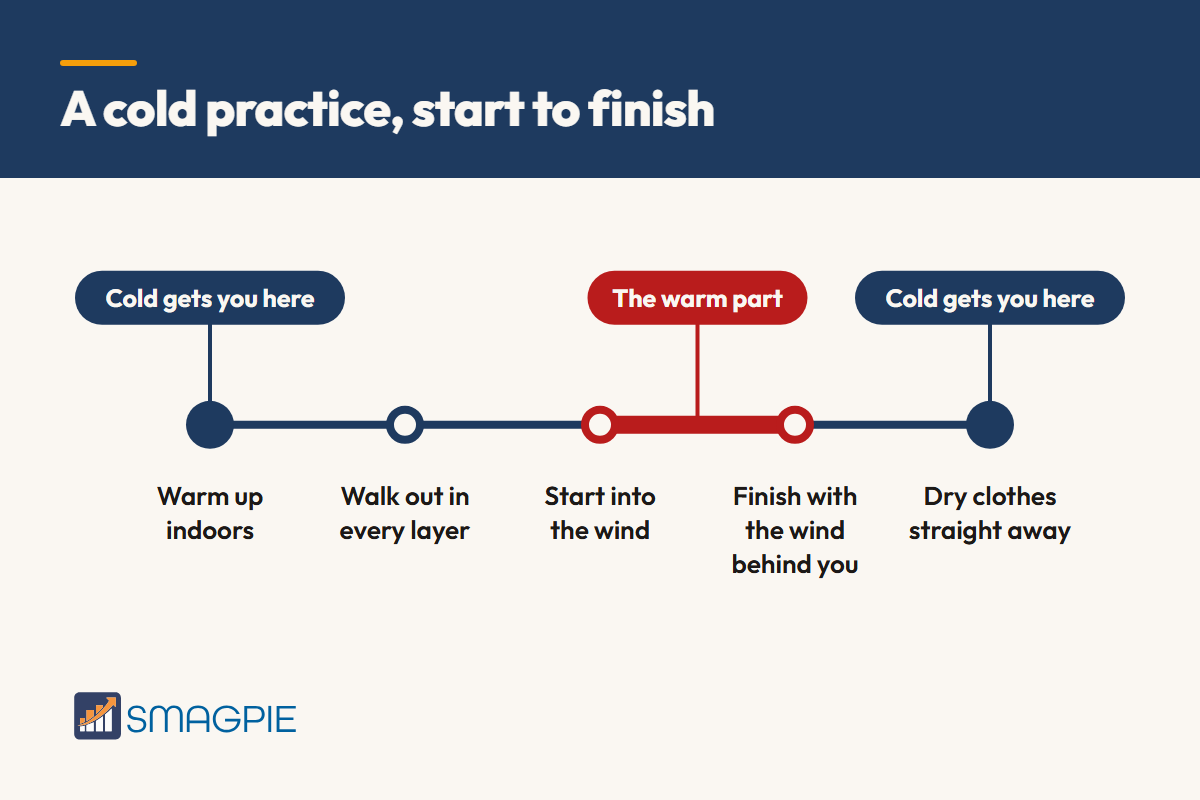
- Walk out in every layer you own. Christopher Lundstrom, who teaches kinesiology at the University of Minnesota, says to warm up in extra layers and shed them just before you start.8
- No gap between the warm-up and the work. Lundstrom again: “Just a few minutes of standing around in the cold in sweaty clothes can cause your body temperature to plummet.”8 Give the instructions indoors.
- Keep moving between repeats. Lundstrom’s advice for interval sessions is to keep moving so body temperature stays up.8 Jog the recoveries, and write the reps by minutes, not distance, so the whole team starts and stops together and nobody stands waiting for the last group.
- At a cold meet, sweats stay on until the starter calls them up. Give one person the job of carrying the bag. (Practice.)
Plan for the warm-up to take longer than it does in September.
Paces: go by effort
I can’t give you a cold-pace chart, because the research doesn’t support one. ACSM says studies disagree on whether cold air slows a runner whose body and muscles are warm: some found slower, some faster, some no change.2
What does slow a winter run is everything around the cold: muscles that never warmed up, heavy clothing, a shorter stride on snow, and wind.2 None of those come with a number you can trust.
So, as practice:
- Easy days run by effort. If the watch reads slower on packed snow in two layers, the run still did its job. Tell the team not to chase the pace. For the athletes with no watch, easy means they can talk in full sentences.
- Sessions that need exact pace go where the footing is clear. A plowed lot, the bus loop once the buses have gone, a track lane you shoveled yourselves. An indoor track or treadmills if you have them.
- Hard days that can’t move become effort sessions. Hills and fartlek work in any footing that’s safe to run on.
- Race-pace work waits for a decent day. There is usually one in the week. Write the week with the hard day floating, and pick the day from Monday’s forecast.
Wind and the route
Lundstrom and the Minnesota physical therapist give the same advice: head out into the wind and come home with it at your back.78 Do it the other way round and the team turns into the wind when they’re wet with sweat, which is when wind strips heat fastest.2
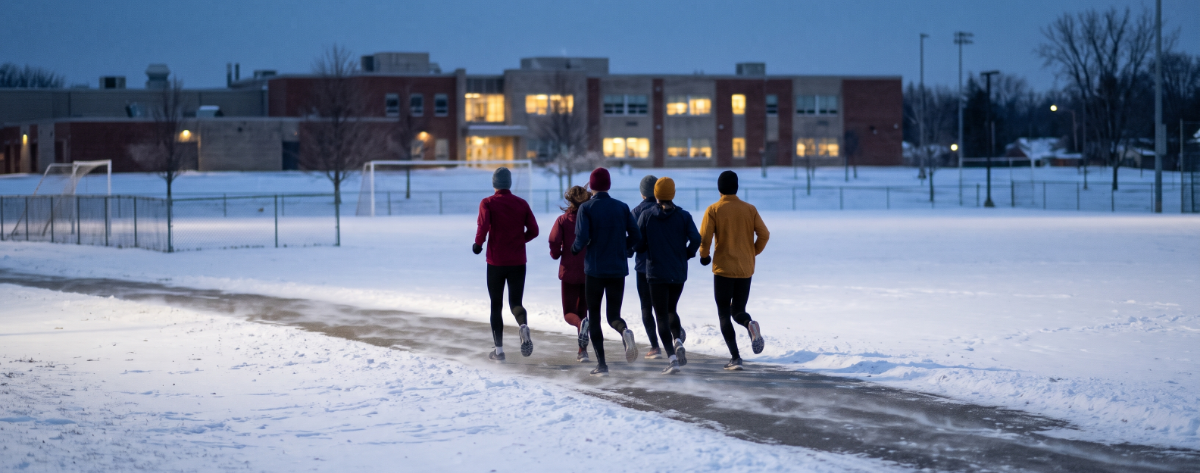
Short loops near the building beat one long out-and-back. Anyone who is struggling is never far from the door.6 Group the team by pace so nobody runs alone: the athlete who pulls up hurt and walks back is the one who gets cold. After-school runs also end in the dark, and snowbanks narrow the road. Loops on school grounds solve that too. (Practice.)
Ice
Ice changes the plan at any temperature. The Minnesota clinic’s line is plain: “If there is a layer of ice on the roads, it is not a good day for footing.”7 Move the fast session indoors or turn it into an easy run.
When the team does run on snow or ice, Lundstrom’s advice is to shorten the stride and slow down, most of all when turning or changing speed, and to take care on hills. He calls traction cleats a worthwhile investment for anyone who runs on ice often.8 For a team, the cheaper fix is the route. Walk it at lunch.
Lungs
You may have read that winter athletes have a lot of asthma. The numbers come from elite cross-country skiers, who breathe very cold air hard for hours a day over many years: about a third of Swedish elite skiers have asthma, against about 9% of Swedes their age.5 That is not a high-school runner doing 40 minutes after school.
Still, cold, dry air does irritate airways, and in the general population breathing symptoms start to show up at air temperatures somewhere between 19°F and 0°F.5 A neck gaiter pulled over the mouth warms the next breath. It’s cheap and reasonable on the coldest days. Nobody has shown that it prevents lasting harm, so don’t promise that.
Two practical lines:
- Hard intervals are the session to move or postpone when it’s very cold, because that’s when athletes breathe hardest. (Practice.)
- An athlete with asthma should talk to their doctor before training in the cold.8 A runner who coughs or wheezes after cold runs should tell you and see a doctor.
The minutes after the run
In cold air, hypothermia is most likely when a runner stops moving: injured, exhausted, or just finished and waiting.2 The run itself is the warm part of the afternoon.
- Dry top and a hat straight away. Lundstrom: “Whatever you plan to do after your run, get into dry clothes as soon as you can.”8 Dry means everything against the skin. A dry shirt over a wet sports bra is still wet.
- Work back from the late bus. End the run with ten minutes to change. Cool down, stretch and talk indoors. (Practice.)
- Dry bags sit at the door they come in by, not in a locker across the building. (Practice.)
- Know which door stays open. Arrange it with the custodian, and stay until the last athlete is picked up. (Practice.)
- Send dry socks and gloves on wet days. Cold and wet together are worse than colder and dry.2
- Keep them drinking. Athletes sweat in the cold and notice it less.3
Know who needs watching
Before the first cold week, find out who has trouble in the cold. Check the physical forms, ask your athletic trainer, and ask each athlete privately. A text counts. Missouri’s guidance lists the conditions to ask about, including Raynaud’s, hives from the cold, exercise-induced breathing trouble and any past cold injury.3 The Minnesota clinic adds a simple sign: fingers or toes that turn white and tingle in the cold are worth a doctor’s visit.7 It also lists what to look for when a runner comes in: pain or numbness and skin that looks red, pale or waxy point to frostbite, and shivering that won’t stop or confusion point to hypothermia.7
Keep spare gloves and hats in the team bag. The athletic trainers’ association also lists blankets, spare clothing, something to drink and a phone.9
”There’s really no bad weather”
In Duluth, Minnesota, a group trains outside three times a week through the winter for Grandma’s Marathon, starting with an easy three miles and adding distance as it warms up. One of the runners, Erik Heen, told the local TV station: “There’s really no bad weather. It’s just you got to dress for it.”10 Their coach, Tony Stensland, was more honest about the hard part: “It’s not easy to get out the door on days like this and it’s not easy to get started either.”10
Heen is mostly right, and a team can train outside far more days than most people think. He isn’t right about ice, and he isn’t coaching fourteen-year-olds. Dress well, start warm, finish dry, and keep a line you won’t cross.
Sources
- National Weather Service.. Understanding Wind Chill. weather.gov, n.d.. https://www.weather.gov/safety/cold-wind-chill-chart ↩
- Castellani JW, Eglin CM, Ikäheimo TM, Montgomery H, Paal P, Tipton MJ.. ACSM Expert Consensus Statement: Injury Prevention and Exercise Performance during Cold-Weather Exercise. Curr Sports Med Rep 2021;20(11):594–607, 2021. https://doi.org/10.1249/JSR.0000000000000907 ↩
- Missouri State High School Activities Association.. MSHSAA Cold Weather Guidelines. mshsaa.org, 2025. https://www.mshsaa.org/resources/SportsMedicine/Cold%20Weather%20Guidelines.pdf ↩
- Michigan High School Athletic Association.. MHSAA Cold Weather Policy for Skiing (Competition and Practice), 2025-26. mhsaa.com, 2025. https://www.mhsaa.com/sites/default/files/Skiing-Boys/2025-26/MHSAA_Cold_Weather_Policy_2025-for-Web.pdf ↩
- Hanstock HG, Ainegren M, Stenfors N.. Exercise in Sub-zero Temperatures and Airway Health: Implications for Athletes With Special Focus on Heat-and-Moisture-Exchanging Breathing Devices. Front Sports Act Living 2020;2:34, 2020. https://pmc.ncbi.nlm.nih.gov/articles/PMC7739679/ ↩
- Cleveland Clinic (Lewis C, sports medicine physician).. Everything You Need to Know About Running in Cold Weather. health.clevelandclinic.org, 2021. https://health.clevelandclinic.org/everything-you-need-to-know-about-running-in-cold-weather ↩
- Loberg LM.. Tips for running in the cold. HealthPartners / TRIA Orthopedics blog, n.d.. https://www.healthpartners.com/blog/running-in-the-cold/ ↩
- University of Minnesota (Lundstrom C).. Talking cold weather running tips with the U of M. twin-cities.umn.edu, 2021. https://twin-cities.umn.edu/news-events/talking-cold-weather-running-tips-u-m ↩
- Cappaert TA, Stone JA, Castellani JW, Krause BA, Smith D, Stephens BA.. National Athletic Trainers' Association Position Statement: Environmental Cold Injuries. J Athl Train 2008;43(6):640–658, 2008. https://pmc.ncbi.nlm.nih.gov/articles/PMC2582557/ ↩
- Pierce S.. Up North: Runners train for Grandma's Marathon in subzero temperatures. WDIO-TV, Duluth, n.d.. https://www.wdio.com/up-north/up-north-runners-train-for-grandmas-marathon-in-subzero-temperatures ↩