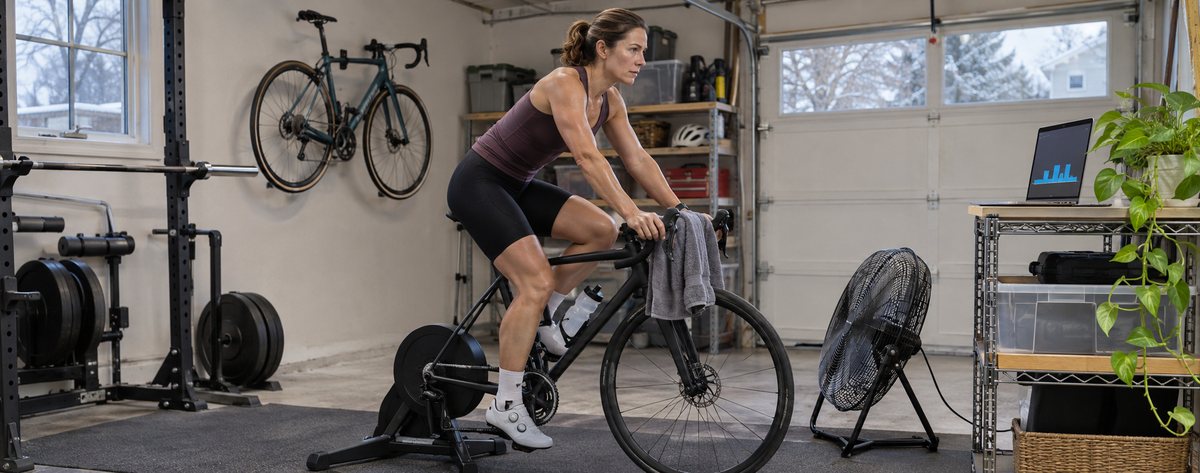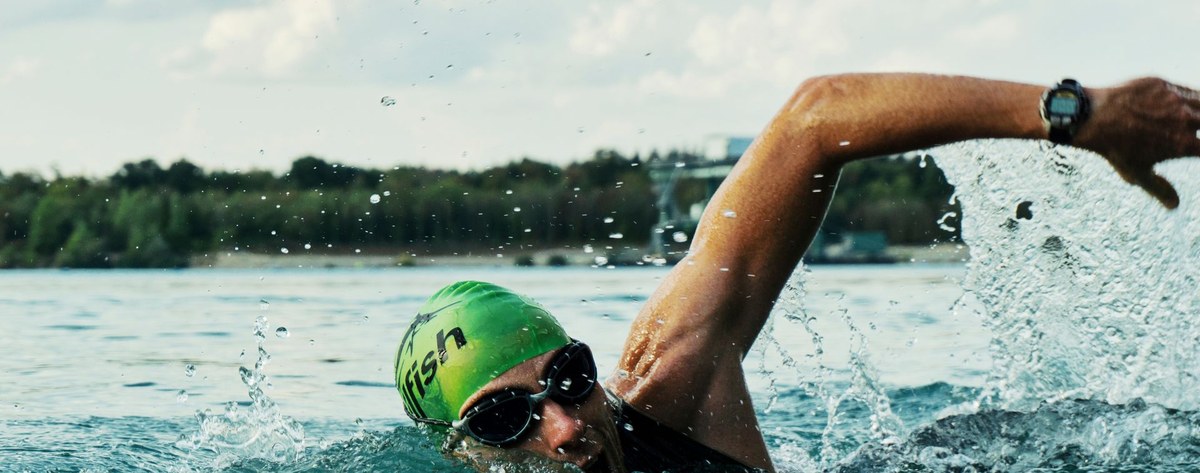
A trained runner or cyclist walks onto the pool deck carrying what has rewarded them in every sport so far: a large aerobic engine and the conviction that effort solves problems. In the water, that conviction is the problem. It is the single most reliable predictor of a miserable first month.
Here is what a coach has to say early and often: the first two months of swimming are not about fitness. They are about learning the movement and wasting less energy. Your athlete is not unfit. That is precisely why they will fight the water, drive their heart rate to 180 on a 50-meter length, climb out gasping, and conclude they “can’t swim.” They can. They are just spending a Tour-de-France engine to overcome drag they are creating themselves.
Your engine is already built. This is the one time in your athletic life when trying harder makes you slower.
Skills before fitness: the foundation order
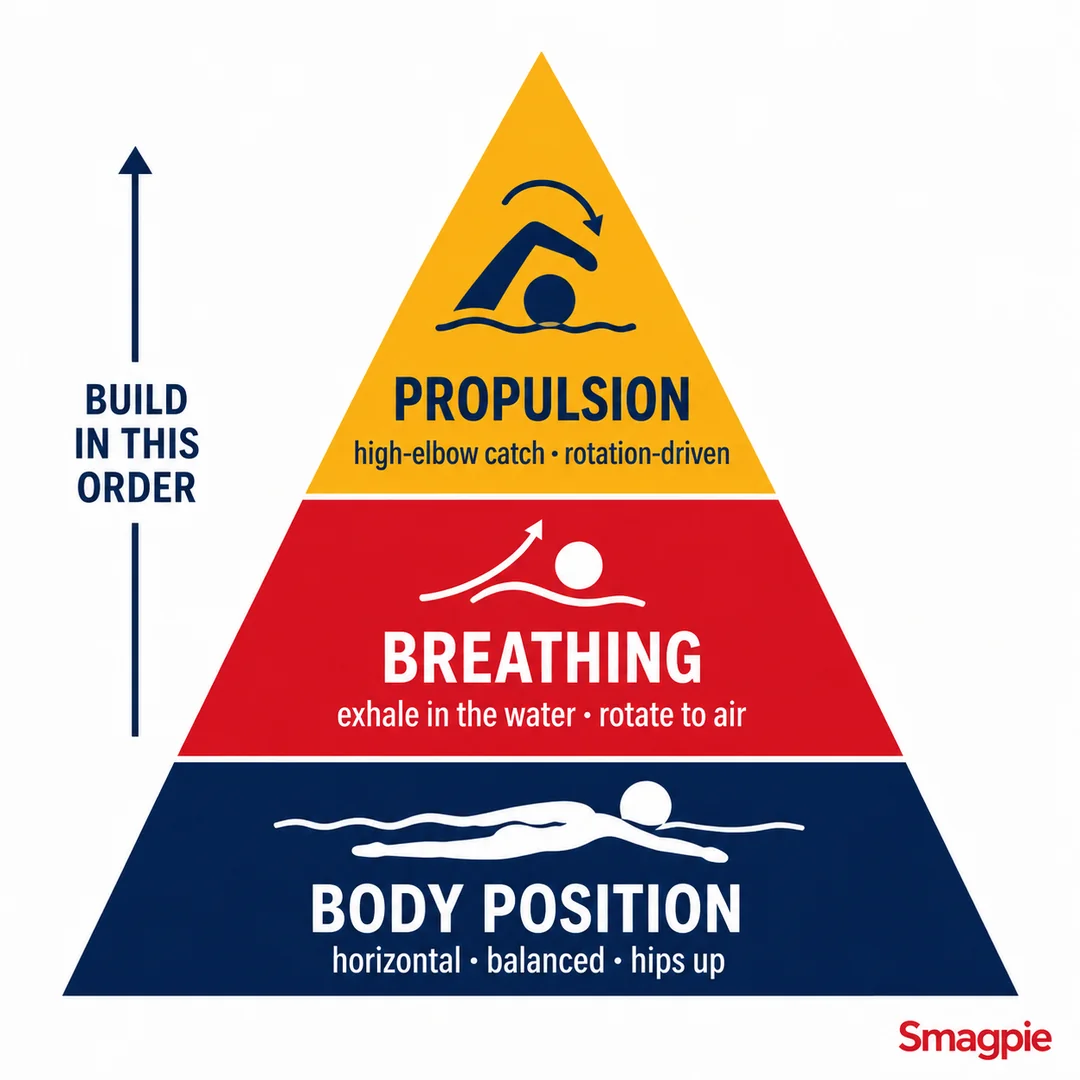
Every credible source teaches the same sequence, and the order is not negotiable: body position, then breathing, then propulsion.13
The reason is mechanical. A swimmer whose hips and legs sink is towing a sea anchor. No amount of arm strength overcomes that drag. It just burns the engine faster. So the first job is a long, balanced, horizontal body line, and only once that holds do you add the pull. Total Immersion, the school most explicit on this point, asks beginners to spend something like 10–20 practice hours, most of the first month, on balance and comfort before chasing any speed.4
To a driven endurance athlete that can sound like a punishment. Put it in terms they already know: this is the swim’s base phase. A runner accepts weeks of easy mileage before intervals; a cyclist accepts that a bad bike fit wastes a strong engine, that position beats raw watts. Body position in the water is the bike fit. The horizontal line is the aero tuck. Fix the position before you add the power.
The first weeks: a small, repeatable drill set
A triathlete needs exactly one stroke. Freestyle. You do not teach butterfly, you do not teach a racing turn.1 (One safety caveat: for an athlete who genuinely can’t swim at all and is frightened, comfort and survival skills (floating, calm breathing, treading) come before freestyle. “Freestyle only” is the efficiency answer for someone already safe in water, not a license to skip water safety.)
Across every source, the same handful of drills recur. The trick for coaching a non-swimmer is to stop naming them like a swim coach and start naming them by the fault they fix. “Catch-up” means nothing to an XC coach; “the drill that stops you rushing the next stroke before you’ve finished this one” lands.
| Drill | What it builds | The fault it fixes |
|---|---|---|
| Catch-up (one hand waits, extended, until the other reaches it) | Patience, distance-per-stroke, timing the arms out front | Frantic, overlapping arms that never finish a stroke |
| Six-kick switch (on your side, six kicks, one stroke, switch) | Rotation (the actual source of power) and balance | Swimming flat, all-arms, no hip drive |
| Fingertip drag (drag the fingertips along the surface on recovery) | A high-elbow recovery and an honest body line | A low, swinging, wide arm recovery |
| Fist drill (swim with closed fists, then open them) | Feeling the catch with the whole forearm | Slipping water with a flat, pushing palm |
For the athlete who has truly never swum, U.S. Masters Swimming teaches an “evolution” that starts even more gently: scull to feel the water, then a long dog-paddle, then head-up “Tarzan” freestyle, all before any of the above.3 Don’t make an athlete who swam as a kid crawl through it. Check first, and send only the true never-swam athletes down that path.
Two coaching cautions that save weeks. First, catch-up is a teaching tool, never a racing stroke. It deliberately exaggerates the glide to build timing; nobody should swim that way in a race.25 Second, do drills fresh, not fatigued. Learning a movement needs a clear head; bolting drills onto the end of an exhausting set teaches sloppiness.
The video below is the single best free demonstration of this progression for an absolute beginner. It walks from blowing bubbles at the wall through the full stroke, and explicitly frames hip rotation as the way to “use the larger muscle groups and become more efficient.”
How much, how often
The sources agree on how much: at least three sessions a week, 20–45 minutes each, consistency over volume.12 An instructor or a Masters group for the first weeks is worth every dollar for anyone uncomfortable in the water.
But an endurance coach has to spell this out, because it turns everything their athlete knows upside down: in swimming, frequency beats duration, and junk yardage is not neutral. It does harm. In running, the long run is the cornerstone. In early swimming, a long, tired, sloppy swim actively trains in the wrong movement. Three short, sharp, technical swims teach more than one exhausting one. They also cost almost nothing in whole-body fatigue, which matters because your athlete is still running and cycling through these two months. A 30-minute technique swim protects their other training instead of competing with it.
Glide versus rhythm: the one real disagreement
This is where coaches get confused online, so take it head-on. It is a coaching debate between two respected schools, not a scientific dispute. Total Immersion teaches a long, patient glide and a low stroke rate.4 Swim Smooth, the other major school, explicitly calls excessive glide a fault (the “Overglider”) and argues triathletes need a more continuous rhythm to hold position in chop, crowds, and open water with no walls.5
Both are run by qualified coaches. Both are right, one after the other. Most coaches settle it with the kind of phase change your athlete already knows from training blocks:
There is no magic stroke rate, and the honest coaches say so. The video below opens by admitting there is no single right number, only a way to find what’s right for each swimmer. Take the same honest tone with your athlete.
The pool lies: open water is a different sport
This is the point most likely to wreck a race day: pool competence does not equal open-water competence. The pool flatters the beginner with a black line, walls, warm clear water and your own lane, and then tells them nothing about what actually happens in a lake at 7 a.m. with two hundred other people.8
A runner who can swim 1,500 meters in the pool thinking they’re race-ready is making the same mistake as a track runner assuming they’re ready for a technical trail race. The gap between the two is the story.
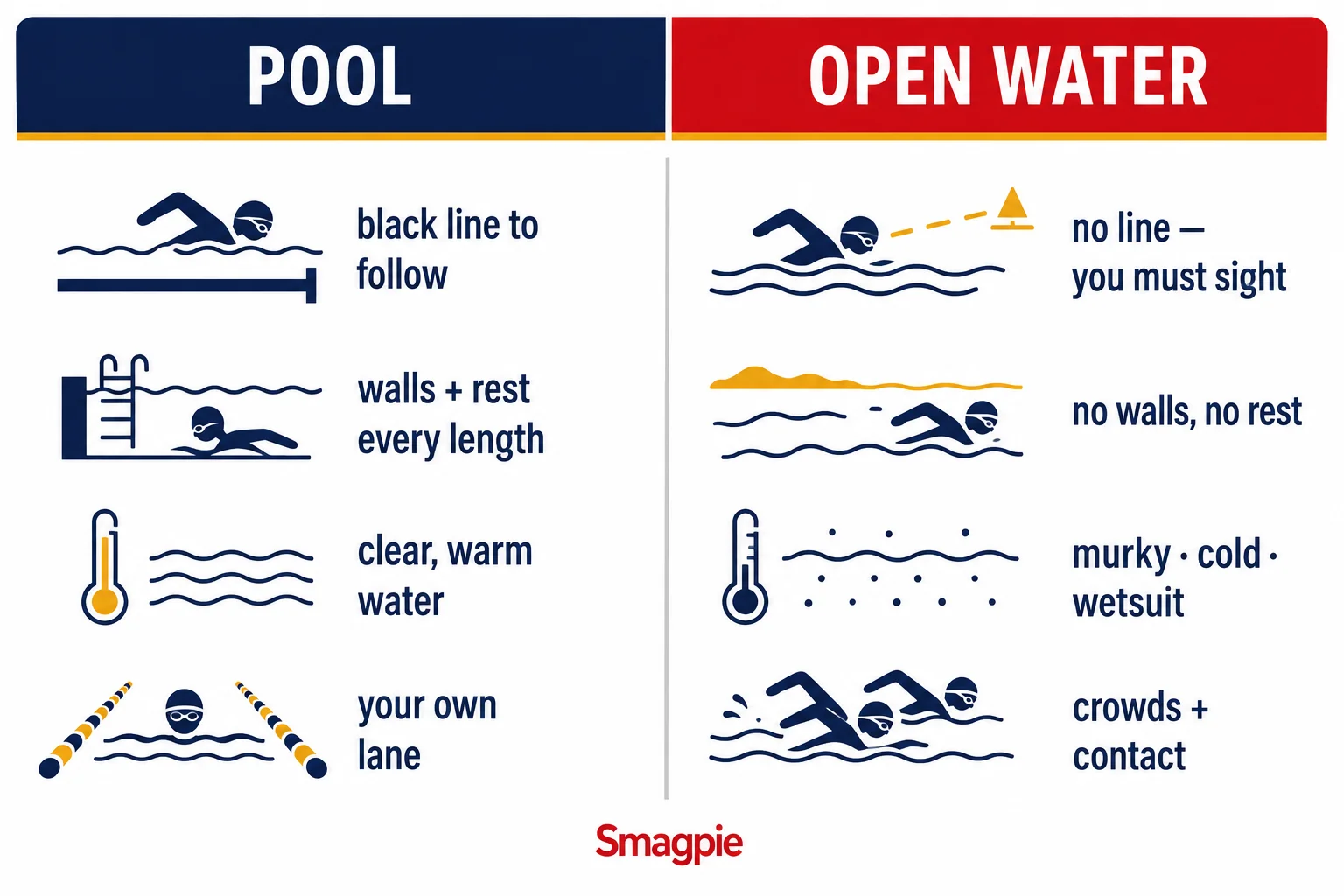
The differences are not marginal:
- No walls, no rest. Every pool length hands you a push-off and a breather. Open water is continuous. There is no free rest, ever.8
- No black line, so you have to sight. More on this below; it’s the most important skill.
- Wetsuit panic. The chest compression of a wetsuit produces a breathless feeling that triggers panic if it’s first met on race morning. It must be practiced beforehand.6
- Crowds and contact. The “washing-machine” mass start. The fix is tactical, and a cyclist who’s ridden a bunch sprint already knows it.9
The wetsuit is mostly good news, so lead with that before the warning: a wetsuit’s buoyancy lifts the hips and legs, which fixes the number-one beginner flaw, sinking hips, essentially for free.6 Practice in it so the neck-and-chest restriction doesn’t surprise you, but understand the suit is mostly your friend.
Sighting: swimming straight without a line
Without a black line to follow, beginners routinely swim 10–20% farther than the course by drifting off line.10 The technique is “alligator eyes”: press lightly on the lead arm, lift the eyes just clear of the surface (nose and mouth stay wet), spot a target, then rotate into a normal breath. Don’t combine the sight and the breath into one big head-lift; that’s what sinks the hips and stalls the stroke.910
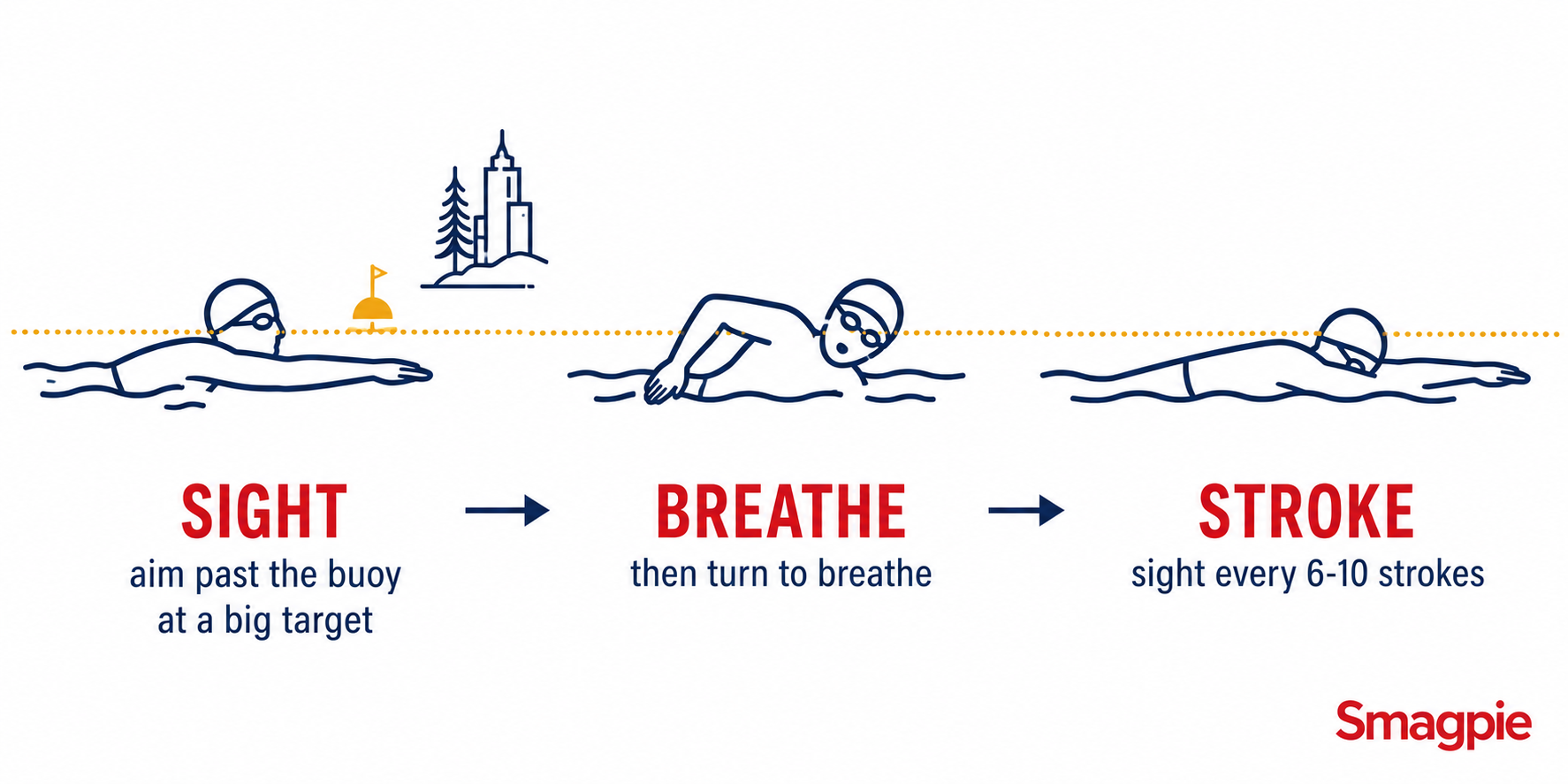
Two field cues: aim at a big landmark behind the buoy (a tree, a building, a flag), because the buoy itself vanishes behind chop. And sight every 6–10 strokes in calm water, more often in chop or a crowd. (Treat those numbers as coaching rules of thumb, not constants.)10
Cold water: the one hard safety rule
Everything above is technique you can be relaxed about. This one is not. It is the single claim in this article that rests on real physiology rather than coaching lore, and a coach should treat it as a flat, non-negotiable rule.
For a cyclist, there’s a familiar hook here: this is the swimming version of that first cold descent when your hands stop working and you can’t feel the brakes. It is a body reflex with a known fix, not a test of toughness.
Runner or cyclist: what actually differs
Both arrive air-hungry and prone to over-muscling, and the teaching order is identical for both. But the entry sport shapes the specific struggles, and naming “this will be harder for you, and here’s why” earns a coach the right to be heard. (These come from coaching experience, not measured findings.)
- Ankles. Runners often have stiff ankles that sit with the toes pulled up, and a coach can see the poor kick on deck: if the foot stays flexed as if standing, the kick is a brake. Cyclists have arguably the worst ankle mobility of any endurance athlete, because the pedal stroke never asks for the pointed-toe range a kick needs. Expect the kick to be the weakest link, felt as “my legs just sink and drag.”
- Sinking hips. Cyclists combine tight hip flexors, often-sleepy glutes, and denser, less-buoyant legs from years folded over the bars. Their hips will likely sit lower than a runner’s until rotation and (especially) wetsuit buoyancy correct it. Sinking legs are anatomy, not a fitness failure.
- The kick is for balance, not propulsion, and that’s good news for a cyclist. Their instinct is that legs are the engine, because on the bike they are. Over-kicking with a stiff ankle just burns the aerobic system and adds drag. Tell them to relax the legs.
- The catch will feel weak, because cycling undertrains the lats and pulling muscles. Normal. Not a reason to muscle it.
- Breathing is alien to a cyclist. They’ve never had breathing dictated by movement; breathing to both sides on a stroke count is a brand-new thing to coordinate. A runner, who cadence-breathes a little, is at least partly primed.
One place the cyclist has the edge: the mass start. A pack-experienced cyclist already reads lines, holds position, and stays calm in a crowd. The swim start is a crit start: chaos, contact, positioning. Start wide or toward the back, let the hotheads go, and settle rather than sprint the first 100–200 meters.9
The payoff comes fast
End on the fact that keeps a humbled athlete showing up. Across sources, coaches consistently observe that most beginners improve markedly after just three to six open-water sessions, because what holds them back is getting used to the water, not fitness, and the anxiety drops as fast as the skill arrives.679 (That’s a coaching observation, not a measured constant, but a well-supported one.)
Sources
- Slaughter, E. (U.S. Masters Swimming). How to Start Training for a Triathlon If You're an Inexperienced Swimmer. U.S. Masters Swimming. https://www.usms.org/fitness-and-training/articles-and-videos/articles/how-to-start-training-for-a-triathlon-if-youre-an-inexperienced-swimmer ↩
- Slaughter, E. (U.S. Masters Swimming). Swimming Drills and Sets for Beginner Triathletes. U.S. Masters Swimming. https://www.usms.org/fitness-and-training/articles-and-videos/articles/swimming-drills-and-sets-for-beginner-triathletes ↩
- U.S. Masters Swimming. Learn to Swim Freestyle With This Drill Progression (video). U.S. Masters Swimming. https://www.usms.org/fitness-and-training/articles-and-videos/videos/learn-to-swim-freestyle-with-this-drill-progression ↩
- Laughlin, T. (Total Immersion). Six-Week Beginner Freestyle Stroke Efficiency Program; Self-Coaching Series: Balance. Total Immersion. https://www.totalimmersion.net/blog/six-week-beginner-freestyle-stroke-efficiency-program-v15-320/ ↩
- Swim Smooth. Freestyle catch, distance-per-stroke, and the 'Overglider' stroke type. Swim Smooth. https://www.swimsmooth.com/ ↩
- USA Triathlon. The What, Why, and How of Open Water Swimming Training for Triathletes. USA Triathlon. https://www.usatriathlon.org/articles/training-tips/the-what-why-and-how-of-open-water-swimming-training-for-triathletes ↩
- USA Triathlon. Feel Good About Open Water Swimming. USA Triathlon. https://www.usatriathlon.org/articles/training-tips/feel-good-about-open-water-swimming ↩
- Triathlete. Pool to Open Water: How to Make the Switch. Triathlete. https://www.triathlete.com/training/the-triathlete-guide-to-going-from-the-pool-to-the-open-water/ ↩
- FORM. 8 Open Water Swimming Tips for Every Triathlete. FORM. https://www.formswim.com/blogs/all/8-open-water-swimming-tips-for-every-triathlete ↩
- TriLaunchpad. How to Sight in Open Water and Swim Straight. TriLaunchpad. https://triathlon.mx/blogs/triathlon-news/how-to-sight-in-open-water-and-swim-straight ↩
- Orca. Cold Water: The Body's Response and Acclimatization. Orca. https://www.orca.com/en-us/blog/cold-water-swimming-bodys-response-and-acclimatization ↩
- Tipton, M. et al. (overview). Cold Shock Response — gasp reflex and hyperventilation on cold-water immersion. Cold-water immersion physiology. https://en.wikipedia.org/wiki/Cold_shock_response ↩