Two runners from the same college cross-country team, writing about the same sport in the same article.
The first: “Quiet, runner: In middle and high school, I was often summed up in these two words.”1 She goes on to describe the work of getting out from under them — “I have recognized the need to create my own identity rather than accepting and reinforcing others’ perceptions of the ‘quiet runner.’”2
The second, about the same sport: “It’s special that I have the ability to do my sport wherever I am… running is a part of me that doesn’t change no matter where I am.”3
Same team. Same event. Same amount of caring about it. One of them is describing a cage and the other is describing a passport — and that difference, not the intensity of their commitment, is what fifteen years of research on athletic identity is actually about.
First, the thing nobody should say to a fifteen-year-old
There’s a version of this article that tells coaches their athletes care too much, and it’s wrong.
The largest analysis of athletic identity pooled 101 studies and 20,498 athletes across four continents. Its finding: identity’s correlation with positive factors was 0.22, and with negative factors 0.17.4 Both small. Both in the same neighbourhood. Where it gets interesting is underneath — identity correlates with intrinsic motivation and commitment at 0.51, and with body-image concerns at 0.14.5 And the better the athlete, the more strongly they identify.6
Read that honestly and it isn’t a green light or a warning. It’s a null. Asked the simple question — is identifying as an athlete good for you or bad for you — the literature came back empty, because the thing driving a strong athletic identity is mostly the same thing driving intrinsic motivation and being good at your sport.
That matters for how you talk to the kid who cares the most, because that kid is not a problem to be managed. Telling them to care less is useless advice about the best thing they have going.
Asked the simple question — is identifying as an athlete good for you or bad for you — the literature came back empty. The useful question isn’t how much of them is the sport. It’s how many other rooms the house has.
What actually predicts trouble
When researchers stop measuring how much and start measuring what kind, the picture sharpens fast — and it sharpens the same way in four separate places.
In 173 competitive track-and-field athletes in Flanders, researchers split identity into exploration and commitment. What travelled with depressive symptoms wasn’t commitment — it was ruminative exploration, described as repeatedly worrying about sport-identity-related choices. Those athletes had more injuries behind them and more rest days. The commitment dimensions showed the opposite, more resilient pattern.7
In 795 undergraduates, an identity built on intrinsic motivation and mastery predicted lower depression risk, while one built on status-seeking predicted higher.8 In a grounded-theory study of high-performance swimming, a “dominant performance narrative” produced an exclusive swimmer identity tied to results — with transitions as the points where wellbeing broke.9
And in 149 female volleyball players, mean age sixteen, none of them injured: the athletes who identified most strongly with their sport reported more generalized anxiety, more social phobia and more depressive symptoms than their teammates.10 That study also measured the AIMS exclusivity subscale directly, and the most specialized athletes scored higher on it.11
Four samples, four instruments, one shape. The word the field uses for the risky version is exclusivity — how much of the house is this one room. Not how much you love the room.
For a coach, the whole thing collapses into a difference you can hear at practice:
“I’m a runner and I had a bad race.” “Maybe I’m not actually a runner.”
The first is commitment. The second is rumination, and it’s the sentence that travels with the symptoms. You don’t need a questionnaire. You need to notice which one the kid says after a bad Saturday.
Where your attention already goes
Here’s an uncomfortable structural fact, and it has nothing to do with anyone’s intentions.
Your talking time is already allocated, and it’s allocated by pace. You stand at the end of the interval with a watch, so the front group gets the most of you — and what they get from you is splits, places and times. The athletes receiving the heaviest dose of identity-narrowing input from their coach are your top seven, by mechanism. Meanwhile the back half of the roster gets almost nothing, which is one way a kid ends up summed up in two words.
Nobody decided this. The stopwatch decided it.
The injury is coming, and it lands on the scaffolding
In 113 competitive adolescent distance runners in England, 68% reported a running-related injury in the previous twelve months.12 In 748 high-school cross-country and track athletes in California, 68% of girls and 59% of boys reported having been hurt at some point in their running life, most often a tibial stress injury.13 Those two numbers measure different windows — one a year, one a career — and the English group was a self-selected club cohort. Read conservatively they still converge on the same planning assumption: over four years, most of your athletes will lose meaningful time at least once.
So what happens in those weeks isn’t a rare event you improvise around. It’s a recurring feature of the job.
The best evidence on it is a systematic review of musculoskeletal injury and mental health in young athletes, which concluded that stronger athlete identity is a risk factor for developing depressive symptoms after injury.14 The proposed mechanism is that loss of identity, uncertainty and fear sit between the injury and the symptoms.15
And it names the age window, which is the part worth writing on a whiteboard: athletes aged fifteen to twenty-one may be more likely to have symptoms of post-traumatic stress after injury than athletes under fourteen.16 That’s your juniors and seniors — not your freshmen.
Most coaches’ instinct runs the other way. The hurt freshman looks fragile and gets the attention. The hurt junior is the one who has spent three years building a self out of this, with one season left to spend it. The review’s explanation is developmental: identity is under construction at exactly that age, and an injury lands on the scaffolding.17
Two limits belong with that finding. Only twelve of the review’s nineteen included articles are primary studies — six are themselves reviews. And the cleanest identity-to-depression result in the youth literature comes from a study of 48 athletes.18 The direction is consistent. The base is small.
Here’s what the same review lists on either side of the ledger:
Note what’s in the right-hand column. Two of those four are things a coach controls directly, and they’re the review’s own recommended practices — reduce the uncertainty, keep the athlete connected to the sport, support them, and connect them to help if they need it.19
Part 1 said keep them in the loop. Here’s how that fails
Part 1 of this series argued that the injured athlete has to stay inside the team’s social loop. That’s still right, and the qualitative research is blunt about the cost when it doesn’t happen: social exclusion during injury lowered mood and self-esteem, and worries about peer judgment pushed athletes to conceal injuries and withdraw.20
But “keep them in the loop” is the kind of advice everyone agrees with and almost nobody executes, because it fails in six specific ways and all of them are quiet.
The plan evaporates at week three. You give a good dated plan on day one, the rehab has a setback, nobody re-dates it, and the athlete is now in open-ended nothing. A clear plan is what injured athletes describe as giving them control back21 — but the plan needs a re-date, not just a date. The collapse is never on day one.
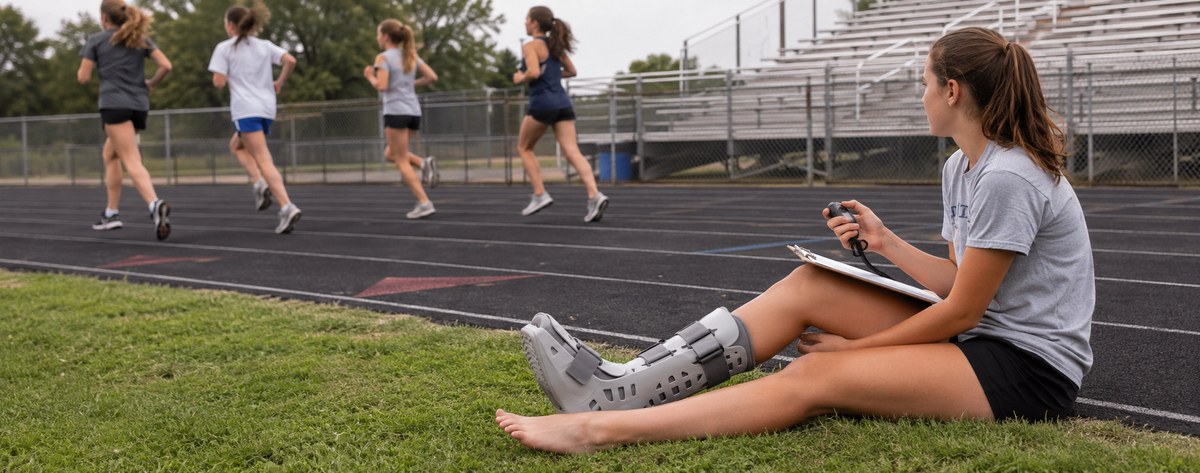
You quietly stop writing their training. Two weeks in, the hurt athlete’s week becomes “do whatever the trainer says.” That isn’t the athlete withdrawing from the sport. It’s the sport withdrawing from the athlete.
They get adult attention and lose their peers. Six weeks standing next to a coach with a clipboard is adjacent to the team, not in it. The finding is about friendships, not about supervision. Give the job to a pair, or keep them warming up with the group they came from.
Nobody plans the return day. They come back to a team that re-sorted itself while they were gone, into a pack behind where they left, in front of everyone. That day needs its own plan and almost never gets one.
The six-week injury silently becomes the end. Back for ten days in November, season ends, never comes out in spring. No last race, no ceremony, nobody notices. This is the hinge between the two halves of this article.
And the honest one: coaches avoid the injured athlete. Not out of neglect — because the conversation is uncomfortable, there’s nothing to coach, and there are thirty-nine other kids mid-workout. If you recognise yourself in that sentence, that’s the useful part.
The test for whether you’ve given someone a role or a chore is simple: would a healthy athlete want it? Splits at 1200 and 2400, the chute, exchange-zone judge, warm-up leader for the freshman pack — those are jobs. “Since you can’t run, carry the water” is a punishment wearing a job’s clothes.
One more, because it’s invisible and it’s usually nobody’s decision: most programs bus only the athletes who compete. That single administrative habit does more identity damage than anything you say out loud.
The last race nobody marks
The research on leaving sport says two things. Athletes with a strong athletic identity have more mental-health symptoms during retirement — and, in the same appraisal, identity showed no relationship to symptoms before retirement.22
That second half sits awkwardly next to the volleyball study, which found exactly such a relationship in healthy, still-competing sixteen-year-olds.23 I don’t think they’re measuring the same variable: the retirement work measures identity strength in collegiate and elite athletes on their way out, while the volleyball study measured strength inside a group already high on exclusivity. Strength and exclusivity aren’t the same thing — which is the distinction this whole article rests on. Worth knowing the tension exists rather than finding it in the footnotes.
The study that actually matches your athletes is smaller and less famous. Thirty-five former high-school athletes who didn’t continue sport in college were followed for 22 weeks: their athlete identity barely moved.24 Which sounds reassuring until you turn it over. The identity stays after the outlet is gone. They still feel like an athlete, with nothing to be an athlete at.
And here’s what none of this research covers.
All of it is about people who had a career and knew it ended. On a no-cut high-school roster, that’s your seniors, maybe. For a lot of the rest, the last race was a JV race in October of sophomore year, and nobody — including them — knew it was the last one. They don’t retire. They just don’t come out in the spring.
There’s also a mass identity transition on your team every autumn, and it has a date on it. You enter seven at regionals. The rest of the roster’s season ends at conference while the program keeps training, keeps traveling, keeps existing without them — and the seniors in that group are finished, in a locker room, in the middle of a season that continues around them.
No study cited in this article is about that. It’s the highest-frequency version of what the retirement literature describes, it’s entirely predictable, and it’s the one moment in the year a coach could plan for and almost nobody does.
The good news is that the way out is well described. A synthesis of 24 qualitative studies split the post-injury experience into identity disruption and identity reconstruction, and named how reconstruction happens: athletes rebuild by taking on alternative roles — coaching, volunteering, or a new sport.25 Shannon Kennedy is the worked example. Eight stress fractures across four years: “I’d run for eight years injury free and suddenly I had a tibial stress fracture. Over the next four years, I had seven more stress fractures, until finally, I listened to my body.”26 She switched to rowing. The athlete survived the switch.
The number is public, permanent, and they never agreed to it
About 45% of high-school athletes say they fear being judged by others, and 64% report a fear of failure — with girls significantly more likely to report both.27
Now add the thing that’s genuinely new about being sixteen right now: every race they’ve ever run is on the internet, under their name, forever.
The closest research is about adults. Among competitive female runners, the training log becomes part of the identity, with athletes deliberately curating what they post to shape how they’re seen.28 Among 225 club runners, those who had deleted sessions for being too slow scored higher on avoidance-driven goals, and the app was associated with pressure and comparison specifically during injury or reduced performance.29
But that research is about Strava, and Strava is opt-in, self-curated, adult, and deletable. A fourteen-year-old’s results page is none of those things. It’s involuntary, public and permanent. She never agreed to it and it never comes down. Nobody has studied what that does — and that gap, not the adult data, is the point worth carrying.
Chris Bennett, who coached high-school cross-country before Nike, has the line worth stealing: “I had to get them to be aware of the fact that their best day may not be their fastest day. The day that they’re most proud of may not end on an award stand.”30 If the only performances your program celebrates out loud are PRs, the roster learns exactly how many rooms the house has.
Widening the house, in things you already do
None of this needs a curriculum. It needs the sentences you’re already saying to be about something else occasionally.
Know one non-running thing about every athlete. Marching band, works Thursdays at the grocery store, has a little brother, draws. Not a wellness form — your own notes, filled in over a season. That list is the widening database, and the day someone gets hurt it’s the thing you use. The names you can’t fill in are your watch list.
Use the warm-up and cooldown. It’s the only unmetered time in the sport — twenty-odd minutes a day when nobody is being timed. Jog with a different pack each day and every athlete gets you once a week. You added nothing to your schedule.
Ask for a non-time goal on the same line as the time goal. Not instead of. Deleting the time goal insults the athlete and every coach reading this.
Protect one genuinely empty block a year. Cross-country into indoor into outdoor into summer base is twelve months, one label, one adult. You don’t set the seasons, but you do decide whether summer is mandatory-in-effect and whether “you’re doing winter track, right?” is a question or an instruction. And audit what your practice window makes impossible — theatre, jazz band, robotics, a job. A program that won’t excuse a concert is running the most efficient narrowing instrument it owns.
For swimmers there’s a free version of this: event identity is a room inside a room. “I’m a 100 breaststroker” is narrower than “I’m a swimmer,” you control it directly through dual-meet lineups, and making everyone swim an off event costs nothing you weren’t already spending.
A note on what “widen” means here, because the obvious reading doesn’t survive contact with a distance program: for most of your athletes it isn’t a second varsity sport — the calendar forbids it. It’s one thing with its own calendar and its own people. The “own people” part is load-bearing. A second interest inside the same social circle is the same room with different furniture.
There’s a name for the failure mode at the far end of neglect. The US Center for SafeSport defines emotional misconduct to include “acts that deny attention or support: such as ignoring or isolating someone for long time periods, or routinely excluding them from activities or coaching guidance for no productive reason.”31 Read that as a description of an injured distance runner in September and it stings, because it happens without anyone deciding to do it.
Its Code covers the US Olympic and Paralympic Movement, not your public high school — the Center says so itself, and points organisations outside that world back to their own district and state-association policies.32 So it isn’t a rule you’re bound by. Borrow the definition anyway.
The short version
A strong athletic identity isn’t the risk — it’s mostly the same thing that makes an athlete good. A narrow one is, and it’s measurable in healthy sixteen-year-olds, not just hurt ones. Most of your athletes will lose real time to injury before they graduate, and fifteen-to-twenty-one is the window where that lands hardest on a sense of self.
So build the other rooms now, while nothing is wrong. Keep the hurt ones inside the group, with a job a healthy athlete would want and a plan with a re-date on it. And stop describing your athletes with only one noun.
Anna Cockrell, who won Olympic silver after years of describing practice as a daily performance, got to the other side of it: “If track doesn’t work out for me, there’s more to life than this. This isn’t the sum of who I am.”33
That’s the sentence. The job is helping a sixteen-year-old find it before they need it.
Sources
- IFSA-Butler. Running into a new adventure: two cross-country student-athletes on running and identity. IFSA-Butler Student Stories. https://ifsa-butler.org/student-stories/running-into-a-new-adventure-two-cross-country-student-athletes-on-running-and-identity/ ↩
- IFSA-Butler. Running into a new adventure: two cross-country student-athletes on running and identity. IFSA-Butler Student Stories. https://ifsa-butler.org/student-stories/running-into-a-new-adventure-two-cross-country-student-athletes-on-running-and-identity/ ↩
- IFSA-Butler. Running into a new adventure: two cross-country student-athletes on running and identity. IFSA-Butler Student Stories. https://ifsa-butler.org/student-stories/running-into-a-new-adventure-two-cross-country-student-athletes-on-running-and-identity/ ↩
- Lochbaum M, Cooper S, Limp S. The Athletic Identity Measurement Scale: a systematic review with meta-analysis from 1993 to 2021. European Journal of Investigation in Health, Psychology and Education 12(9):1391–1414, 2022. https://doi.org/10.3390/ejihpe12090097 ↩
- Lochbaum M, Cooper S, Limp S. The Athletic Identity Measurement Scale: a systematic review with meta-analysis from 1993 to 2021. European Journal of Investigation in Health, Psychology and Education 12(9):1391–1414, 2022. https://doi.org/10.3390/ejihpe12090097 ↩
- Lochbaum M, Cooper S, Limp S. The Athletic Identity Measurement Scale: a systematic review with meta-analysis from 1993 to 2021. European Journal of Investigation in Health, Psychology and Education 12(9):1391–1414, 2022. https://doi.org/10.3390/ejihpe12090097 ↩
- Claes L, Aerts H, Vanderhaegen J, Vankerckhoven L, Luyckx K. A multidimensional perspective on athletic identity in competitive athletes: associations with sociodemographic and sport-specific variables and psychological symptoms. European Journal of Sport Science 25(7):e70001, 2025. https://doi.org/10.1002/ejsc.70001 ↩
- Chang D. Athletic identity and depressive symptom risk in college students: a machine learning approach to identify at-risk profiles and protective correlates. Frontiers in Psychology 17:1764766, 2026. https://doi.org/10.3389/fpsyg.2026.1764766 ↩
- Uzzell KS, Knight CJ, Pankow K, Hill DM. Wellbeing in high-performance swimming: a grounded theory study. Psychology of Sport and Exercise 70:102557, 2024. https://doi.org/10.1016/j.psychsport.2023.102557 ↩
- Clark VC, Ulman SM, Erdman AL, Gale EB, Janosky J, Stapleton EJ. Athletic identity, anxiety, and depression in moderate to highly specialized female adolescent volleyball players. Frontiers in Psychology 16:1525074, 2025. https://doi.org/10.3389/fpsyg.2025.1525074 ↩
- Clark VC, Ulman SM, Erdman AL, Gale EB, Janosky J, Stapleton EJ. Athletic identity, anxiety, and depression in moderate to highly specialized female adolescent volleyball players. Frontiers in Psychology 16:1525074, 2025. https://doi.org/10.3389/fpsyg.2025.1525074 ↩
- Mann RH, McKay CD, Clift BC, Williams CA, Barker AR. Injuries and training practices in competitive adolescent distance runners: a retrospective cross-sectional study. Frontiers in Sports and Active Living 3:664632, 2021. https://doi.org/10.3389/fspor.2021.664632 ↩
- Tenforde AS, Sayres LC, McCurdy ML, Collado H, Sainani KL, Fredericson M. Overuse injuries in high school runners: lifetime prevalence and prevention strategies. PM&R 3(2):125–131, 2011. https://doi.org/10.1016/j.pmrj.2010.09.009 ↩
- Park AL, Furie K, Wong SE. Stronger athlete identity is a risk factor for more severe depressive symptoms after musculoskeletal injury in pediatric athletes: a systematic review. Current Reviews in Musculoskeletal Medicine 16(5):220–228, 2023. https://pmc.ncbi.nlm.nih.gov/articles/PMC10188729/ ↩
- Park AL, Furie K, Wong SE. Stronger athlete identity is a risk factor for more severe depressive symptoms after musculoskeletal injury in pediatric athletes: a systematic review. Current Reviews in Musculoskeletal Medicine 16(5):220–228, 2023. https://pmc.ncbi.nlm.nih.gov/articles/PMC10188729/ ↩
- Park AL, Furie K, Wong SE. Stronger athlete identity is a risk factor for more severe depressive symptoms after musculoskeletal injury in pediatric athletes: a systematic review. Current Reviews in Musculoskeletal Medicine 16(5):220–228, 2023. https://pmc.ncbi.nlm.nih.gov/articles/PMC10188729/ ↩
- Park AL, Furie K, Wong SE. Stronger athlete identity is a risk factor for more severe depressive symptoms after musculoskeletal injury in pediatric athletes: a systematic review. Current Reviews in Musculoskeletal Medicine 16(5):220–228, 2023. https://pmc.ncbi.nlm.nih.gov/articles/PMC10188729/ ↩
- Manuel JC, Shilt JS, Curl WW, Smith JA, Durant RH, Lester L, Sinal SH. Coping with sports injuries: an examination of the adolescent athlete. Journal of Adolescent Health 31(5):391–393, 2002. https://doi.org/10.1016/S1054-139X(02)00400-7 ↩
- Park AL, Furie K, Wong SE. Stronger athlete identity is a risk factor for more severe depressive symptoms after musculoskeletal injury in pediatric athletes: a systematic review. Current Reviews in Musculoskeletal Medicine 16(5):220–228, 2023. https://pmc.ncbi.nlm.nih.gov/articles/PMC10188729/ ↩
- Wheatley C, Arnold R, Moore L, Cleave LJ, Mann RH, Shah EJ, McKay C. A qualitative study exploring factors linked to adolescent athletes' mental health during sports injury. BMJ Open Sport & Exercise Medicine 12(2):e003082, 2026. https://doi.org/10.1136/bmjsmem-2025-003082 ↩
- Wheatley C, Arnold R, Moore L, Cleave LJ, Mann RH, Shah EJ, McKay C. A qualitative study exploring factors linked to adolescent athletes' mental health during sports injury. BMJ Open Sport & Exercise Medicine 12(2):e003082, 2026. https://doi.org/10.1136/bmjsmem-2025-003082 ↩
- Roberts K, Kuhlman K, Byrd M, Hunt T. The influence of athletic identity on mental health symptoms during retirement from sport. Journal of Sport Rehabilitation 32(5):630–634, 2023. https://doi.org/10.1123/jsr.2022-0362 ↩
- Clark VC, Ulman SM, Erdman AL, Gale EB, Janosky J, Stapleton EJ. Athletic identity, anxiety, and depression in moderate to highly specialized female adolescent volleyball players. Frontiers in Psychology 16:1525074, 2025. https://doi.org/10.3389/fpsyg.2025.1525074 ↩
- Ferrara PM, Crouter SE, Zakrajsek RA, Angelle PS, Springer CM, Willis CV, Strohacker K. Exploration of temporal changes in exercise and identity in former high school athletes entering college: a mixed methods study. Journal of American College Health, 2026. https://doi.org/10.1080/07448481.2026.2721435 ↩
- Liu S, Noh YE, Kim J. Athletic identity and sport injury: a systematic review and meta-aggregation. BMC Psychology 14(1):111, 2025. https://doi.org/10.1186/s40359-025-03902-7 ↩
- Kennedy S. I was one of those young phenom girls. The XC. https://thexc.substack.com/p/i-was-one-of-those-young-phenom-girls ↩
- Ward MJ, Stead TS, Mangal RK, Ganti L. Prevalence of stress amongst high school athletes. Health Psychology Research 11:70167, 2023. https://doi.org/10.52965/001c.70167 ↩
- Russell HC, Potts C, King M, Henrich L, Tracey J. Strava use in competitive female runners: a qualitative exploration of perceived utility and psychosocial implications. Psychology of Sport and Exercise 85:103136, 2026. https://doi.org/10.1016/j.psychsport.2026.103136 ↩
- Rob Kolnes M, Øvretveit K. A mixed-methods analysis of motivational dynamics and Strava use in active club runners. Behavioral Sciences 16(2):224, 2026. https://doi.org/10.3390/bs16020224 ↩
- LAist / NPR. Nike Run Club's oddly mindful coach. LAist. https://laist.com/news/npr-news/nike-run-clubs-oddly-mindful-coach ↩
- U.S. Center for SafeSport. Emotional and Physical Abuse and Misconduct Toolkit. U.S. Center for SafeSport. https://eptoolkit.uscenterforsafesport.org/full-ep-toolkit/ ↩
- U.S. Center for SafeSport. Emotional and Physical Abuse and Misconduct Toolkit. U.S. Center for SafeSport. https://eptoolkit.uscenterforsafesport.org/full-ep-toolkit/ ↩
- Cockrell A. Letter to my younger self. The Players' Tribune. https://www.theplayerstribune.com/posts/letter-to-my-younger-self-anna-cockrell-usa-track-and-field-olympics ↩